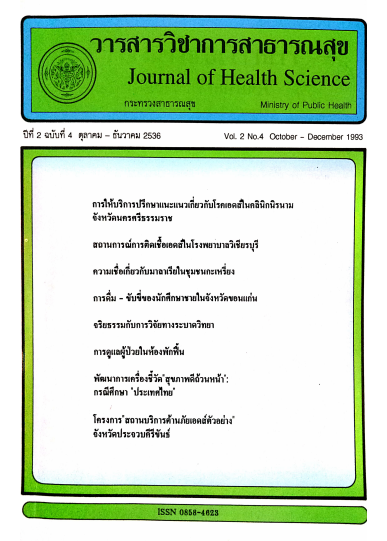
Drink-riding Among Male Student Motorcyclists in Khon Kaen, Thailand
Abstract
The study utilized a mix of qualitative and quantitative research methods to determine factors that influence 15-25 year old male tertiary students to ride a motorcycle after drinking alcohol. Focus group discussions explored cultural contexts surrounding alcohol use and motorcycle riding. A structured questionnaire was developed following analysis of these discussions which focused on perceptions, attiudes and reported practice of drink-riding. The questionnaire was administered to male tertiary students (n=191) who ride motorcycles and sometimes drink alcohol. Questionnaire respondents were selected by systematic cluster random sampling from 9 tertiary institutions in Khon Kaen. Structured non-particpant observations of traffic situations and the public use of alcohol in Khon Kaen describe aspects of the social environment influencing student motorcyclists. Alcohol breath analysis was performed on student motorcycle rider volunteers (n=37) outside selected drinking venues. Observations established alcohol was cheap, available and pervasively used within Thai male society. There is serious and general disregard of traffic regulations together with inconsistent enforcement of traffic regulation. Almost all (94%) questionnaire responds incorrectly perceive the physiological effects of alcohol can be overcome by behavioural strategies. Half (50%) have inaccurate perception of safe quantities of alcohol, and this inaccurate perception is associated with drink-riding (relative risk=3.60). Respondents (59%) are encouraged drink to excess by peers, and consider it likely that peers (88%), and a high percentage of male authority figures, drink-ride. 24% of respondents commonly drink-ride. 24% of respondents commonly drink-ride 22% of student riders recorded blood alcohol concentrations>0.08 gm% on volunfeer breath analysis. The study concluded that student drink-riding is widespread and not prioritized by the community as a problem Allied to this is a lack of prioritization of the problem by law enforcers. Students lack information about the impact of alcohol. Interventions need to focus on targeted awareness raising in student group and working towards effective law and enforcement.
Downloads
Downloads
Published
How to Cite
Issue
Section
License
Copyright (c) 1993 Ministry of Public Health

This work is licensed under a Creative Commons Attribution-NonCommercial-NoDerivatives 4.0 International License.