ผลการใช้โปรแกรมคอมพิวเตอร์แจ้งเตือนแบบทันทีในการป้องกันการสั่งยาที่ไม่เหมาะสมในผู้ป่วยที่มีภาวะไตบกพร่อง ในโรงพยาบาลชัยภูมิ
คำสำคัญ:
ภาวะไตบกพร่อง, ยา, โปรแกรมคอมพิวเตอร์บทคัดย่อ
ความเป็นมา: การสั่งยาในผู้ป่วยที่มีภาวะไตบกพร่อง ควรปรับขนาดยาให้เหมาะสมกับการทำงานของไต การพัฒนาระบบเพื่อสนับสนุนการตัดสินใจของแพทย์จะมีส่วนช่วยในการตัดสินใจทางคลินิกในการป้องกันความคลาดเคลื่อนในการสั่งยาและเพิ่มความปลอดภัยในการดูแลผู้ป่วย
วัตถุประสงค์: เพื่อประเมินผลการแจ้งเตือนและการตอบสนองของผู้สั่งยาต่อการแจ้งเตือนของโปรแกรมคอมพิวเตอร์แจ้งเตือนแบบทันทีในการป้องกันการสั่งยาที่ไม่เหมาะสมสำหรับผู้ป่วยที่มีภาวะไตบกพร่อง
วิธีวิจัย: การศึกษาแบบย้อนหลัง เก็บข้อมูลผู้ป่วยที่ได้รับการสั่งยา 11 รายการที่มีการทำงานของไต (eGFR) ตามที่กำหนดในโปรแกรมแจ้งเตือนหรือไม่มีประวัติ eGFR ในระยะเวลา 1 ปี และติดตามผลการตอบสนองต่อการแจ้งเตือน ของผู้สั่งยาจากเวชระเบียนของโรงพยาบาลในผู้ป่วยแต่ละราย ในช่วงเวลาตั้งแต่ 1 เมษายน พ.ศ. 2567 ถึง 30 กันยายน พ.ศ. 2567
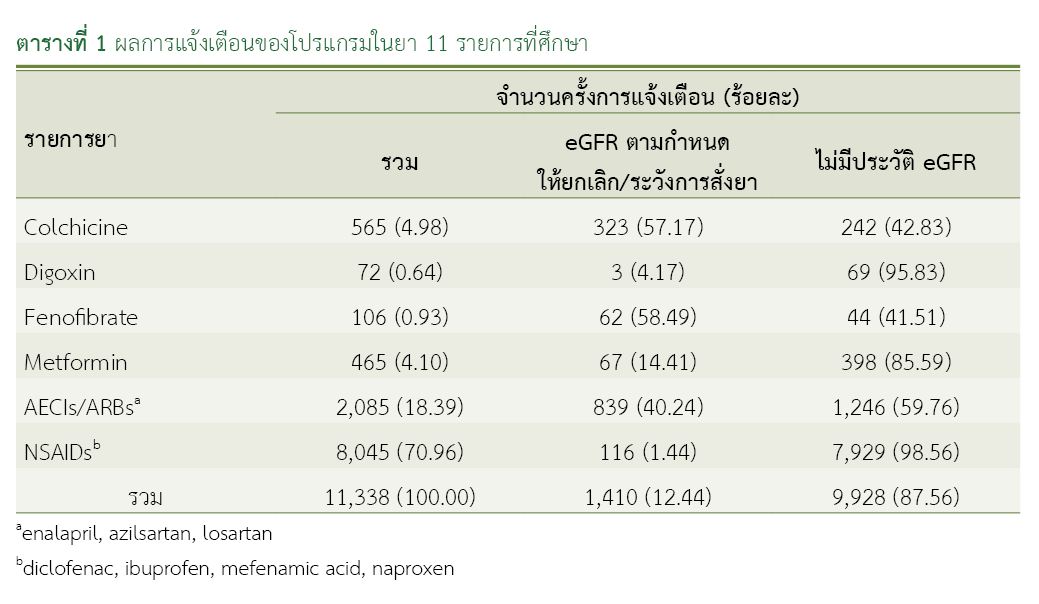
ผลการวิจัย: พบแจ้งเตือนทั้งหมด 11,338 ครั้ง ประกอบด้วยผู้ป่วยที่ได้รับยาและไม่มีประวัติ eGFR ร้อยละ 87.56 และผู้ป่วยที่มี eGFR ตามที่กำหนดร้อยละ 12.44 การตอบสนองของผู้สั่งยาต่อการแจ้งเตือนของโปรแกรมกรณีมี eGFR ตามที่กำหนด ผู้สั่งยายกเลิกการสั่งยาร้อยละ 14.89 ยืนยันการสั่งยาต่อและให้ติดตาม eGFR ในการนัดครั้งถัดไปร้อยละ 20.78 ยืนยันการสั่งยาต่อโดยไม่ติดตาม eGFR ร้อยละ 64.33 กรณีที่ผู้ป่วยไม่มีประวัติ eGFR ผู้สั่งยายืนยันการสั่งยาต่อและให้ติดตาม eGFR ในการนัดครั้งถัดไปร้อยละ 9.48 ยืนยันการสั่งยาต่อโดยไม่ติดตาม eGFR ร้อยละ 90.52
สรุปผล: โปรแกรมแจ้งเตือนสามารถแจ้งเตือนได้ตามที่กำหนด และสามารถช่วยให้ผู้สั่งยาทบทวน ปรับเปลี่ยนการสั่งยาให้เหมาะสมกับผู้ป่วยที่มีภาวะไตบกพร่องโดยใช้ข้อมูลเชิงคลินิกร่วมกับคำเตือน
เอกสารอ้างอิง
Liyanage T, Toyama T, Hockham C, Ninomiya T, Perkovic V, Woodward M, et al. Prevalence of chronic kidney disease in Asia: a systematic review and analysis. BMJ Glob Health. 2022;7(1):e007525. doi: 10.1136/bmjgh-2021-007525.
Cha'on U, Tippayawat P, Sae-Ung N, Pinlaor P, Sirithanaphol W, Theeranut A, et al. High prevalence of chronic kidney disease and its related risk factors in rural areas of Northeast Thailand. Sci Rep. 2022;12(1):18118. doi: 10.1038/s41598-022-22538-w.
Awdishu, L, Mehta, RL. The 6R's of drug induced nephrotoxicity. BMC Nephrol. 2017;18(1):124. doi: 10.1186/s12882-017-0536-3.
Liu C, Yan S, Wang Y, Wang J, Fu X, Song H, et al. Drug-induced hospital-acquired acute kidney injury in China: a multicenter cross-sectional survey. Kidney Dis (Basel). 2021;7(2):143–155. doi: 10.1159/000510455.
Laville SM, Vendar J, Massy ZA, Gras-Champel V, Moragny J, Frimat L, et al. Quantifying the potential contribution of drugs to the occurrence of acute kidney injury in patients with chronic kidney disease. Clin Kidney J. 2024;18(1):sfae357. doi: 10.1093/ckj/sfae357.
Leendertse AJ, van Dijk EA, De Smet PA, Egberts TC, van den Bemt PM. Contribution of renal impairment to potentially preventable medication-related hospital admissions. Ann Pharmacother. 2012;46(5):625-33. doi: 10.1345/aph.1Q633.
Joosten H, Drion I, Boogerd KJ, van der Pijl EV, Slingerland RJ, Slaets JP, et al. Optimising drug prescribing and dispensing in subjects at risk for drug errors due to renal impairment: improving drug safety in primary healthcare by low eGFR alerts. BMJ Open. 2013;3(1):e002068. doi: 10.1136/bmjopen-2012-002068.
Sweileh WM, Janem SA, Sawalha AF, Abu-Taha AS, Zyoud SH, Sabri IA, et al. Medication dosing errors in hospitalized patients with renal impairment: a study in Palestine. Pharmacoepidemiol Drug Saf. 2007;16(8):908-12. doi: 10.1002/pds.1412.
Chertow GM, Lee J, Kuperman GJ, Burdick E, Horsky J, Seger DL, et al. Guided medication dosing for inpatients with renal insufficiency. JAMA. 2001;286(22):2839-44. doi: 10.1001/jama.286.22.2839.
Hirsch JS, Brar R, Forrer C, Sung C, Roycroft R, Seelamneni P, et al. Design, development, and deployment of an indication- and kidney function-based decision support tool to optimize treatment and reduce medication dosing errors. JAMIA Open. 2021;4(2):ooab039. doi: 10.1093/jamiaopen/ooab039.
หฤทัย คุโณทัย, ราตรี แสงส่ง, ดาราณี อิศราวิชญกุล, ชาริณี มีอาษา. ผลของการพัฒนาระบบการปรับขนาดยาในผู้ป่วยที่มีภาวะไตบกพร่อง ต่อความเหมาะสมของการใช้ยาในผู้ป่วยที่เข้ารับการรักษาในโรงพยาบาลตติยภูมิแห่งหนึ่ง. วารสารเภสัชกรรมโรงพยาบาล [อินเตอร์เน็ต]. 2565 [สืบค้นเมื่อ 10 ม.ค. 2568];32(3):230-40. สืบค้นจาก: https://he02.tci-thaijo.org/index.php/TJHP/article/view/259271
ศุภาพิชญ์ อาทะวงศ์, ดาริกา อนุรักษ์ชนะพล, สุกัลยา ยิดนรดิน, ปนัดดา ฮูเซ็น, ปัญญาภรณ์ ทรงสุนทรวงศ์, วรางค์รัตน์ สุวรรณชาตรี, และคณะ. การพัฒนาระบบการปรับขนาดยาสำหรับผู้ป่วยโรคไตเรื้อรัง แผนกจ่ายยาผู้ป่วยนอก โรงพยาบาลนพรัตนราชธานี [อินเตอร์เน็ต]. กรุงเทพมหานคร: โรงพยาบาลนพรัตนราชธานี; 2564 [สืบค้นเมื่อ 10 ม.ค. 2568]. สืบค้นจาก: https://nrh.nopparat.go.th/research/public/view/pdf/64_6.pdf
Thomas L. Critical limits of laboratory results for urgent clinician notification. EJIFCC. 2003;14(1):11–18. PMID: 30323722.
Yang LJ, Hsu SM, Wu PH, Lin MY, Huang TH, Lin YT, et al. Association of digoxin with mortality in patients with advanced chronic kidney disease: a population-based cohort study. PLoS One. 2021;16(1):e0245620. doi: 10.1371/journal.pone.0245620.
Kidney Disease Improving Global Outcomes (KDIGO) CKD Work Group. KDIGO 2012 clinical practice guideline for the evaluation and management of chronic kidney disease [Internet]. n.p.: The International Society of Nephrology; 2013 [cite 2025 Jan 22]. Available from: https://kdigo.org/wp-content/uploads/2017/02/KDIGO_2012_CKD_GL.pdf
Whelton A, Stout RL, Spilman PS, Klassen DK. Renal effects of ibuprofen, piroxicam, and sulindac in patients with asymptomatic renal failure. a prospective, randomized, crossover comparison. Ann Intern Med. 1990;112(8):568-76. doi: 10.7326/0003-4819-112-8-568.
Nderitu P, Doos L, Jones PW, Davies SJ, Kadam UT. Non-steroidal anti-inflammatory drugs and chronic kidney disease progression: a systematic review. Fam Pract. 2013;30(3):247-55. doi: 10.1093/fampra/cms086.
คณะอนุกรรมการป้องกันโรคไตเรื้อรัง สมาคมโรคไตแห่งประเทศไทย. คำแนะนำสำหรับการดูแลผู้ป่วยโรคไตเรื้อรังก่อนการบำบัดทดแทนไต พ.ศ. 2565 (ฉบับปรับปรุงเพิ่มเติม) [อินเทอร์เน็ต]. กรุงเทพมหานคร: สมาคมโรคไตแห่งประเทศไทย; 2565 [สืบค้นเมื่อ 22 ม.ค. 2568]. สืบค้นจาก: https://www.nephrothai.org/wp-content/uploads/2023/06/CKD-guideline_-draft_5-เพิ่มเติม-2565-.pdf
ปภัสรา วรรณทอง. ระบบ computerized provider order entry (CPOE) กับการพัฒนาระบบยา [อินเตอร์เน็ต]. นนทบุรี: ศูนย์การศึกษาต่อเนื่องทางเภสัชศาสตร์ สภาเภสัชกรรม; 2566 [สืบค้นเมื่อ 22 ม.ค. 2568]. สืบค้นจาก: https://ccpe.pharmacycouncil.org/index.php?option=article_detail&subpage=article_detail&id=1408
van Balveren JA, Verboeket-van de Venne WPHG, Doggen CJM, Cornelissen AS, Erdem-Eraslan L, de Graaf AJ, et al. Clinical usefulness of drug-laboratory test interaction alerts: a multicentre survey. Clin Chem Lab Med. 2021;59(7):1239-45. doi: 10.1515/cclm-2020-1770.
ดาวน์โหลด
เผยแพร่แล้ว
วิธีการอ้างอิง
ฉบับ
บท
การอนุญาต
ลิขสิทธิ์ (c) 2025 กองบริหารการสาธารณสุข สำนักงานปลัดกระทรวงสาธารณสุข และ ชมรมเภสัชกรโรงพยาบาลกระทรวงสาธารณสุข

This work is licensed under a Creative Commons Attribution-NonCommercial-NoDerivatives 4.0 International License.
วารสารเภสัชกรรมคลินิกเป็นวารสารในรูปแบบเปิด ผู้ใช้ทั่วไปสามารถเข้าถึง ดาวน์โหลด เอกสารไฟล์บทความบนเว็บไซต์วารสาร โดยไม่มีค่าใช้จ่ายแต่อย่างใด
ข้อความภายในบทความที่ตีพิมพ์ในวารสารเภสัชกรรมคลินิกทั้งหมด รวมถึงรูปภาพประกอบ ตาราง เป็นลิขสิทธิ์ของกองบริหารการสาธารณสุข สำนักงานปลัดกระทรวงสาธารณสุข และ ชมรมเภสัชกรโรงพยาบาลกระทรวงสาธารณสุข อนุญาตให้นำไปใช้ประโยชน์และเผยแพร่ต่อได้โดยอยู่ภายใต้เงื่อนไขสัญญาอนุญาตครีเอทีฟคอมมอนส์ โดยต้องแสดงที่มาจากวารสาร – ไม่ใช้เพื่อการค้า – ห้ามแก้ไขดัดแปลง (Creative Commons Attribution-NonCommercial-NoDerivatives 4.0; CC BY-NC-ND 4.0) การนำเนื้อหา ข้อความหรือข้อคิดเห็น รูปภาพ ตาราง ของบทความไปจัดพิมพ์เผยแพร่ในรูปแบบต่าง ๆ เพื่อใช้ประโยชน์ในเชิงพาณิชย์ ต้องได้รับอนุญาตจากกองบรรณาธิการวารสารเภสัชกรรมคลินิกอย่างเป็นลายลักษณ์อักษร
ข้อความที่ปรากฏในบทความในวารสารเป็นความคิดเห็นส่วนตัวของผู้เขียนแต่ละท่านไม่เกี่ยวข้องกับกองบริหารการสาธารณสุข สำนักงานปลัดกระทรวงสาธารณสุข และบุคลากรในกองบริหารการสาธารณสุข สำนักงานปลัดกระทรวงสาธารณสุข แต่อย่างใด ความรับผิดชอบองค์ประกอบทั้งหมดของบทความแต่ละเรื่องเป็นของผู้เขียนแต่ละท่าน หากมีความผิดพลาดใด ๆ ผู้เขียนแต่ละท่านจะรับผิดชอบบทความของตนเอง ตลอดจนความรับผิดชอบด้านเนื้อหาและการตรวจร่างบทความเป็นของผู้เขียน ไม่เกี่ยวข้องกับกองบรรณาธิการ