
Risk Factors Associated with Extravasation from Norepinephrine Among Inpatients at Pattani Hospital
Keywords:
extravasation, norepinephrine, adverse drug reaction (ADR)Abstract
Background: Extravasation is an adverse drug reaction (ADR) that can occur following the intravenous administration of norepinephrine. These events may arise from various factors. Identifying potential risk factors associated with extravasation can provide risk indicators which may guide the development of hospital-level prevention systems and strategies to minimize the severity of such ADRs.
Objective: To analyze the factors associated with extravasation from norepinephrine use in inpatients at Pattani Hospital.
Methods: This was explorative prognostic factor research study employed a retrospective observational cohort design. The study include patients who were admitted to Pattani Hospital and received norepinephrine from October 1, 2020 to 31th December 2023. Data were extracted from the HOSxP program and medical records. A total of 95 patients were included, categorized into two groups: (1) patients with ADRs (23 patients) and (2) patients without ADRs (72 patients). Statistical analyses were performed using t-tests, exact probability tests, and odds ratios from univariable and multivariable logistic regression.
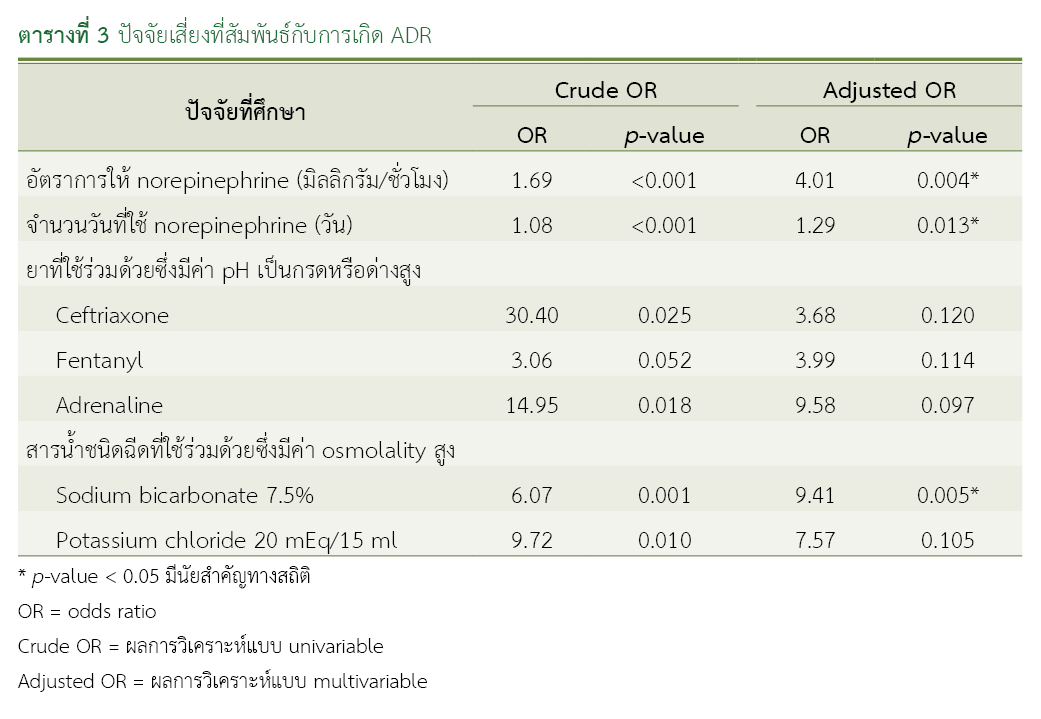
Results: The median norepinephrine rate in the ADR group was 1.2 mg/hr (IQR 0.68–2.20), compared to 0.4 mg/hr (IQR 0.20–0.54) in the non-ADR group (OR = 4.02; 95%CI: 1.6–10.2, p-value < 0.01). The median duration of norepinephrine administration was 4 days (IQR 2–8) in the ADR group versus 3 days (IQR 2–4) in the non-ADR group (OR = 1.29; 95%CI: 1.06–1.59, p-value < 0.05). Sodium bicarbonate 7.5% injection was used in 65.2% of the ADR group, compared to 23.6% of the non-ADR group (OR = 9.41; 95%CI: 1.94–45.67, p-value < 0.01). All three factors - higher dose, longer duration, and concomitant use of sodium bicarbonate - were significantly associated with an increased risk of ADRs (p-value < 0.05).
Conclusion: Risk factors associated with the occurrence of ADRs included higher rates of drug administration, prolonged duration of administration, and co-administration with high-osmolality drugs. These factors were statistically significantly associated with occurrence extravasation (p-value < 0.05).
References
ภาสกร รัตนเดชสกุล, จันทร์จารึก รัตนเดชสกุล. ลดความเสี่ยงจากการใชยาดวยขอมูล ADR (adverse drug reaction) [อินเทอร์เน็ต]. นนทบุรี: ศูนย์การศึกษาต่อเนื่องทางเภสัชศาสตร์ สภาเภสัชกรรม; 2560 [สืบค้นเมื่อ 3 พ.ค. 2567]. สืบค้นจาก: https://ccpe.pharmacycouncil.org/index.php?option=article_detail&subpage=article_detail&id=312
West Midlands Expert Advisory Group for Systemic Anti-Cancer Therapy (SACT). Guideline for management of extravasation of systemic anticancer therapy including cytotoxic agents [Internet]. West Midlands: National Health Service; 2017 [cited 2024 Apr 27]. Available from: https://www.england.nhs.uk/mids-east/wp-content/uploads/sites/7/2018/04/management-extravasation-of-a-systemic-anti-cancer-therapy-including-cytotoxic-agents.pdf
พิพัฒน์ เกาะแก้ว. ประสิทธิผลของแนวปฏิบัติป้องกันการเกิดหลอดเลือดดำส่วนปลายอักเสบจากการใช้ยาที่มีความเสี่ยงสูงในงานห้องผู้ป่วยหนัก 2 โรงพยาบาลลำพูน วารสารสาธารณสุขและสุขภาพศึกษา [อินเทอร์เน็ต]. 2567 [สืบค้นเมื่อ 30 เม.ย. 2567];4(1):e266990. สืบค้นจาก: https://he02.tci-thaijo.org/index.php/tjphe/article/view/266990
O'Grady NP, Alexandar M, Burns LA, Dellinger EP, Garland J, Heard SO, et al. Guidelines for the prevention of intravascular catheter-related infections. Clin Infect Dis. 2011;52(9):e162-93. doi: 10.1093/cid/cir257.
ลำดวน มีภาพ, อนัฆพงษ์ พันธุ์มณี, คำผล สัตยาวงษ์, ธิดารัตน์ เกษแก้วกาญจน์, นลัทพร สืบเสาะ, ประกายรุ่ง ต้นทัพไทย, และคณะ. ผลการทดสอบปฏิบัติการพยาบาลเพื่อจัดการอาการของการรั่วซึมของยาและสารละลายทางหลอดเลือดดำส่วนปลาย ในหอผู้ป่วยอายุรกรรม โรงพยาบาลศรีนครินทร์. วารสารโรงพยาบาลมหาวิทยาลัยขอนแก่น [อินเทอร์เน็ต]. 2563 [สืบค้นเมื่อ 25 มี.ค. 2567];1(4):228-303. สืบค้นจาก: https://www.kkuhj.com/files/2021/5ca961a7417d458fbf77cab4027bbad2.pdf
จรีณา คงพันธุ์, ผกากรอง พันธุ์ไพโรจน์. ผลของการใช้แนวปฏิบัติการให้ยาที่มีความเสี่ยงสูงต่อการปฏิบัติการพยาบาลและอุบัติการณ์การเกิดภาวะหลอดเลือดดำส่วนปลายอักเสบ ในหอผู้ป่วยกึ่งวิกฤตอายุกรรม โรงพยาบาลสงขลา. วารสารวิทยาลัยพยาบาลพระจอมเกล้า จังหวัดเพชรบุรี [อินเทอร์เน็ต]. 2564 [สืบค้นเมื่อ 25 มี.ค. 2567];4(1):156-69. สืบค้นจาก: https://he01.tci-thaijo.org/index.php/pck/article/view/246931
Extravasation Information. Extravasation injury definition [Internet]. n.p.: Extravasation Information 2016-2023; 2023 [cited 29 May 2024]. Available from: http://www.extravasation.org.uk
Brooks N. Intravenous therapy administration: a practical guide [Internet]. Keswick (England): M&K Update Ltd.; 2017 [cited 30 Jun 2024]. Available from: https://www.mkupdate.co.uk/book/100091-intravenous-therapy-administration-a-practical-guide
Royal College of Nursing. Standards for infusion therapy, 4th ed. [Internet]. London: Royal College of Nursing; 2016 [cited 18 Mar 2024]. Available from: https://www.rcn.org.uk/clinical-topics/Infection-prevention-and-control-advice/Standards-for-infusion-therapy
Dougherty L. IV therapy: recognizing the differences between infiltration and extravasation. Br J Nurs. 2008;17(14):896, 898-901. doi: 10.12968/bjon.2008.17.14.30656.
สมาคมเภสัชกรรมโรงพยาบาล (ประเทศไทย). อาการไม่พึงประสงค์จากการใช้ยา. ใน: กรอบงานพื้นฐานระบบยา [อินเทอร์เน็ต]. กรุงเทพมหานคร: สมาคมเภสัชกรรมโรงพยาบาล (ประเทศไทย); 2563 [สืบค้นเมื่อ 18 มี.ค. 2564]. หน้า 23-27. สืบค้นจาก: https://www.thaihp.org/wp-content/uploads/2022/06/หนังสือกรอบงานพื้นฐาน.pdf
Peduzzi P, Concato J, Kemper E, Holford TR, Feinstein AR. A simulation study of the number of events per variable in logistic regression analysis. J Clin Epidemiol. 1996;49(12):1373-9. doi:10.1016/s0895-4356(96)00236-3.
Van der Wal G, Janssen JC, Spronk PE. Extravasation injury by norepinephrine: a case report and description of treatment options. Neth J Crit Care [Internet]. 2013 [cited 2024 Apr 27];17(3):15-7. Available from: https://de-intensivist.nl/wp-content/uploads/2022/06/V17-NO3-Extravasation-injury-by-norepinephrine-a-case-report-and-description-of-treatment-options.pdf
ปภัสรา วรรณทอง. Phlebitis และ extravasation จากยา non-cytotoxic: อาการไมพึงประสงคจากยาที่เภสัชกรควรรู้ [อินเทอร์เน็ต]. นนทบุรี: ศูนย์การศึกษาต่อเนื่องทางเภสัชศาสตร์ สภาเภสัชกรรม; 2563 [สืบค้นเมื่อ 30 เม.ย. 2567]. สืบค้นจาก: https://ccpe.pharmacycouncil.org/index.php?option=article_detail&subpage=article_detail&id=824
ปาริชาติ ลิ้มเจริญ, ทองเปลว ชมจันทร์. การศึกษาการเกิดภาวะรั่วซึมของยาออกนอกหลอดเลือดดำ ในผู้ป่วยที่ได้รับยานอร์อิปิเนฟรินทางหลอดเลือดดำส่วนปลาย. วารสารโรงพยาบาลสิงห์บุรี [อินเทอร์เน็ต]. 2566 [สืบค้นเมื่อ 25 มี.ค. 2567];32(2):B92-110. สืบค้นจาก: https://he01.tci-thaijo.org/index.php/shj/article/view/263285
Karimee D, Buakhong M, Lertvipapath P, Limsuwat C. Incidence of extravasation during norepinephrine administration via peripheral venous catheter in emergency patients. J Health Sci Med Res. 2024;42(4):e20241039. doi: 10.31584/jhsmr.20241039.
Downloads
Published
How to Cite
Issue
Section
License
Copyright (c) 2025 Health Administration Division, Office of the Permanent Secretary, Ministry of Public Health and The Society of Hospital Pharmacist, Ministry of Public Health

This work is licensed under a Creative Commons Attribution-NonCommercial-NoDerivatives 4.0 International License.
วารสารเภสัชกรรมคลินิกเป็นวารสารในรูปแบบเปิด ผู้ใช้ทั่วไปสามารถเข้าถึง ดาวน์โหลด เอกสารไฟล์บทความบนเว็บไซต์วารสาร โดยไม่มีค่าใช้จ่ายแต่อย่างใด
ข้อความภายในบทความที่ตีพิมพ์ในวารสารเภสัชกรรมคลินิกทั้งหมด รวมถึงรูปภาพประกอบ ตาราง เป็นลิขสิทธิ์ของกองบริหารการสาธารณสุข สำนักงานปลัดกระทรวงสาธารณสุข และ ชมรมเภสัชกรโรงพยาบาลกระทรวงสาธารณสุข อนุญาตให้นำไปใช้ประโยชน์และเผยแพร่ต่อได้โดยอยู่ภายใต้เงื่อนไขสัญญาอนุญาตครีเอทีฟคอมมอนส์ โดยต้องแสดงที่มาจากวารสาร – ไม่ใช้เพื่อการค้า – ห้ามแก้ไขดัดแปลง (Creative Commons Attribution-NonCommercial-NoDerivatives 4.0; CC BY-NC-ND 4.0) การนำเนื้อหา ข้อความหรือข้อคิดเห็น รูปภาพ ตาราง ของบทความไปจัดพิมพ์เผยแพร่ในรูปแบบต่าง ๆ เพื่อใช้ประโยชน์ในเชิงพาณิชย์ ต้องได้รับอนุญาตจากกองบรรณาธิการวารสารเภสัชกรรมคลินิกอย่างเป็นลายลักษณ์อักษร
ข้อความที่ปรากฏในบทความในวารสารเป็นความคิดเห็นส่วนตัวของผู้เขียนแต่ละท่านไม่เกี่ยวข้องกับกองบริหารการสาธารณสุข สำนักงานปลัดกระทรวงสาธารณสุข และบุคลากรในกองบริหารการสาธารณสุข สำนักงานปลัดกระทรวงสาธารณสุข แต่อย่างใด ความรับผิดชอบองค์ประกอบทั้งหมดของบทความแต่ละเรื่องเป็นของผู้เขียนแต่ละท่าน หากมีความผิดพลาดใด ๆ ผู้เขียนแต่ละท่านจะรับผิดชอบบทความของตนเอง ตลอดจนความรับผิดชอบด้านเนื้อหาและการตรวจร่างบทความเป็นของผู้เขียน ไม่เกี่ยวข้องกับกองบรรณาธิการ