
Evaluation of Intravenous Chemotherapy Induced Hypersensitivity Reaction at Udonthani Hospital
Keywords:
hypersensitivity reactions, prolonged drug administration time, desensitization, chemotherapy, incidenceAbstract
Background: Hypersensitivity reactions (HSRs) can occur during chemotherapy administration, with varying degrees of severity. HSRs may affect treatment by necessitating changes in medication or even permanent discontinuation of therapy.
Objective: This study aimed to investigate the incidence and severity of HSRs resulting from chemotherapy and to evaluate the effectiveness of HSR management strategies.
Method: A retrospective cohort study was conducted among cancer patients who received intravenous chemotherapy at Udonthani Hospital, Udonthani Province, between January 1, 2019, and December 31, 2023. The incidence, severity, and chemotherapy cycle of onset for reported HSRs were analyzed using descriptive statistics. Differences in outcomes from HSR management at different drug administration rates were compared using Fisher’s exact test. All data were analyzed using IBM SPSS Statistics version 28.
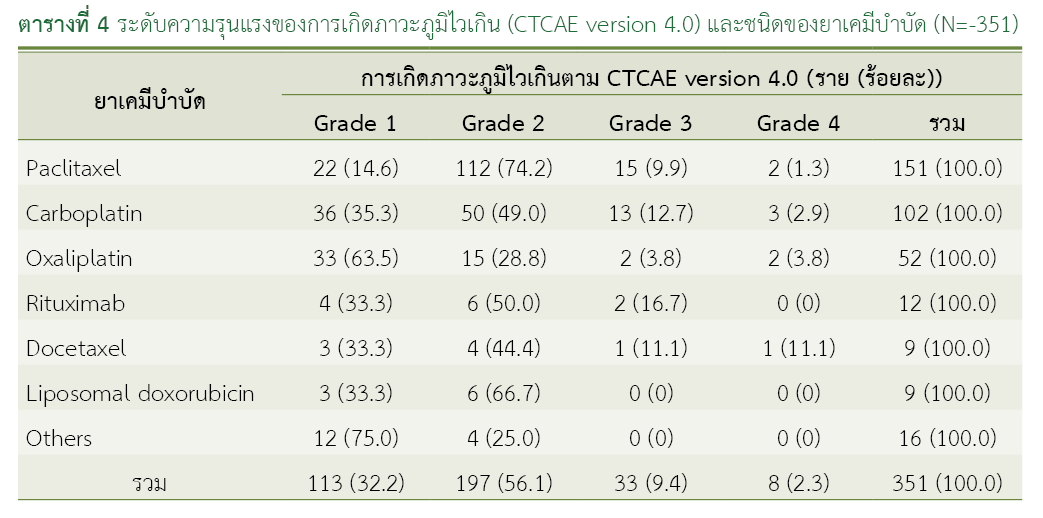
Results: A total of 12,914 chemotherapy cycles were administered to cancer patients. HSRs occurred 351 times (2.7%). The most common chemotherapy agent causing HSRs was paclitaxel (43%), with a median onset at cycle 2. This was followed by carboplatin, with a median onset at cycle 11. Most HSRs were of CTCAE grade 2 severity (56.1%). Management with prolonged drug administration time had a success rate of 75.0–84.6%, while desensitization had a success rate of 88.4%. There was no statistically significant difference in the success rates between the two prolonged infusion methods (p-value = 0.105), based on the absence of recurrent hypersensitivity and the completion of chemotherapy.
Conclusion: This study found that HSRs were most commonly caused by paclitaxel and were primarily mild (CTCAE grades 1 and 2). Prolonged drug administration time was shown to be an effective management strategy. In patients experiencing severe HSRs (CTCAE grades 3 and 4), both prolonged infusion and desensitization may be considered viable treatment options.
References
มานิตย์ แซ่เตียว, สุภัสร์ สุบงกช. ภาวะภูมิไวเกิน. ใน: สุภัสร์ สุบงกช, มานิตย์ แซ่เตียว, สุธาร จันทะวงศ์, บรรณาธิการ. เภสัชกรรมปฏิบัติในโรคมะเร็ง Oncology Pharmacy Practice. พิมพ์ครั้งที่ 4. ขอนแก่น: โรงพิมพ์มหาวิทยาลัยขอนแก่น; 2561. หน้า 399-415.
Pagani M, Bavbek S, Alvarez-Cuesta E, Berna Dursun A, Bonadonna P, Castells M, et al. Hypersensitivity reactions to chemotherapy: an EAACI Position Paper. Allergy. 2022;77(2):388-403. doi: 10.1111/all.15113.
National Cancer Institute. Common terminology criteria for adverse events, version 4.0 [Internet]. n.p.: National Cancer Institute; 2009 [cited 2024 Oct 10]. Available from: https://ctep.cancer.gov/protocoldevelopment/electronic_applications/ctc.htm#ctc_40
Navo M, Kunthur A, Badell ML, Coffer LW 2nd, Markman M, Brown J, et al. Evaluation of the incidence of carboplatin hypersensitivity reactions in cancer patients. Gynecol Oncol. 2006;103(2):608-13. doi: 10.1016/j.ygyno.2006.04.002.
Tsao LR, Young FD, Otani IM, Castells MC. Hypersensitivity reactions to platinum agents and taxanes. Clin Rev Allergy Immunol. 2022;62(3):432-48. doi: 10.1007/s12016-021-08877-y.
Villarreal-González RV, González-Díaz S, Vidal-Gutiérrez O, Cruz-de la Cruz C, Pérez-Ibave DC, Garza-Rodríguez ML. Hypersensitivity reactions to anticancer chemotherapy and monoclonal antibodies: safety and efficacy of desensitization. J Oncol Pharm Pract. 2024;30(5):811-22. doi: 10.1177/10781552231189461.
Boulanger J, Boursiquot JN, Cournoyer G, Lemieux J, Masse MS, Almanric K, et al. Management of hypersensitivity to platinum- and taxane-based chemotherapy: cepo review and clinical recommendations. Curr Oncol. 2014;21(4):e630-41. doi: 10.3747/co.21.1966.
Roselló S, Blasco I, García Fabregat L, Cervantes A, Jordan K; ESMO Guidelines Committee. Management of infusion reactions to systemic anticancer therapy: ESMO Clinical Practice Guidelines. Ann Oncol. 2017;28(suppl_4):iv100-18. doi: 10.1093/annonc/mdx216.
Sefah K, Kilowski KA, Gifford SA, Grove A, Shaffer J, Bryan B, et al. Standardized titration protocol reduces the incidence of paclitaxel infusion-related hypersensitivity reactions. JCO Oncol Pract. 2023;19(12):1199-205. doi: 10.1200/OP.23.00225.
Lee CW, Matulonis UA, Castells MC. Rapid inpatient/outpatient desensitization for chemotherapy hypersensitivity: standard protocol effective in 57 patients for 255 courses. Gynecol Oncol. 2005;99(2):393-9. doi: 10.1016/j.ygyno.2005.06.028.
Downloads
Published
How to Cite
Issue
Section
License
Copyright (c) 2025 Health Administration Division, Office of the Permanent Secretary, Ministry of Public Health and The Society of Hospital Pharmacist, Ministry of Public Health

This work is licensed under a Creative Commons Attribution-NonCommercial-NoDerivatives 4.0 International License.
วารสารเภสัชกรรมคลินิกเป็นวารสารในรูปแบบเปิด ผู้ใช้ทั่วไปสามารถเข้าถึง ดาวน์โหลด เอกสารไฟล์บทความบนเว็บไซต์วารสาร โดยไม่มีค่าใช้จ่ายแต่อย่างใด
ข้อความภายในบทความที่ตีพิมพ์ในวารสารเภสัชกรรมคลินิกทั้งหมด รวมถึงรูปภาพประกอบ ตาราง เป็นลิขสิทธิ์ของกองบริหารการสาธารณสุข สำนักงานปลัดกระทรวงสาธารณสุข และ ชมรมเภสัชกรโรงพยาบาลกระทรวงสาธารณสุข อนุญาตให้นำไปใช้ประโยชน์และเผยแพร่ต่อได้โดยอยู่ภายใต้เงื่อนไขสัญญาอนุญาตครีเอทีฟคอมมอนส์ โดยต้องแสดงที่มาจากวารสาร – ไม่ใช้เพื่อการค้า – ห้ามแก้ไขดัดแปลง (Creative Commons Attribution-NonCommercial-NoDerivatives 4.0; CC BY-NC-ND 4.0) การนำเนื้อหา ข้อความหรือข้อคิดเห็น รูปภาพ ตาราง ของบทความไปจัดพิมพ์เผยแพร่ในรูปแบบต่าง ๆ เพื่อใช้ประโยชน์ในเชิงพาณิชย์ ต้องได้รับอนุญาตจากกองบรรณาธิการวารสารเภสัชกรรมคลินิกอย่างเป็นลายลักษณ์อักษร
ข้อความที่ปรากฏในบทความในวารสารเป็นความคิดเห็นส่วนตัวของผู้เขียนแต่ละท่านไม่เกี่ยวข้องกับกองบริหารการสาธารณสุข สำนักงานปลัดกระทรวงสาธารณสุข และบุคลากรในกองบริหารการสาธารณสุข สำนักงานปลัดกระทรวงสาธารณสุข แต่อย่างใด ความรับผิดชอบองค์ประกอบทั้งหมดของบทความแต่ละเรื่องเป็นของผู้เขียนแต่ละท่าน หากมีความผิดพลาดใด ๆ ผู้เขียนแต่ละท่านจะรับผิดชอบบทความของตนเอง ตลอดจนความรับผิดชอบด้านเนื้อหาและการตรวจร่างบทความเป็นของผู้เขียน ไม่เกี่ยวข้องกับกองบรรณาธิการ