
Development of a Model for Monitoring Potentially Inappropriate Medication Use in Patients with Chronic Kidney Disease Stage 3 and Above
Keywords:
chronic kidney disease (CKD), potentially inappropriate medication (PIM), Kidney Care Card, patient education, health literacy, rational drug use (RDU) literacyAbstract
Background: Patients with chronic kidney disease (CKD) are at high risk of receiving potentially inappropriate medications because of altered pharmacokinetics and inadequate communication of kidney function status across healthcare settings.
Objective: To develop a monitoring model for potentially inappropriate medication use in patients with CKD stages 3 and 4 and to evaluate its effects on the knowledge of patients or caregivers, as well as the satisfaction of patients, caregivers, and healthcare personnel.
Methods: The study consisted of two phases. Phase 1 involved model development through a literature review, interviews with healthcare professionals, and the development of tools, including a Kidney Care Card, educational materials, and a knowledge assessment questionnaire. Phase 2 employed a one-group pretest–posttest quasi-experimental design involving 45 patients with CKD stages 3 and 4. Knowledge was assessed at baseline, immediately after the intervention, and at the 3-month follow-up. Data were analyzed using repeated-measures ANOVA.
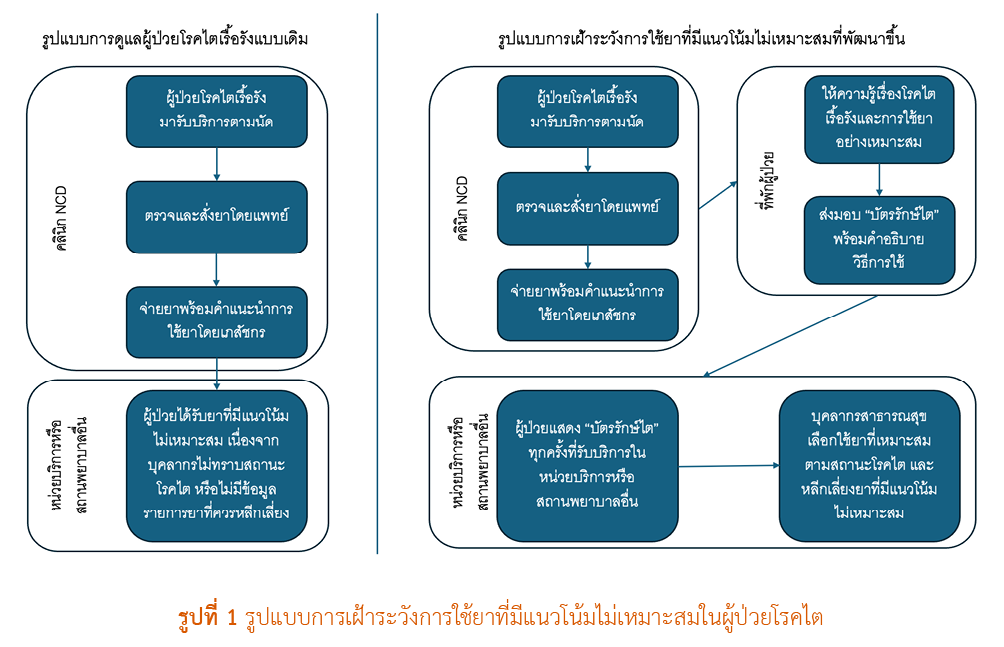
Results: The developed model consisted of individualized patient education combined with the use of a Kidney Care Card. Mean knowledge scores increased significantly from 20.24 ± 4.46 at baseline to 25.29 ± 1.82 immediately after the intervention and were maintained at 25.18 ± 1.99 at the 3-month follow-up (p < 0.001). The proportion of correct responses increased for most questionnaire items. The Kidney Care Card served as a communication tool for conveying patients' kidney function status between patients and healthcare personnel. Most patients and caregivers reported satisfactory level of satisfaction, while most healthcare personnel reported a high level of satisfaction.
Conclusion: The developed monitoring model significantly improved knowledge regarding appropriate medication use among patients with CKD and may promote appropriate medication use in clinical practice.
References
Herrington WG, Judge PK, Grams ME, Wanner C. Chronic kidney disease. Lancet. 2026;407(10523):90-104. doi: 10.1016/s0140-6736(25)01942-7.
Liyanage T, Toyama T, Hockham C, Ninomiya T, Perkovic V, Woodward M, et al. Prevalence of chronic kidney disease in Asia: a systematic review and analysis. BMJ Glob Health. 2022;7(1):e007525. doi: 10.1136/bmjgh-2021-007525.
Doak W, Lerma E, Shah AD. Chronic kidney disease for the primary care provider. Dis Mon. 2026;72(1):102027. doi: 10.1016/j.disamonth.2025.102027.
GBD 2019 Diseases and Injuries Collaborators. Global burden of 369 diseases and injuries in 204 countries and territories, 1990-2019: a systematic analysis for the Global Burden of Disease Study 2019. Lancet. 2020;396(10258):1204-22. doi: 10.1016/s0140-6736(20)30925-9.
กมลทิพย์ วิจิตรสุนทรกุล. ระบาดวิทยาและการทบทวนมาตรการป้องกันโรคไตเรื้อรัง [อินเทอร์เน็ต]. นนทบุรี: กองโรคไม่ติดต่อ กรมควบคุมโรค กระทรวงสาธารณสุข; 2567 [สืบค้นเมื่อ 7 ธ.ค. 2567]. สืบค้นจาก: https://ddc.moph.go.th/uploads/publish/1308820241031010423.pdf
Hall RK, Kazancıoğlu R, Thanachayanont T, Wong G, Sabanayagam D, Battistella M, et al. Drug stewardship in chronic kidney disease to achieve effective and safe medication use. Nat Rev Nephrol. 2024;20(6):386-401. doi: 10.1038/s41581-024-00823-3.
Ingsathit A, Thakkinstian A, Chaiprasert A, Sangthawan P, Gojaseni P, Kiattisunthorn K, et al. Prevalence and risk factors of chronic kidney disease in the Thai adult population: Thai SEEK study. Nephrol Dial Transplant. 2010;25(5):1567-75. doi: 10.1093/ndt/gfp669.
Hyvert S, Yailian AL, Haesebaert J, Vignot E, Chapurlat R, Dussart C, et al. Association between health literacy and medication adherence in chronic diseases: a recent systematic review. Int J Clin Pharm. 2023;45(1):38-51. doi: 10.1007/s11096-022-01470-z.
Suriyong P, Auamnoy T, Suksawang P, Kanjanarat P, Khansamrong T, Supakanjanakanti K, et al. Assessment of rational drug use literacy and its influencing factors among pharmacy students. Am J Pharm Educ. 2025;89(8):101456. doi: 10.1016/j.ajpe.2025.101456.
Bujang MA, Omar ED, Foo DHP, Hon YK. Sample size determination for conducting a pilot study to assess reliability of a questionnaire. Restor Dent Endod. 2024;49(1):e3. doi: 10.5395/rde.2024.49.e3.
Ardavani A, Curtis F, Hopwood E, Highton P, Katapa P, Khunti K, et al. Effect of pharmacist interventions in chronic kidney disease: a meta-analysis. Nephrol Dial Transplant. 2025;40(5):884-907. doi: 10.1093/ndt/gfae221.
Cashmore BA, Cooper TE, Evangelidis NM, Green SC, Lopez-Vargas P, Tunnicliffe DJ. Education programmes for people with chronic kidney disease and diabetes. Cochrane Database Syst Rev. 2024;8(8):CD007374. doi: 10.1002/14651858.CD007374.pub3.
Promyoue T, Somsuvit C, Kanjanarat P. Associations of health literacy, medication adherence and health behavior for delaying kidney progression in patients with chronic kidney diseases in stage 3-4. Thai J Pharm Pract [Internet]. 2023 [cited 2026 Mar 18];15(1):60-72. Available from: https://he01.tci-thaijo.org/index.php/TJPP/article/view/254140
Kurani S, Jeffery MM, Thorsteinsdottir B, Hickson LJ, Barreto EF, Haag J, et al. Use of potentially nephrotoxic medications by U.S. adults with chronic kidney disease: NHANES, 2011-2016. J Gen Intern Med. 2020;35(4):1092-101. doi: 10.1007/s11606-019-05557-8.
Davis-Ajami ML, Fink JC, Wu J. Nephrotoxic medication exposure in U.S. adults with predialysis chronic kidney disease: health services utilization and cost outcomes. J Manag Care Spec Pharm. 2016;22(8):959-68. doi: 10.18553/jmcp.2016.22.8.959.
Chamvichak J, Surasen N. The effect of a dose adjustment alert system on the appropriateness of drug use in hospitalized patients with chronic kidney disease at Chaturaphakphiman hospital. J Res Health Inno Dev [Internet]. 2025 [cited 2026 Mar 18];6(2):372-82. Available from: https://he01.tci-thaijo.org/index.php/jrhi/article/view/281275
Tawadrous D, Shariff SZ, Haynes RB, Iansavichus AV, Jain AK, Garg AX. Use of clinical decision support systems for kidney-related drug prescribing: a systematic review. Am J Kidney Dis. 2011;58(6):903-14. doi: 10.1053/j.ajkd.2011.07.022.
Downloads
Published
How to Cite
Issue
Section
License
Copyright (c) 2026 Health Administration Division, Office of the Permanent Secretary, Ministry of Public Health and The Society of Hospital Pharmacist, Ministry of Public Health

This work is licensed under a Creative Commons Attribution-NonCommercial-NoDerivatives 4.0 International License.
วารสารเภสัชกรรมคลินิกเป็นวารสารในรูปแบบเปิด ผู้ใช้ทั่วไปสามารถเข้าถึง ดาวน์โหลด เอกสารไฟล์บทความบนเว็บไซต์วารสาร โดยไม่มีค่าใช้จ่ายแต่อย่างใด
ข้อความภายในบทความที่ตีพิมพ์ในวารสารเภสัชกรรมคลินิกทั้งหมด รวมถึงรูปภาพประกอบ ตาราง เป็นลิขสิทธิ์ของกองบริหารการสาธารณสุข สำนักงานปลัดกระทรวงสาธารณสุข และ ชมรมเภสัชกรโรงพยาบาลกระทรวงสาธารณสุข อนุญาตให้นำไปใช้ประโยชน์และเผยแพร่ต่อได้โดยอยู่ภายใต้เงื่อนไขสัญญาอนุญาตครีเอทีฟคอมมอนส์ โดยต้องแสดงที่มาจากวารสาร – ไม่ใช้เพื่อการค้า – ห้ามแก้ไขดัดแปลง (Creative Commons Attribution-NonCommercial-NoDerivatives 4.0; CC BY-NC-ND 4.0) การนำเนื้อหา ข้อความหรือข้อคิดเห็น รูปภาพ ตาราง ของบทความไปจัดพิมพ์เผยแพร่ในรูปแบบต่าง ๆ เพื่อใช้ประโยชน์ในเชิงพาณิชย์ ต้องได้รับอนุญาตจากกองบรรณาธิการวารสารเภสัชกรรมคลินิกอย่างเป็นลายลักษณ์อักษร
ข้อความที่ปรากฏในบทความในวารสารเป็นความคิดเห็นส่วนตัวของผู้เขียนแต่ละท่านไม่เกี่ยวข้องกับกองบริหารการสาธารณสุข สำนักงานปลัดกระทรวงสาธารณสุข และบุคลากรในกองบริหารการสาธารณสุข สำนักงานปลัดกระทรวงสาธารณสุข แต่อย่างใด ความรับผิดชอบองค์ประกอบทั้งหมดของบทความแต่ละเรื่องเป็นของผู้เขียนแต่ละท่าน หากมีความผิดพลาดใด ๆ ผู้เขียนแต่ละท่านจะรับผิดชอบบทความของตนเอง ตลอดจนความรับผิดชอบด้านเนื้อหาและการตรวจร่างบทความเป็นของผู้เขียน ไม่เกี่ยวข้องกับกองบรรณาธิการ