
Development of a Proactive Screening Model for Pharmaceutical Care in Inpatients
Keywords:
inpatient screening, trigger tool, pharmaceutical care, drug-related problems, adverse drug reactionsAbstract
Background: Drug-related problems (DRPs) and adverse drug reactions (ADRs) are significant factors affecting patient safety and clinical outcomes. Inpatient pharmaceutical care in the wards of Sawanpracharak Hospital is primarily based on incident reporting combined with direct observation, which does not comprehensively cover all patients. In addition, there is a lack of a systematic, proactive screening process to identify patients at risk of drug-related problems.
Objective: (1) To develop and evaluate a patient screening model for proactive inpatient pharmaceutical care and (2) to assess the identification, prevention, and resolution of drug-related problems (DRPs) in hospitalized patients.
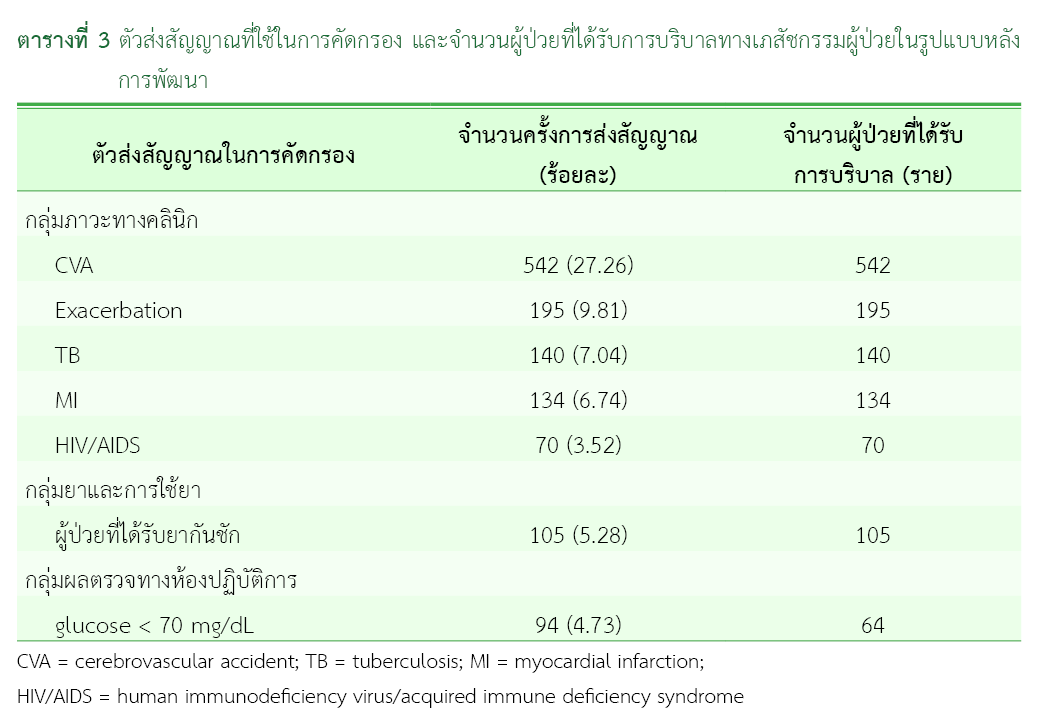
Methods: This action research was conducted in three phases: (1) problem analysis and development of a patient screening model for proactive inpatient pharmaceutical care using trigger tools, direct observation, chart review by healthcare professionals, and voluntary patient reporting, with patient screening performed based on predefined trigger criteria; (2) implementation of the developed model (October 5, 2023, to May 31, 2025); and (3) data collection and outcome analysis after implementation, compared with the pre-implementation period. Data were analyzed using descriptive and inferential statistics, including the chi-square test and Mann–Whitney U test. Statistical significance was set at p-value < 0.05.
Results: Following the development of the model, the number of patients receiving pharmaceutical care increased significantly by 7.61-fold compared with the pre-development period (p-value < 0.001). Significant increases in the number of patients receiving pharmaceutical care were observed among patients receiving warfarin therapy, patients experiencing adverse drug reactions, and patients receiving medications requiring education on special administration techniques (p-value < 0.001). The rate of DRPs was 12.53 per 1,000 patient-days. The majority of identified problems (49.17%) were ADR-related, and ward pharmacists successfully prevented 48.55% of these events from reaching patients.
Conclusion: The developed patient screening model for proactive inpatient pharmaceutical care has the potential to enhance the identification of patients requiring pharmaceutical care and improve the detection, prevention, and resolution of drug-related problems effectively.
References
World Health Organization. WHO draft guidelines for adverse event reporting and learning systems [Internet]. Geneva: WHO Document Production Services; 2005 [cited 2024 Dec 11]. Available from: https://iris.who.int/server/api/core/bitstreams/ca6b372b-e56b-4229-8b47-349480a4e8b9/content
Health Product Vigilance Center. Spontaneous reports of adverse drug reactions 2024 [Internet]. Nonthaburi: Thai Food and Drug Administration; 2025 [cited 2025 Feb 8]. Available from: https://hpvcthai.fda.moph.go.th/publication-documents/category/annual-adverse
น่ารัก ยี่สุ่นแป้น, ปราโมทย์ ตระกูลเพียรกิจ, วรรณี กีรติเตชากร, ทิฆัมพร เอื้อวิเศษวงศ์, ธิดา นิงสานนท์, อุษา ฉายเกล็ดแก้ว, และคณะ. การค้นหาเหตุการณ์ไม่พึงประสงค์จากการใช้ยาโดยใช้เครื่องมือส่งสัญญาณของโรงพยาบาลประจำจังหวัด ประเทศไทย. วารสารเภสัชกรรมไทย [อินเทอร์เน็ต]. 2558 [สืบค้นเมื่อ 5 ก.พ. 2568];7(2):234-49. สืบค้นจาก: https://he01.tci-thaijo.org/index.php/TJPP/article/view/169583
Tragulpiankit P, Kaojarern S, Pummangura C, Wananukul W, Luscombe D. Pharmacist participation in the reduction of preventable adverse drug reactions in Thai hospitalised patients. J Appl Ther Res [Internet]. 2009 [cited 2025 Feb 12];7(1):3-10. Available from: https://repository.li.mahidol.ac.th/handle/123456789/28312
Kaboli PJ, Hoth AB, McClimon BJ, Schnipper JL. Clinical pharmacists and inpatient medical care: a systematic review. Arch Intern Med. 2006;166(9):955-64. doi:10.1001/archinte.166.9.955.
Meyer-Massetti C, Cheng CM, Schwappach DL, Paulsen L, Ide B, Meier CR, et al. Systematic review of medication safety assessment methods. Am J Health Syst Pharm. 2011;68(3):227-40. doi: 10.2146/ajhp100019.
Griffin FA, Resar RK. IHI global trigger tool for measuring adverse events (second edition) [Internet]. Boston (MA): Institute for Healthcare Improvement; 2009 [cited 2024 Nov 20]. Available from: https://www.ihi.org/library/white-papers/ihi-global-trigger-tool-measuring-adverse-events
เยาวลักษณ์ สิทธิเดช. การพัฒนาเครื่องมือส่งสัญญาณเพื่อใช้ค้นหาปัญหาการใช้ยาของผู้ป่วยใน ณ โรงพยาบาลพระนครศรีอยุธยา. วารสารเภสัชกรรมคลินิก [อินเทอร์เน็ต]. 2567 [สืบค้นเมื่อ 5 ก.พ. 2568];30(3):292-305. สืบค้นจาก: https://thaidj.org/index.php/TJCP/article/view/15227
Hepler CD, Strand LM. Opportunities and responsibilities in pharmaceutical care. Am J Hosp Pharm. 1990;47(3):533–43. PMID: 2316538.
Hickson RP, Steinke DT, Skitterall C, Williams SD. Evaluation of a pharmaceutical assessment screening tool to measure patient acuity and prioritise pharmaceutical care in a UK hospital. Eur J Hosp Pharm. 2017;24(2):74-9. doi: 10.1136/ejhpharm-2015-000829.
Szekendi MK, Sullivan C, Bobb A, Feinglass J, Rooney D, Barnard C, Noskin GA. Active surveillance using electronic triggers to detect adverse events in hospitalized patients. Qual Saf Health Care. 2006;15(3):184-90. doi: 10.1136/qshc.2005.014589.
ระวิวรรณ หลิมศิโรรัตน์, โพยม วงศ์ภูวรักษ์, สุชาดา สูรพันธุ์, วรสิน เกตานนท์. ผลการให้บริบาลทางเภสัชกรรมสำหรับผู้ป่วยที่ได้รับยาวอร์ฟารินครั้งแรก ในหอผู้ป่วยอายุรกรรมและศัลยกรรม ณ โรงพยาบาลพระมงกุฎเกล้า. วารสารเวชสารแพทย์ทหารบก [อินเทอร์เน็ต]. 2560 [สืบค้นเมื่อ 12 ก.พ. 2568];70(4):217-28. สืบค้นจาก: https://he02.tci-thaijo.org/index.php/rtamedj/article/view/109850
เจนจิรา ตันติวิชญวานิช, รังสิมา ไชยาสุ. ผลของการบริบาลทางเภสัชกรรมในผู้ป่วยที่ใช้ยาวาร์ฟารินของโรงพยาบาลปัตตานี. วารสารเภสัชกรรมไทย [อินเทอร์เน็ต]. 2556 [สืบค้นเมื่อ 12 ก.พ. 2568];5(2):108-19. สืบค้นจาก: https://he01.tci-thaijo.org/index.php/TJPP/article/view/169341
American Diabetes Association Professional Practice Committee. 6. Glycemic goals and hypoglycemia: standards of care in diabetes-2025. Diabetes Care. 2025;48(Suppl 1):S128-45. doi:10.2337/dc25-S006.
Ahmed FW, Majeed MS, Kirresh O. Non-Diabetic Hypoglycemia. In: StatPearls [Internet]. Treasure Island (FL): StatPearls Publishing; 2025 [cited 2025 May 16]. Available from: https://www.ncbi.nlm.nih.gov/books/NBK573079/
ธิรัตว์ พาพล. การพัฒนาแนวทางการเฝ้าระวังการแพ้ยาและอาการไม่พึงประสงค์จากยา โรงพยาบาลหาดสำราญเฉลิมพระเกียรติ 80 พรรษา อำเภอหาดสำราญ จังหวัดตรัง. วารสารสิ่งแวดล้อมศึกษาการแพทย์และสุขภาพ [อินเทอร์เน็ต]. 2567 [สืบค้นเมื่อ 2 มี.ค. 2568];9(2):491-501. สืบค้นจาก: https://so06.tci-thaijo.org/index.php/hej/article/view/275179
Downloads
Published
How to Cite
Issue
Section
License
Copyright (c) 2026 Health Administration Division, Office of the Permanent Secretary, Ministry of Public Health and The Society of Hospital Pharmacist, Ministry of Public Health

This work is licensed under a Creative Commons Attribution-NonCommercial-NoDerivatives 4.0 International License.
วารสารเภสัชกรรมคลินิกเป็นวารสารในรูปแบบเปิด ผู้ใช้ทั่วไปสามารถเข้าถึง ดาวน์โหลด เอกสารไฟล์บทความบนเว็บไซต์วารสาร โดยไม่มีค่าใช้จ่ายแต่อย่างใด
ข้อความภายในบทความที่ตีพิมพ์ในวารสารเภสัชกรรมคลินิกทั้งหมด รวมถึงรูปภาพประกอบ ตาราง เป็นลิขสิทธิ์ของกองบริหารการสาธารณสุข สำนักงานปลัดกระทรวงสาธารณสุข และ ชมรมเภสัชกรโรงพยาบาลกระทรวงสาธารณสุข อนุญาตให้นำไปใช้ประโยชน์และเผยแพร่ต่อได้โดยอยู่ภายใต้เงื่อนไขสัญญาอนุญาตครีเอทีฟคอมมอนส์ โดยต้องแสดงที่มาจากวารสาร – ไม่ใช้เพื่อการค้า – ห้ามแก้ไขดัดแปลง (Creative Commons Attribution-NonCommercial-NoDerivatives 4.0; CC BY-NC-ND 4.0) การนำเนื้อหา ข้อความหรือข้อคิดเห็น รูปภาพ ตาราง ของบทความไปจัดพิมพ์เผยแพร่ในรูปแบบต่าง ๆ เพื่อใช้ประโยชน์ในเชิงพาณิชย์ ต้องได้รับอนุญาตจากกองบรรณาธิการวารสารเภสัชกรรมคลินิกอย่างเป็นลายลักษณ์อักษร
ข้อความที่ปรากฏในบทความในวารสารเป็นความคิดเห็นส่วนตัวของผู้เขียนแต่ละท่านไม่เกี่ยวข้องกับกองบริหารการสาธารณสุข สำนักงานปลัดกระทรวงสาธารณสุข และบุคลากรในกองบริหารการสาธารณสุข สำนักงานปลัดกระทรวงสาธารณสุข แต่อย่างใด ความรับผิดชอบองค์ประกอบทั้งหมดของบทความแต่ละเรื่องเป็นของผู้เขียนแต่ละท่าน หากมีความผิดพลาดใด ๆ ผู้เขียนแต่ละท่านจะรับผิดชอบบทความของตนเอง ตลอดจนความรับผิดชอบด้านเนื้อหาและการตรวจร่างบทความเป็นของผู้เขียน ไม่เกี่ยวข้องกับกองบรรณาธิการ