FACTORS ASSOCIATED WITH ORAL CANCER RISK BEHAVIORS AMONG THE SENIOR CITIZENS IN UBON RATCHATHANI PROVINCE
Keywords:
Risk taking, Oral cancer, Aged, Health beliefs modelAbstract
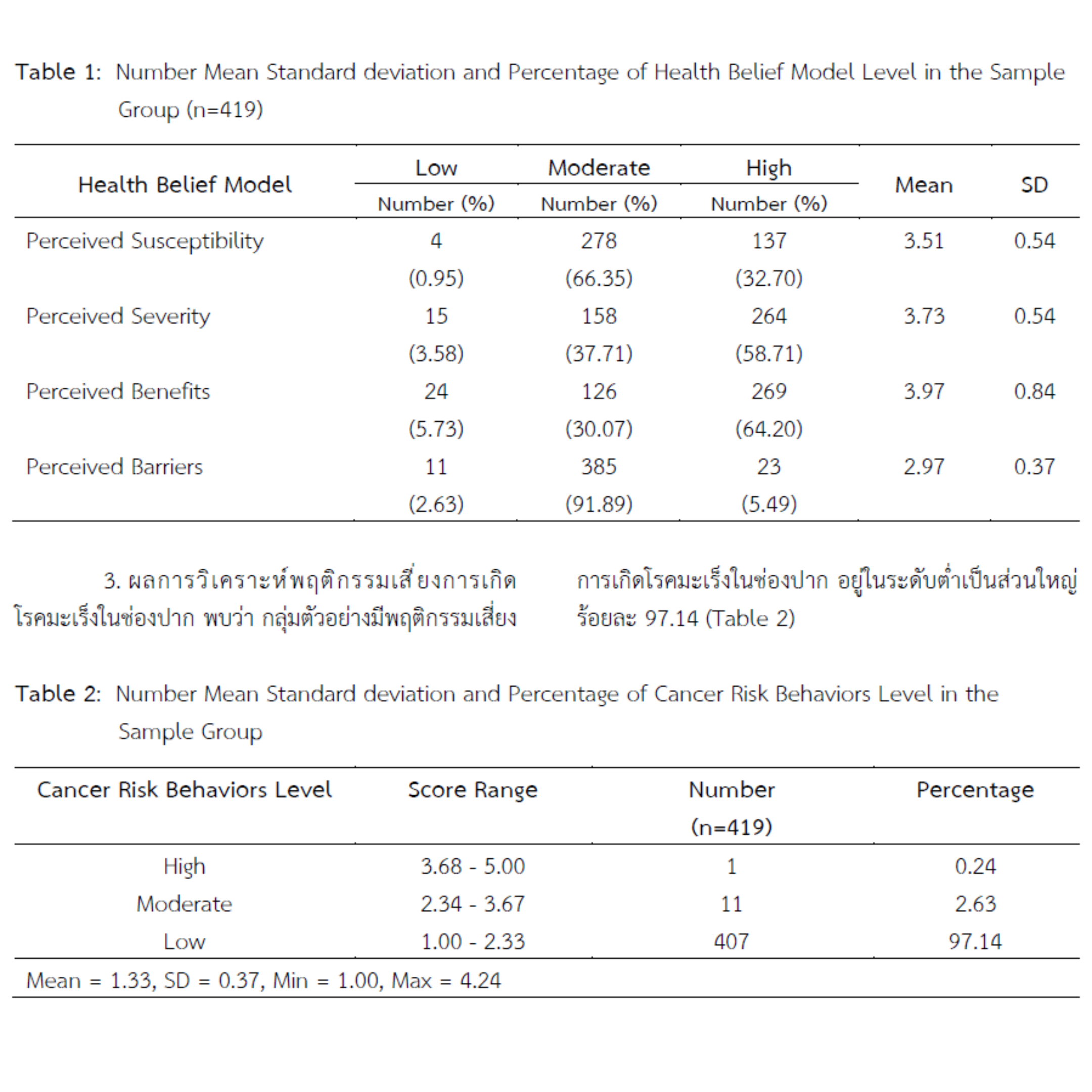
Oral cancer is a type of malignancy that occurs in the mucosal tissues of the oral cavity. It is commonly found among older adults and has significant impacts on their quality of life, particularly in terms of physical appearance, speech, voice, and swallowing. Personal health behaviors are considered a critical factor influencing the development of oral cancer. This cross-sectional descriptive study aimed to examine risk behaviors associated with oral cancer and related factors among older adults in Ubon Ratchathani Province. A total of 419 participants were selected using multi-stage random sampling. Data was collected through questionnaires and analyzed using descriptive statistics, Fisher’s exact test, and Spearman’s rank correlation coefficient. The findings revealed that most participants exhibited low levels of risk behaviors for oral cancer (97.14%). According to the Health Belief Model, 64.20% and 58.71% of participants had high levels of perceived benefits of disease prevention and perceived severity of the disease, respectively. Meanwhile, 91.89% and 66.35% had moderate levels of perceived barriers to prevention/treatment and perceived susceptibility to the disease, respectively. Significant correlations were found between oral cancer risk behaviors and perceived susceptibility (rs = –0.198, p < 0.001) as well as perceived barriers (rs = 0.159, p = 0.001). In conclusion, older adults with greater awareness of disease susceptibility tend to engage in fewer risk behaviors, whereas those perceiving more barriers are more likely to engage in risky behaviors. Public health agencies should incorporate the Health Belief Model into primary-level oral health promotion policies, with a focus on increasing risk perception and reducing access barriers to effectively prevent and reduce oral cancer risk behaviors among the elderly.
References
Alexandra T. et al. (2020). Autophagy-A Hidden but Important Actor on Oral Cancer Scene. International journal of molecular sciences, 21(23), 9325. https://doi.org/10.3390/ijms2123932
Becker, M.H. (1974). The health belief model and personal health behavior. New Jersey. American Journal: Charles B. Slack.
Best, J.W. (1981). Research in Education. Science and Education. http://www.sciepub.com/reference/242156
Crombie A. et al. (2014). Health-related quality of life of patients treated with primary chemoradiotherapy for oral cavity squamous cell carcinoma: a comparison with surgery. The British journal of oral & maxillofacial surgery, 52(2), 111–117. https://doi.org/10.1016/j.bjoms.2013.09.014
Dental Clinics of North America. (2018). Impact of Oral Cancer on Quality of Life. North America: Impact of Oral Cancer on Quality of Life.
Janz N. K. & Becker M. H. (1984). The health belief model: A decade later. Health Education and Prevention, 3(1), 1-47.
Jiravatnakul, A. (2015). Statistics for Health Science Research (4th ed.). Bangkok: Witthipat.
Krejcie R. V. & Morgan D. W. (1970). Determining Sample Size for Research Activities. Educational and psychological measurement, 60, 607-610. https://doi.org/10.1177/001316447003000308
Laeboonma, P. (2008). Health belief model and cigarette smoking behavior of people in Mae Pu Health Center, Mae Phrik District, Lampang Province, [Thesis of Master of Public Health]. Graduate School: Chiang Mai University.
Li C. C. et al. (2018). Oral Cancer: Genetics and the Role of Precision Medicine. Dental clinics of North America, 62(1), 29–46. https://doi.org/10.1016/j.cden.2017.08.002
Manosunthon S. et al. (2012). Risk Factors for Non-Communicable Diseases among Thai Muslims: A Cross-Sectional Study. Thai Muslim Well-being Foundation. https://muslim4health.or.th/
National Cancer Institute. (2022). Hospital-Based Cancer Registry 2021. National Cancer Institute. https://www.nci.go.th/th/New_web/index.html
National Cancer Prevention and Control Plan Committee. (2018). National Cancer Control Program (2018-2022). National Cancer Institute. https://www.rama.mahidol.ac.th/policy/en/sdgs17-p005
Punthasee P. & Srisawad K. (2020). Correlations between Health Belief and 3E 2S Health Behaviors of Elderly in Taejew Community Tungwatdorn Sathorn Bangkok Thailand. Journal of Health and Health Management, 6(1), 45-57.
Rovinellin R. J. & Hambleton R. K. (1997). On the Use of Content Specialists in the Assessment of Criterion-Referenced Test Item Validity. Tijdschrift Voor Onderwijs Research, 2, 49-60.
Soynahk, C. (2018). A Study of Health Belief Model and the Risk of Type 2 Diabetes in Eorking Muslim Populations, [Thesis of Master of Nursing Science Program in Community Nurse Practitioner]. Huachiew Chalermprakiet University.
Srisaad, B. (2002). Preliminary Research (7th Ed). Bangkok: Suwiryasasarn.
Ubon Ratchathani Provincial Public Health Office. (2022). Organizational Structure of Ubon Ratchathani Provincial Public Health Office. Ubon Ratchathani Provincial Public Health Office. https://www.phoubon.in.th/data/structure.pdf.
Ubon Ratchathani Provincial Public Health Office. (2023). Elderly Population 60 Years of Age and Over in Ubon Ratchathani Province. Ubon Ratchathani Provincial Public Health Office. https://ubn.hdc.moph.go.th/hdc/main/index.php.
Ubon Rratchathani Cancer Hospital. (2023). Cancer data 2017-2022. Ubon Ratchathani Cancer Hospital. http://uboncancer.go.th/ubcc2016v2/statcancer.php
World Health Organization. (2023, March 14). Oral health. World Health Organization. https://www.who.int/news-room/fact-sheets/detail/oral-health?fbclid=IwAR1I-ciTi9erEag2Z3cN_bSoPPip_rCYbmw4jNiXoGPTpQuOmugkAwmg9YA
Downloads
Published
How to Cite
Issue
Section
License
Copyright (c) 2025 Primary Health Care Journal (Northeastern Edition)

This work is licensed under a Creative Commons Attribution-NonCommercial-NoDerivatives 4.0 International License.