EFFECTIVENESS OF HEALTH LITERACY PROGRAM FOR ERGONOMIC TO HEALTH BEHAVIOR OF DAIRY FARMERS IN TWO PROVINCES
Keywords:
Health Literacy, Ergonomics, Health Education Programs, Health Behaviors, Dairy FarmersAbstract
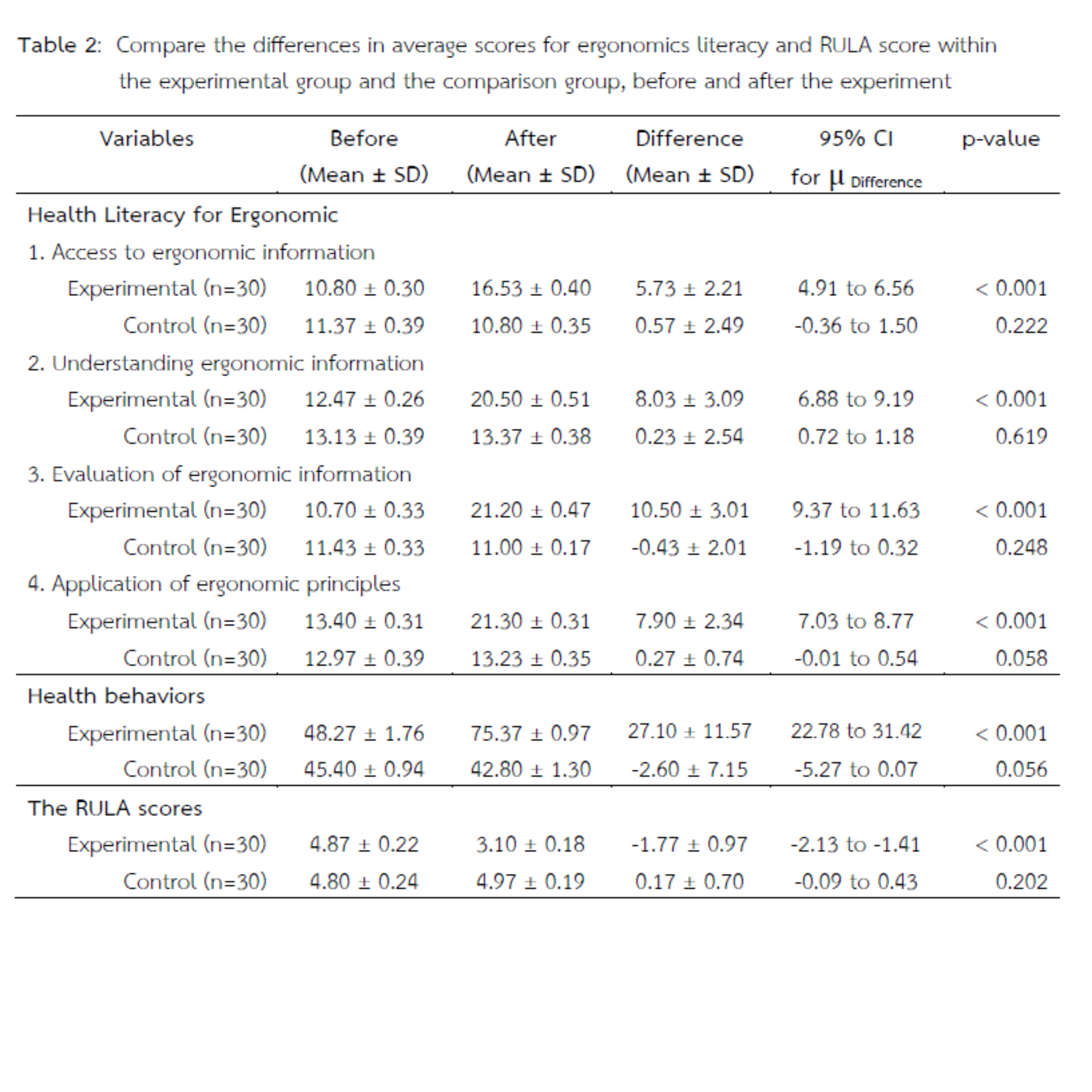
Musculoskeletal disorders (MSDs) are the leading health issue among continuous manual laborers, primarily stemming from poor workplace ergonomics. This quasi-experimental study aimed to investigate the effects of an ergonomic health literacy promotion program on the health behaviors of dairy farmers. The sample consisted of 60 dairy farmers, equally divided into an experimental group (n = 30) and a comparison group (n = 30). The experimental group participated in a 10-week ergonomic health literacy promotion program. Data were collected using questionnaires and working posture risk assessments, and subsequently analyzed utilizing descriptive and inferential statistics, specifically the Independent t-test and Paired t-test. The findings revealed that, post-intervention, the experimental group demonstrated a statistically significant increase in all five domains of ergonomic health literacy compared to both their pre-intervention baseline and the comparison group (p-value < 0.001). Furthermore, the experimental group exhibited significantly higher health behavior scores than the comparison group (Mean diff. = 32.57, 95% CI = 29.33 to 35.80, p-value < 0.001), along with a significant reduction in occupational risk (Mean diff. = -1.87, 95% CI = -2.38 to -1.35, p-value < 0.001). In conclusion, the ergonomic health literacy promotion program effectively enhances health behaviors and mitigates the risk of musculoskeletal disorders among dairy farmers. This program can serve as a practical guideline for addressing ergonomic challenges within the agricultural sector.
References
Cochran, W. G. (1977). Sampling techniques (3rd ed.). John Wiley & Sons.
Department of Disease Control. (2016, January 05). Manual for capacity development of occupational health service network for community workers in ergonomics. https://ddc.moph.go.th/uploads/files/69956e0d4b5a1f09414c0f47a5336039.pdf
Health Literacy Promotion Center, Department of Health. (2018). Health literacy evaluation tool for Thai people. Ministry of Public Health.
Information and Communication Technology Center, Department of Livestock Development. (2024). Report of the number of farmers and livestock in Thailand (Monthly report 2024). https://ict.dld.go.th/index.php/th/service/report/eregist-monthly/report-monthly2567
Office of the Permanent Secretary, Ministry of Labour. (2023). Labor situation in the first quarter of 2023 (January - March 2023). https://share.google/uhnEvNqzI0M1cWTml
Kaewyuang S. & Supapong S. (2023). Prevalence and Associated Factors of Musculoskeletal Disorders among Workers in a Naval Dockyard. Royal Thai Navy Medical Journal, 50(1), 43-53.
Lakkhanalikhitkun, E. (2024). The effect of participatory ergonomics program to improve working condition for reducing musculoskeletal risks among concrete workers in a factory, Chonburi Province. Disease Control Journal, 50(2), 330-344. https://doi.org/10.14456/dcj.2024.26
Maimahad N. et al. (2022). Occupational health literacy and safety work behaviors of operational employees: A case study of a rubber block factory in Thailand. Journal of Community Public Health, 8(3), 136-148.
McAtamney L. & Nigel Corlett E. (1993). RULA: a survey method for the investigation of work-related upper limb disorders. Applied Ergonomics, 24(2), 91-99.
Ministry of Agriculture and Cooperatives. (2023, September 10). Important data report from the Ministry of Agriculture and Cooperatives, data dated 10 September 2023. Ministry of Agriculture and Cooperatives. https://www.moac.go.th/site-home
Jirawatkul, A. (2009). Statistics in health sciences for research (2nd ed.). Witthayapat.
Sørensen K. et al. (2012) Health literacy and public health: A systematic review and integration of definitions and models. BMC Public Health, 12(80), 1-13.
Kraewglom U. & Tnaudee N. (2021). Effect of an ergonomic health promotion program on behavior modification to reduce the risk of musculoskeletal disorders among garment workers in Bangkok. Journal of the Office of Disease Prevention and Control 7 Khon Kaen, 28(2), 31-40.
Poonyapoora, C. (2024). The Development of Health Literacy Promoting Model for Factory Staff in Nakhon Sawan Province. The Primary Health Care Journal (Northern Edition), 34(2), 4-11.
Jumjee R. et al. (2024). Ergonomic risk management in hand-woven fabric groups using 3E principles: A case study of Ban Bon hand-woven fabric community enterprise, Samrong District, Ubon Ratchathani Province. Thai Journal of Ergonomics, 7(2), 92–103.
Sookpool A. et al. (2020). Effectiveness of Health Literacy and Health Behavior Development Program for Working People. Journal of Health Science of Thailand, 29(3), 419-429.
Downloads
Published
How to Cite
Issue
Section
License
Copyright (c) 2026 Primary Health Care Journal (Northeastern Edition)

This work is licensed under a Creative Commons Attribution-NonCommercial-NoDerivatives 4.0 International License.