
Effect of Methadone on Chronic Pain Management in Terminally Ill Patients: A Retrospective Study
Keywords:
methadone, chronic pain, drug use review, terminally ill patients, adverse effectsAbstract
Background: Methadone is an opioid analgesic with proven efficacy in pain control, which remains an important clinical challenge among patients with advanced illness. However, evidence regarding the prescribing patterns, effectiveness, and safety of methadone in Thailand remains limited.
Objectives: To evaluate the indications, prescribing patterns, initiation methods, starting doses, treatment response, potential drug–drug interactions, adverse drug reactions, use of adjuvant analgesics, and process indicators related to the effectiveness and safety monitoring of methadone for chronic pain management in terminally ill patients.
Methods: A retrospective descriptive study was conducted through a medical record review of patients who received methadone for pain control in the internal medicine wards of Srinagarind Hospital under consultation with the Palliative Care Center between January 1, 2017, and December 31, 2019.
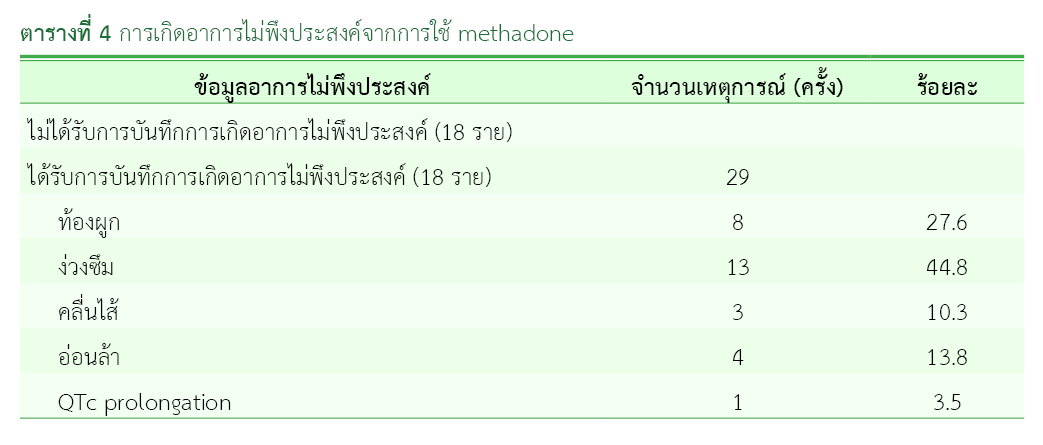
Results: A total of 36 patient records were reviewed, with equal numbers of male and female patients. The median age (interquartile range) was 48.5 (18) years. Most patients experienced cancer-related pain (83.3%). Mixed pain was the most common pain type, accounting for 61.1% of patients when both cancer-related and non-cancer pain groups were combined. Methadone was primarily prescribed as switch therapy from other strong opioids in combination with adjuvant analgesics, using either the three-day method (8.3%) or the stop-and-go method (55.6%). The mean number of potential drug–drug interaction pairs was 3.4 per patient. The most common adverse drug reactions were somnolence and constipation, occurring in 44.8% and 27.6% of patients, respectively. Pain assessments before and after methadone initiation were documented in 75.0% of patients, and 61.1% underwent electrocardiogram monitoring at least once. Overall treatment success was achieved in 72.2% of patients.
Conclusions: Methadone switch therapy combined with adjuvant analgesics, particularly the stop-and-go approach, was effective in controlling severe chronic pain in terminally ill patients. Most adverse effects were mild, and monitoring of treatment effectiveness and safety was performed at an appropriate level.
References
De Lima L, Krakauer EL, Lorenz K, Praill D, Macdonald N, Doyle D. Ensuring palliative medicine availability: the development of the IAHPC list of essential medicines for palliative care. J Pain Symptom Manage. 2007;33(5):521-6. doi: 10.1016/j.jpainsymman.2007.02.006.
Pairojkul S, Thongkhamcharoen R, Raksasataya A, Sorasit C, Nakawiro P, Sudsa S, et al. Integration of specialist palliative care into tertiary hospitals: a multicenter point prevalence survey from Thailand. Palliat Med Rep. 2021;2(1):272-9. doi: 10.1089/pmr.2021.0003.
สุภัสร์ สุบงกช. บทที่ 29 ภาวะปวดจากมะเร็ง. ใน: สุภัสร์ สุบงกช, มานิตย์ แซ่เตียว, สุธาร จันทะวงศ์, บรรณาธิการ. เภสัชกรรมปฏิบัติในโรคมะเร็ง. ขอนแก่น: โรงพิมพ์มหาวิทยาลัยขอนแก่น; 2556. หน้า 569–612.
Anekar AA, Hendrix JM, Cascella M. WHO Analgesic Ladder. In: StatPearls [Internet]. Treasure Island (FL): StatPearls Publishing; 2023 [cited 2025 Jan 25]. Available from: https://www.ncbi.nlm.nih.gov/books/NBK554435/
Benmebarek M, Devaud C, Gex-Fabry M, Powell Golay K, Brogli C, Baumann P, et al. Effects of grapefruit juice on the pharmacokinetics of the enantiomers of methadone. Clin Pharmacol Ther. 2004;76(1):55-63. doi: 10.1016/j.clpt.2004.03.007.
Leppert W. The role of methadone in cancer pain treatment - a review. Int J Clin Pract. 2009;63(7):1095-109. doi: 10.1111/j.1742-1241.2008.01990.x.
Berger AM, Shuster JL, Von Roenn JH, editors. Palliative Care and Supportive Oncology. 4th ed. Philadelphia: Wolters Kluwer; 2013. p. 28–29.
Mercadante S, Bruera E. Opioid switching: a systematic and critical review. Cancer Treat Rev. 2006;32(4):304-15. doi: 10.1016/j.ctrv.2006.03.001.
สถาบันมะเร็งแห่งชาติ กรมการแพทย์, สมาคมการศึกษาเรื่องความปวดแห่งประเทศไทย. คำแนะนำการจัดการความปวดจากมะเร็ง (Clinical guidance for cancer pain management). พิมพ์ครั้งที่ 1. กรุงเทพมหานคร: สถาบันมะเร็งแห่งชาติ กรมการแพทย์; 2565.
Palat G, Chary S. Practical guide for using methadone in pain and palliative care practice. Indian J Palliat Care. 2018;24(Suppl 1):S21-9. doi: 10.4103/IJPC.IJPC_186_17.
Parsons HA, de la Cruz M, El Osta B, Li Z, Calderon B, Palmer JL, et al. Methadone initiation and rotation in the outpatient setting for patients with cancer pain. Cancer. 2010;116(2):520-8. doi: 10.1002/cncr.24754.
Wolters Kluwer. Lexi-Interact Online [Internet]. Hudson (OH): Wolters Kluwer Clinical Drug Information, Inc.; 2025 [cited 2025 Feb 28]. Available from: https://online.lexi.com (password required)
Merative. Micromedex Drug Interactions [Internet]. Ann Arbor (MI): Merative US L.P.; 2025 [cited 2025 Feb 28]. Available from: https://www.micromedexsolutions.com (password required)
สุทิน ชนะบุญ. สถิติและการวิเคราะห์ข้อมูลในงานวิจัยด้านสุขภาพเบื้องต้น. ขอนแก่น: สำนักงานสาธารณสุขจังหวัดขอนแก่น; 2560.
Naranjo CA, Busto U, Sellers EM, Sandor P, Ruiz I, Roberts EA, et al. A method for estimating the probability of adverse drug reactions. Clin Pharmacol Ther. 1981;30(2):239-45. doi: 10.1038/clpt.1981.154.
Pudchakan P, Tanyasaensook K, Chaudakshetrin P, Ketumarn P, Suthisisang C. Evaluation of a methadone protocol for severe chronic pain management in Thai patients: a prospective study. J Pain Relief [Internet]. 2016 [cited 2025 Jun 5];5:243. Available from: https://www.omicsonline.org/open-access/evaluation-of-a-methadone-protocol-for-severe-chronic-pain-managementin-thai-patients-a-prospective-study-2167-0846-1000243.php?aid=71749
Cancer Research UK. Causes and types of cancer pain [Internet]. London: Cancer Research UK; 2024 [cited 2025 Jun 5]. Available from: https://www.cancerresearchuk.org/about-cancer/coping/physically/cancer-and-pain-control/causes-and-types/
Starobova H, Vetter I. Pathophysiology of chemotherapy-induced peripheral neuropathy. Front Mol Neurosci. 2017;10:174. doi: 10.3389/fnmol.2017.00174.
Peirano GP, Mammana GP, Bertolino MS, Pastrana T, Vega GF, Russo J, et al. Methadone as first-line opioid treatment for cancer pain in a developing country palliative care unit. Support Care Cancer. 2016;24(8):3551-6. doi: 10.1007/s00520-016-3191-5.
Fürst P, Lundström S, Klepstad P, Strang P. The use of low-dose methadone as add-on to regular opioid therapy in cancer-related pain at end of life: a national Swedish survey in specialized palliative care. J Palliat Med. 2020;23(2):226-32. doi: 10.1089/jpm.2019.0253.
Caraceni A, Shkodra M. Cancer pain assessment and classification. Cancers (Basel). 2019; 11(4):510. doi: 10.3390/cancers11040510.
Porta-Sales J, Garzón-Rodríguez C, Villavicencio-Chávez C, Llorens-Torromé S, González-Barboteo J. Efficacy and safety of methadone as a second-line opioid for cancer pain in an outpatient clinic: a prospective open-label study. Oncologist. 2016;21(8):981-7. doi: 10.1634/theoncologist.2015-0503.
Anghelescu DL, Faughnan LG, Hankins GM, Ward DA, Oakes LL. Methadone use in children and young adults at a cancer center: a retrospective study. J Opioid Manag. 2011;7(5):353-61. doi: 10.5055/jom.2011.0076.
Ayonrinde OT, Bridge DT. The rediscovery of methadone for cancer pain management. Med J Aust. 2000;173(10):536-40. PMID: 11194738.
Caraceni A, Hanks G, Kaasa S, Bennett MI, Brunelli C, Cherny N, et al. Use of opioid analgesics in the treatment of cancer pain: evidence-based recommendations from the EAPC. Lancet Oncol. 2012;13(2):e58-68. doi: 10.1016/S1470-2045(12)70040-2.
Mercadante S, Casuccio A, Calderone L. Rapid switching from morphine to methadone in cancer patients with poor response to morphine. J Clin Oncol. 1999;17(10):330-12. doi: 10.1200/JCO.1999.17.10.3307.
Rhondali W, Tremellat F, Ledoux M, Ciais JF, Bruera E, Filbet M. Methadone rotation for cancer patients with refractory pain in a palliative care unit: an observational study. J Palliat Med. 2013;16(11):1382-7. doi: 10.1089/jpm.2013.0222.
Mercadante S, Ferrera P, Villari P, Casuccio A. Rapid switching between transdermal fentanyl and methadone in cancer patients. J Clin Oncol. 2005;23(22):5229-34. doi: 10.1200/JCO.2005.13.128.
Sato T, Fukutomi A, Kawamura T, Kawakami K, Sato T, Kamo Y, et al. Low-dose add-on methadone for cancer pain management: a retrospective analysis of 102 Japanese patients. Jpn J Clin Oncol. 2025;55(2):123-30. doi: 10.1093/jjco/hyae156.
McCance-Katz EF, Mandell TW. Drug interactions of clinical importance with methadone and buprenorphine. Am J Addict. 2010;19(1):2-3. doi: 10.1111/j.1521-0391.2009.00011.x.
Mégarbane B, Hreiche R, Pirnay S, Marie N, Baud FJ. Does high-dose buprenorphine cause respiratory depression? Possible mechanisms and therapeutic consequences. Toxicol Rev. 2006;25(2):79-85. doi: 10.2165/00139709-200625020-00002.
Collett BJ. Opioid tolerance: the clinical perspective. Br J Anaesth 1998;81(1):58-68. doi: 10.1093/bja/81.1.58.
Benyamin R, Trescot AM, Datta S, Buenaventura R, Adlaka R, Sehgal N, et al. Opioid complications and side effects. Pain Physician. 2008;11(2 Suppl):S105-20. PMID: 18443635.
McPherson ML, Walker KA, Davis MP, Bruera E, Reddy A, Paice J, et al. Safe and appropriate use of methadone in hospice and palliative care: expert consensus white paper. J Pain Symptom Manage. 2019;57(3):635-45.e4. doi: 10.1016/j.jpainsymman.2018.12.001.
Nicholson AB, Watson GR, Derry S, Wiffen PJ. Methadone for cancer pain. Cochrane Database Syst Rev. 2017;2(2):CD003971. doi: 10.1002/14651858.CD003971.pub4.
Haroutiunian S, McNicol ED, Lipman AG. Methadone for chronic non-cancer pain in adults. Cochrane Database Syst Rev. 2012;11(11):CD008025. doi: 10.1002/14651858.CD008025.pub2.
Downloads
Published
How to Cite
Issue
Section
License
Copyright (c) 2026 Health Administration Division, Office of the Permanent Secretary, Ministry of Public Health and The Society of Hospital Pharmacist, Ministry of Public Health

This work is licensed under a Creative Commons Attribution-NonCommercial-NoDerivatives 4.0 International License.
วารสารเภสัชกรรมคลินิกเป็นวารสารในรูปแบบเปิด ผู้ใช้ทั่วไปสามารถเข้าถึง ดาวน์โหลด เอกสารไฟล์บทความบนเว็บไซต์วารสาร โดยไม่มีค่าใช้จ่ายแต่อย่างใด
ข้อความภายในบทความที่ตีพิมพ์ในวารสารเภสัชกรรมคลินิกทั้งหมด รวมถึงรูปภาพประกอบ ตาราง เป็นลิขสิทธิ์ของกองบริหารการสาธารณสุข สำนักงานปลัดกระทรวงสาธารณสุข และ ชมรมเภสัชกรโรงพยาบาลกระทรวงสาธารณสุข อนุญาตให้นำไปใช้ประโยชน์และเผยแพร่ต่อได้โดยอยู่ภายใต้เงื่อนไขสัญญาอนุญาตครีเอทีฟคอมมอนส์ โดยต้องแสดงที่มาจากวารสาร – ไม่ใช้เพื่อการค้า – ห้ามแก้ไขดัดแปลง (Creative Commons Attribution-NonCommercial-NoDerivatives 4.0; CC BY-NC-ND 4.0) การนำเนื้อหา ข้อความหรือข้อคิดเห็น รูปภาพ ตาราง ของบทความไปจัดพิมพ์เผยแพร่ในรูปแบบต่าง ๆ เพื่อใช้ประโยชน์ในเชิงพาณิชย์ ต้องได้รับอนุญาตจากกองบรรณาธิการวารสารเภสัชกรรมคลินิกอย่างเป็นลายลักษณ์อักษร
ข้อความที่ปรากฏในบทความในวารสารเป็นความคิดเห็นส่วนตัวของผู้เขียนแต่ละท่านไม่เกี่ยวข้องกับกองบริหารการสาธารณสุข สำนักงานปลัดกระทรวงสาธารณสุข และบุคลากรในกองบริหารการสาธารณสุข สำนักงานปลัดกระทรวงสาธารณสุข แต่อย่างใด ความรับผิดชอบองค์ประกอบทั้งหมดของบทความแต่ละเรื่องเป็นของผู้เขียนแต่ละท่าน หากมีความผิดพลาดใด ๆ ผู้เขียนแต่ละท่านจะรับผิดชอบบทความของตนเอง ตลอดจนความรับผิดชอบด้านเนื้อหาและการตรวจร่างบทความเป็นของผู้เขียน ไม่เกี่ยวข้องกับกองบรรณาธิการ