SOFT SKILLS IN THE DIGITAL ERA: ROLES OF VILLAGE HEALTH VOLUNTEERS (VHV) 4.0
Keywords:
Digital Literacy, Soft Skills, Village Health VolunteerAbstract
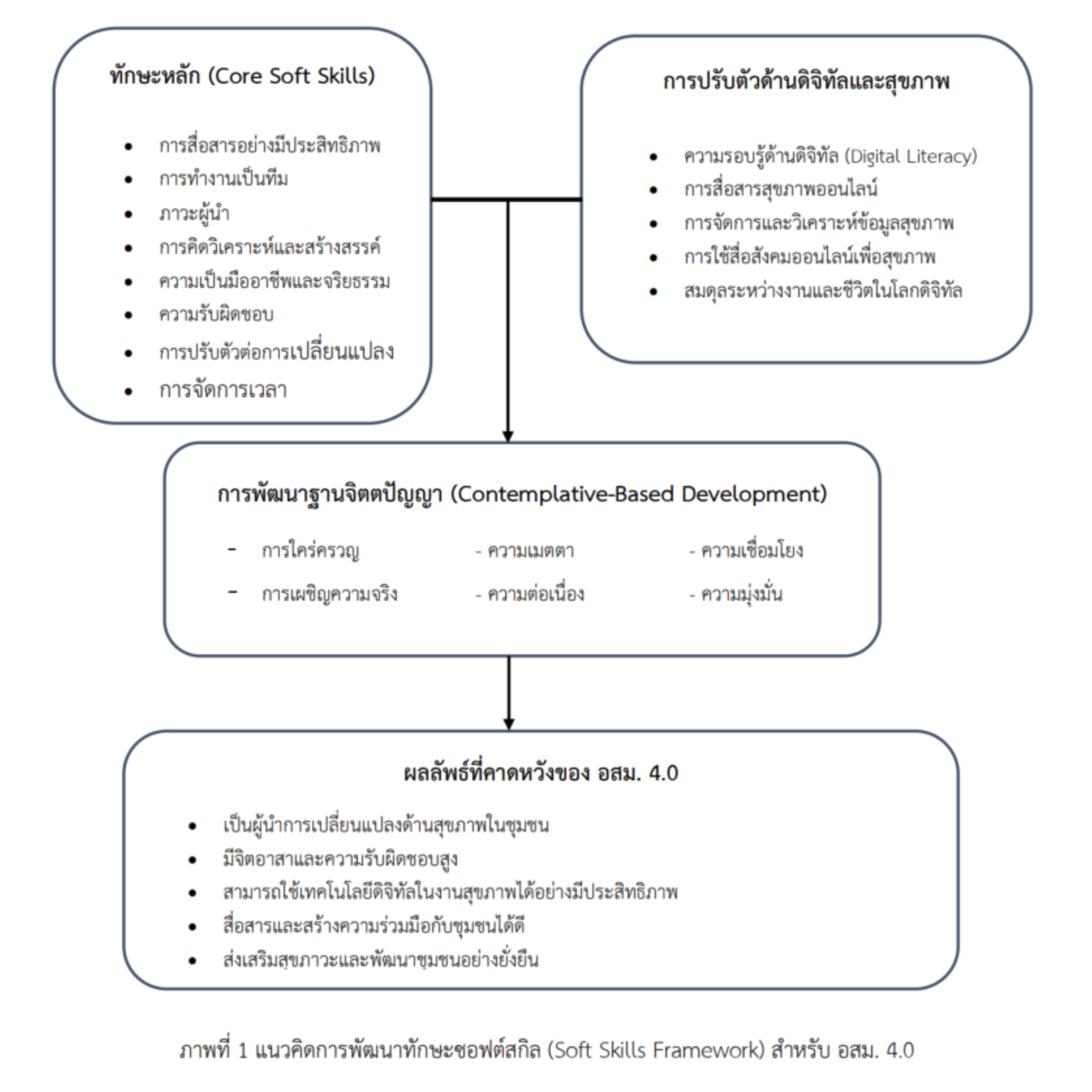
This academic article analyzes the development of soft skills in Village Health Volunteers (VHVs) 4.0, defining these skills as a key competency for enhancing health work potential in the digital age, where technology and innovation are integral to the community health service system. Employing an analytical literature review, this study synthesizes relevant research and academic documents to identify soft skills essential for adaptability, communication, and the management of local health work. The synthesis indicates that key soft skills for VHVs 4.0 comprise five main dimensions: 1) creativity and innovation for problem-solving and the appropriate use of technology; 2) strategic communication and persuasion to promote technology adoption and disseminate health knowledge; 3) effective collaboration grounded in trust, empathy, and shared leadership; 4) flexibility and adaptability to change to meet modern demands and increase work efficiency; and 5) time and personal resource management to balance community missions with self-development. Therefore, the development of VHVs 4.0 should focus on enhancing both psychosocial capital and lifelong learning to transform these soft skills into sustainable human capital. Promoting spiritual values (e.g., compassion, acceptance, and mutual assistance) will lay the foundation for a learning community capable of integrating digital technology to enhance health work effectively and sustainably.
References
Adhim M. R. F. & Suherman E. (2024). Analisis Kompetensi Karyawan Terhadap Kinerja Karyawan di Era Digital. Optimal, 4(3), 95–108. https://doi.org/10.55606/optimal.v4i3.3915
Anderson N. et al. (2014). Innovation and creativity in organizations: A state-of-the-science review, prospective commentary, and guiding framework. Journal of Management, 40(5), 1297-1333.
Frey C. B. & Osborne M. A. (2017). The future of employment: How susceptible are jobs to computerisation?. Technological Forecasting and Social Change, 114, 254–280. https://doi.org/10.1016/j.techfore.2016.08.019
International Education Specialists. (2025, January 18). Essential skills for workers in the digital age. IDP Education. https://www.idp.com/thailand/blog/soft-skill-digital-age/
Kusolsong S. & Kusolsong P. (2022). Development of Participatory Learning Management Model embedded Mental Intelligence - Mentoring System - Project-based Activity – Research-based Learning to Strengthening Soft Skills for Rajabhat University Student Teachers. Journal of Education Khon Kaen University, 45(3), 1-18.
Lamri J. & Lubart T. (2023). Reconciling hard skills and soft skills in a common framework: The generic skills component approach. Journal of Intelligence, 11(6), 107. https://doi.org/10.3390/jintelligence11060107
Obermayer N. et al. (2023). Importance of digital and soft skills in the digital age. European Conference on Knowledge Management, 24(2), 978–987. https://doi.org/10.34190/eckm.24.2.1550
OECD. (2023). OECD Skills Outlook 2023: Skills for a Resilient Green and Digital Transition. OECD Publishing. https://www.oecd.org/content/dam/oecd/en/publications/reports/2023/11/oecd-skills-outlook-2023_df859811/27452f29-en.pdf?utm_source=chatgpt.com
Puti S. et al. (2024). Knowledge, attitudes, skills, and satisfaction of village health volunteers on using community mental health support guidelines in the southern border provinces. Journal of Nursing, Midwifery and Health Sciences Research, 44(2), 63–79.
Ramos-Monge E. et al. (2023). Addressing soft skill gaps in the digital employment market: the case of Spanish students in a technology-based university. Education + Training, 65(6/7), 923–938. https://doi.org/10.1108/ET-04-2023-0165
Shah N. et al. (2023). Leading towards the students’ career development and career intentions through using multidimensional soft skills in the digital age. Education + Training, 65(6/7), 848–870. https://doi.org/10.1108/ET-12-2022-0470
Sitthichaijarumethee S. & Bubpha S. (2022). Soft skills of the administrators affecting effectiveness of medium schools under the Secondary Educational Service Area Office Nong Khai. Journal of MCU Ubon Review, 7(2), 2169-2184.
Songkhla City Municipality. (2025, January 18). Guidelines for developing the potential of public health volunteers (PHVs) 4.0. Songkhla City Municipality https://www.songkhlacity.go.th/2020/files/com_news_research/2019-11_60993e139dc0955.pdf
Suksen, A. (2022). 4 Soft Skills for The Digital Quotient. The journal of social communication innovation, 10(2), 165-173.
Thongkanta C. & Kaewtai N. (2023). Communication by Using Digital Technology for Public Health Care of Health Volunteers in Villages in the 4.0 Era, Nong Bua District, Nakhon Sawan Province. EAU Heritage Journal Science and Technology, 17(1), 30-40.
Thotet, P. (2020). A Study of the Competency Development Model for Village Health Volunteers 4.0 North Region, 2018. Journal of Human Society, 10(1), 34.44.
Uamsathit, T. (2021). The development of 'soft skills' through the actualization of the volunteer project according to the rules of contemplative education. Journal of Liberal Art of Rajamangala University of Technology Suvarnabhumi, 3(1), 37-50.
Uthai S. et al. (2025). Thailand is strengthening its public health system by enhancing the health literacy of village health volunteers. Malaysian Journal of Public Health Medicine, 25(3), 108-117.
Yuenyong P. & Samranjit S. (2024). Relationship between transformational leadership and soft skills of the director of sub-district health promotion hospital in Chachoengsao Province. Thammasat University Hospital Journal Online, 9(1), 32-44.
Downloads
Published
How to Cite
Issue
Section
License
Copyright (c) 2025 Primary Health Care Journal (Northeastern Edition)

This work is licensed under a Creative Commons Attribution-NonCommercial-NoDerivatives 4.0 International License.