EFFECTS OF AN APPLICATION OF SELF-EFFICACY PROMOTION WITH SOCIAL SUPPORT TO PROMOTE BLOOD SUGAR LEVEL REDUCTION IN THE WORKING-AGE DIABETIC RISK GROUP, KHON KAEN PROVINCE
Keywords:
Health Education, Self-Efficacy, Social Support, Health Behaviors, Prediabetic StateAbstract
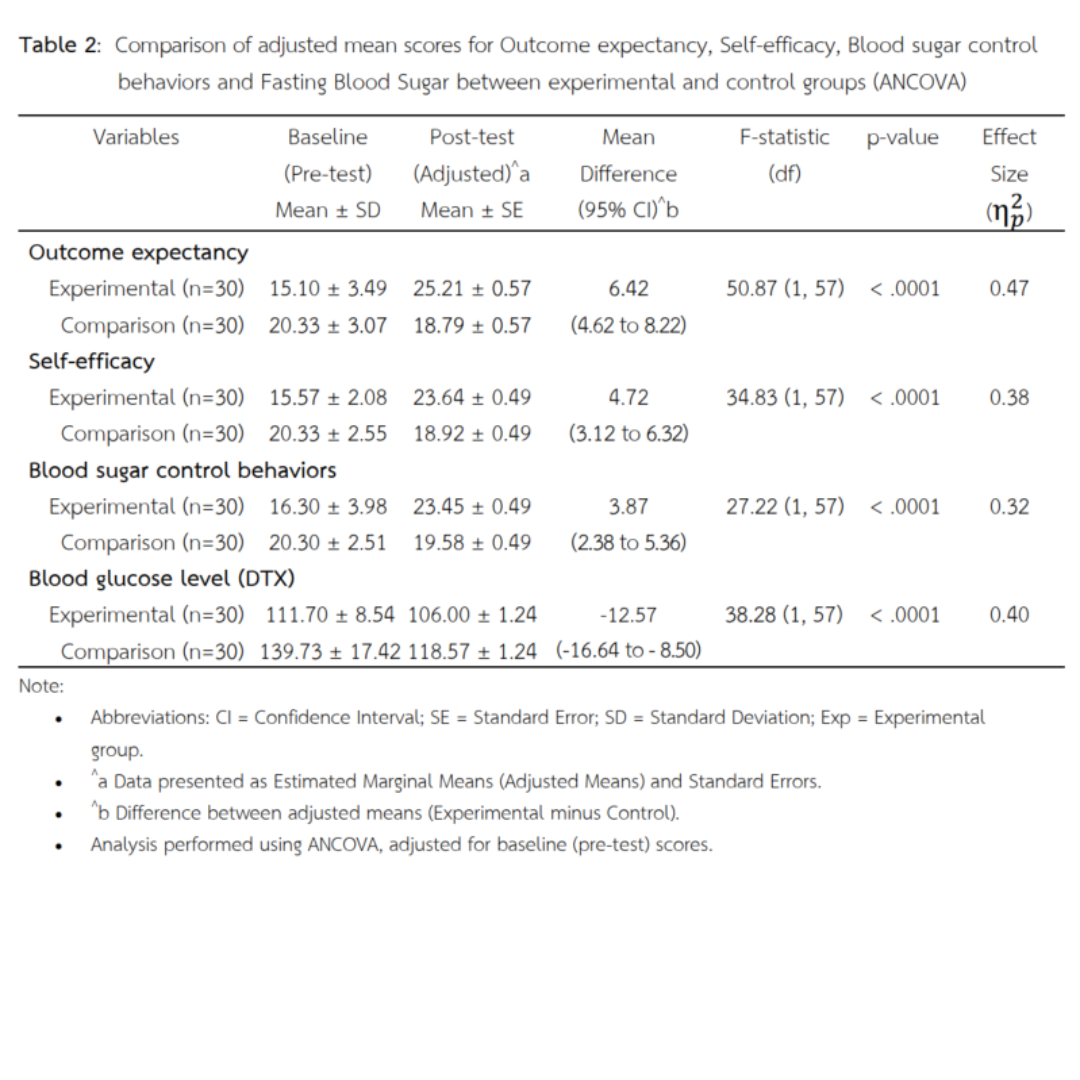
The working-age population is facing a continuously increasing risk of developing diabetes. Modifying health behaviors can effectively reduce this risk. This quasi-experimental research aimed to investigate the effects of a program applying self-efficacy enhancement combined with social support to promote blood sugar reduction among working-age individuals at risk of diabetes. The sample consisted of 60 working-age individuals at risk of diabetes, equally divided into an experimental group (n = 30) and a comparison group (n = 30). The experimental group participated in a blood sugar reduction promotion program for 10 weeks. Data were collected using questionnaires and health behavior logs. The data were analyzed using descriptive and inferential statistics, including Paired t-test and Analysis of Covariance (ANCOVA). The results revealed that after the experiment, the experimental group had significantly higher mean scores in various parameters compared to the comparison group (p < 0.001). These included outcome expectations (Mean diff. = 6.42, 95% CI: 4.62 to 8.22), perceived self-efficacy (Mean diff. = 4.72, 95% CI: 3.12 to 6.32), and blood sugar control behaviors (Mean diff. = 3.87, 95% CI: 2.38 to 5.36). Furthermore, the experimental group showed a significant reduction in blood sugar levels (Mean diff. = -12.57, 95% CI: -16.64 to -8.50). Regarding the changes in blood sugar level proportions, the experimental group exhibited a statistically significant improvement (MH = 18.54, p < 0.001). The majority (76.67%) had their blood sugar levels decrease to the normal range, while only 23.33% remained in the at-risk group. In conclusion, the applied program successfully improved the participants' blood sugar levels, allowing them to return to the normal range. Primary healthcare facilities can implement this program for individuals at risk of diabetes to further reduce their blood sugar levels.
References
Bandura, A. (1977). Social Learning Theory. Englewood Cliffs, NJ: Prentice-Hall.
Bandura, A. (1997). Self-efficacy: The exercise of control. New York: W.H. Freeman and Company.
Chirawatkul, A. (2009). Statistics for Health Science Research. Bangkok: Witthaypat.
Chouwai S. et al. (2023). The Effect of Self-efficacy Perception Enhancing Program towards Square Stepping Exercise on Exercise Behaviors with Pre-diabetes Mellitus. Christian University Journal, 30(1), 123-136.
Department of Health Service Support. (n.d.). Working professionals face an increased risk of diabetes. https://hss.moph.go.th/show_topic.php?id=115
Department of Medical Services. (2023). Diabetes: A risk factor for people who work hard. The Thai Health Promotion Foundation (ThaiHPF). https://www.thaihealth.or.th/?p=316382
Health Education Division. (2020). Operating strategies for health education and health behavior modification: Perceived self-efficacy. Nonthaburi: Department of Health Service Support, Ministry of Public Health.
House, J.S. (1981). Work stress and social support. California: Addison-Wesley.
Jittwongpan T. et al. (2019). Effects of a Self-efficacy Enhancement Program on Preventive Behaviors and Body Mass Index in People at risk of diabetes. Nursing Journal, 48(4), 243-256.
Jongklang W. & Patchasuwan N. H. (2021). The Risk Factor of Type 2 Diabetes in Working Populations, Non-Thai District Nakhon-Ratchasima Province. Research and Development Health System Journal, 14(3), 71-82.
Ministry of Public Health. (2021, March 24). The rate of new diabetes cases from the diabetes at-risk group. Healthkpi. https://healthkpi.moph.go.th/kpi2/kpi-list/view/?id=20
Ministry of Public Health. (2025, August 06). Medical and healthcare data warehouse system. Health Data Center. https://hdc.moph.go.th/center/public/standardsubcatalog
Non-Communicable Diseases Division. (2023, November 13). The Department of Disease Control is campaigning for World Diabetes Day 2023, focusing on educating the public about the risks of diabetes and how early detection can reduce serious complications. Office of Risk Communication and Health Behavior Development, Department of Disease Control. https://ddc.moph.go.th/brc/news.php?news=38403&deptcode=brc&news_views=2606
Phoonphoem P. et al. (2021). The Effectiveness of Self-Efficacy Enhancing Program on Diabetes Preventing Behaviors of the Risk Groups. UMT-Poly Journal, 18(2), 277-320.
Sandee T. et al. (2017). The Effects of Self-Efficacy Enhancement on Health Promotion Behaviors, Body Weight and Fasting Plasma Glucose Among Pre-Diabetes in the Community. Songklanagarind Journal of Nursing, 37(2), 53-66.
Thiputai P. & Limtragool P. (2019). Guideline Improvement for Health Behavior Modification to Promote Self-Efficacy of Pre-Diabetic Patients at a Community in Kalasin Province. Songklanagarind Journal of Nursing, 39(3), 123-136.
Wijaksanakul, K. (2024). Effects of Creating Participation and Social Support on Changing Diabetes Prevention Behaviors Among At-Risk Populations in the Service Area of Phia Phao Tambon Health Promoting Hospital, Kham Nam Saep Subdistrict, Warin Chamrap District, Ubon Ratchathani Province. Journal of Environmental and Community Health, 9(3), 518-527.
Downloads
Published
How to Cite
Issue
Section
License
Copyright (c) 2026 Primary Health Care Journal (Northeastern Edition)

This work is licensed under a Creative Commons Attribution-NonCommercial-NoDerivatives 4.0 International License.