ผลของโปรแกรมการประยุกต์ใช้การส่งเสริมสมรรถนะเเห่งตนร่วมกับแรงสนับสนุนทางสังคมเพื่อส่งเสริมการลดระดับน้ำตาลในเลือดของกลุ่มเสี่ยงเบาหวานวัยทำงาน จังหวัดขอนแก่น
คำสำคัญ:
โปรแกรมสุขศึกษา, การรับรู้สมรรถนะแห่งตน, แรงสนับสนุนทางสังคม, พฤติกรรมสุขภาพ, กลุ่มเสี่ยงโรคเบาหวานบทคัดย่อ
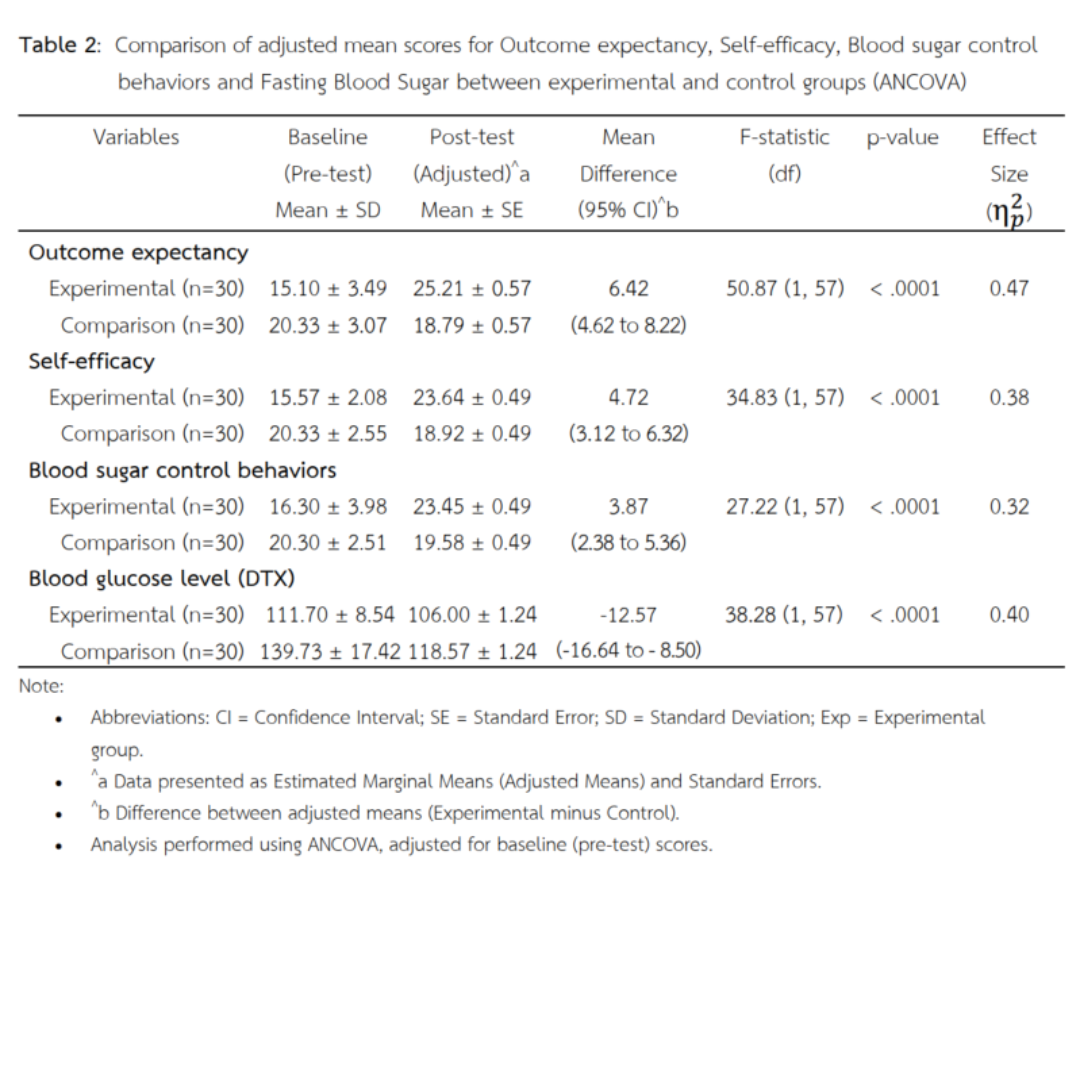
ประชากรวัยทำงานพบโอกาสเสี่ยงเป็นโรคเบาหวานเพิ่มขึ้นอย่างต่อเนื่อง หากมีการปรับเปลี่ยนพฤติกรรมสุขภาพที่ดีขึ้น จะสามารถลดโอกาสเสี่ยงต่อการเป็นโรคเบาหวาน การวิจัยกึ่งทดลองนี้มีวัตถุประสงค์เพื่อศึกษาผลของโปรแกรมการประยุกต์ใช้การส่งเสริมสมรรถนะตนร่วมกับแรงสนับสนุนทางสังคม เพื่อส่งเสริมการลดระดับน้ำตาลในเลือดของกลุ่มเสี่ยงเบาหวานในวัยทำงาน กลุ่มตัวอย่าง คือ ประชาชนวัยทำงานที่เป็นกลุ่มเสี่ยงโรคเบาหวาน จำนวน 60 คน แบ่งเป็นกลุ่มทดลองและกลุ่มเปรียบเทียบ กลุ่มละ 30 คน กลุ่มทดลองได้รับโปรแกรมส่งเสริมการลดระดับน้ำตาลในเลือด ระยะเวลา 10 สัปดาห์ เก็บรวบรวมข้อมูลด้วยแบบสอบถามและแบบบันทึกพฤติกรรมสุขภาพ วิเคราะห์ข้อมูลด้วยสถิติเชิงพรรณนาและสถิติอนุมาน ได้แก่ สถิติทดสอบทีแบบจับคู่ (Paired t-test) และการวิเคราะห์ความแปรปรวนร่วม (Analysis of Covariance: ANCOVA) ผลการวิจัยพบว่า หลังการทดลอง กลุ่มทดลองมีค่าเฉลี่ยคะแนนความคาดหวังในผลลัพธ์จากการป้องกันโรคเบาหวาน สูงกว่ากลุ่มเปรียบเทียบ อย่างมีนัยสำคัญทางสถิติ (p-value < 0.001) ได้แก่ ความคาดหวังในผลลัพธ์ (Mean diff. = 6.42, 95% CI: 4.62 to 8.22) การรับรู้สมรรถนะแห่งตน (Mean diff. = 4.72, 95% CI: 3.12 to 6.32) พฤติกรรมการควบคุมระดับน้ำตาลในเลือด (Mean diff. = 3.87, 95% CI: 2.38 to 5.36) และระดับน้ำตาลในเลือด (Mean diff. = -12.57, 95% CI: -16.64 to -8.50) ผลการเปลี่ยนแปลงสัดส่วนของระดับน้ำตาลในเลือด พบว่า กลุ่มทดลองมีสัดส่วนของระดับน้ำตาลในเลือดเปลี่ยนแปลงไปในทางที่ดีขึ้น อย่างมีนัยสำคัญทางสถิติ (MH = 18.54, p < 0.001) โดยส่วนใหญ่มีระดับน้ำตาลลดลงมาอยู่ในเกณฑ์ปกติ ร้อยละ 76.67 และอยู่ในกลุ่มเสี่ยงเพียง ร้อยละ 23.33 สรุป โปรแกรมที่นำมาประยุกต์ใช้นี้ ส่งผลให้ผู้เข้าร่วมการศึกษามีการเปลี่ยนแปลงของระดับน้ำตาลในเลือดที่ดีขึ้นและสามารถกลับเข้าสู่เกณฑ์ปกติได้ หน่วยงานบริการสุขภาพระดับปฐมภูมิสามารถนำโปรแกรมฯ ไปประยุกต์ใช้กับกลุ่มเสี่ยงโรคเบาหวานเพื่อลดระดับน้ำตาลในเลือดต่อไป
เอกสารอ้างอิง
Bandura, A. (1977). Social Learning Theory. Englewood Cliffs, NJ: Prentice-Hall.
Bandura, A. (1997). Self-efficacy: The exercise of control. New York: W.H. Freeman and Company.
Chirawatkul, A. (2009). Statistics for Health Science Research. Bangkok: Witthaypat.
Chouwai S. et al. (2023). The Effect of Self-efficacy Perception Enhancing Program towards Square Stepping Exercise on Exercise Behaviors with Pre-diabetes Mellitus. Christian University Journal, 30(1), 123-136.
Department of Health Service Support. (n.d.). Working professionals face an increased risk of diabetes. https://hss.moph.go.th/show_topic.php?id=115
Department of Medical Services. (2023). Diabetes: A risk factor for people who work hard. The Thai Health Promotion Foundation (ThaiHPF). https://www.thaihealth.or.th/?p=316382
Health Education Division. (2020). Operating strategies for health education and health behavior modification: Perceived self-efficacy. Nonthaburi: Department of Health Service Support, Ministry of Public Health.
House, J.S. (1981). Work stress and social support. California: Addison-Wesley.
Jittwongpan T. et al. (2019). Effects of a Self-efficacy Enhancement Program on Preventive Behaviors and Body Mass Index in People at risk of diabetes. Nursing Journal, 48(4), 243-256.
Jongklang W. & Patchasuwan N. H. (2021). The Risk Factor of Type 2 Diabetes in Working Populations, Non-Thai District Nakhon-Ratchasima Province. Research and Development Health System Journal, 14(3), 71-82.
Ministry of Public Health. (2021, March 24). The rate of new diabetes cases from the diabetes at-risk group. Healthkpi. https://healthkpi.moph.go.th/kpi2/kpi-list/view/?id=20
Ministry of Public Health. (2025, August 06). Medical and healthcare data warehouse system. Health Data Center. https://hdc.moph.go.th/center/public/standardsubcatalog
Non-Communicable Diseases Division. (2023, November 13). The Department of Disease Control is campaigning for World Diabetes Day 2023, focusing on educating the public about the risks of diabetes and how early detection can reduce serious complications. Office of Risk Communication and Health Behavior Development, Department of Disease Control. https://ddc.moph.go.th/brc/news.php?news=38403&deptcode=brc&news_views=2606
Phoonphoem P. et al. (2021). The Effectiveness of Self-Efficacy Enhancing Program on Diabetes Preventing Behaviors of the Risk Groups. UMT-Poly Journal, 18(2), 277-320.
Sandee T. et al. (2017). The Effects of Self-Efficacy Enhancement on Health Promotion Behaviors, Body Weight and Fasting Plasma Glucose Among Pre-Diabetes in the Community. Songklanagarind Journal of Nursing, 37(2), 53-66.
Thiputai P. & Limtragool P. (2019). Guideline Improvement for Health Behavior Modification to Promote Self-Efficacy of Pre-Diabetic Patients at a Community in Kalasin Province. Songklanagarind Journal of Nursing, 39(3), 123-136.
Wijaksanakul, K. (2024). Effects of Creating Participation and Social Support on Changing Diabetes Prevention Behaviors Among At-Risk Populations in the Service Area of Phia Phao Tambon Health Promoting Hospital, Kham Nam Saep Subdistrict, Warin Chamrap District, Ubon Ratchathani Province. Journal of Environmental and Community Health, 9(3), 518-527.
ดาวน์โหลด
เผยแพร่แล้ว
วิธีการอ้างอิง
ฉบับ
บท
การอนุญาต
ลิขสิทธิ์ (c) 2026 วารสารสาธารณสุขมูลฐาน (ภาคตะวันออกเฉียงเหนือ)

This work is licensed under a Creative Commons Attribution-NonCommercial-NoDerivatives 4.0 International License.