HEALTH IMPACT OF PEOPLE FOR CLEAN CITY POLICY MODEL CITY OF SURAT THANI MUNICIPALITY
Keywords:
Rapid Health Impact Assessment, Clean City Policy, Health Impacts, Healthy City, Surat Thani MunicipalityAbstract
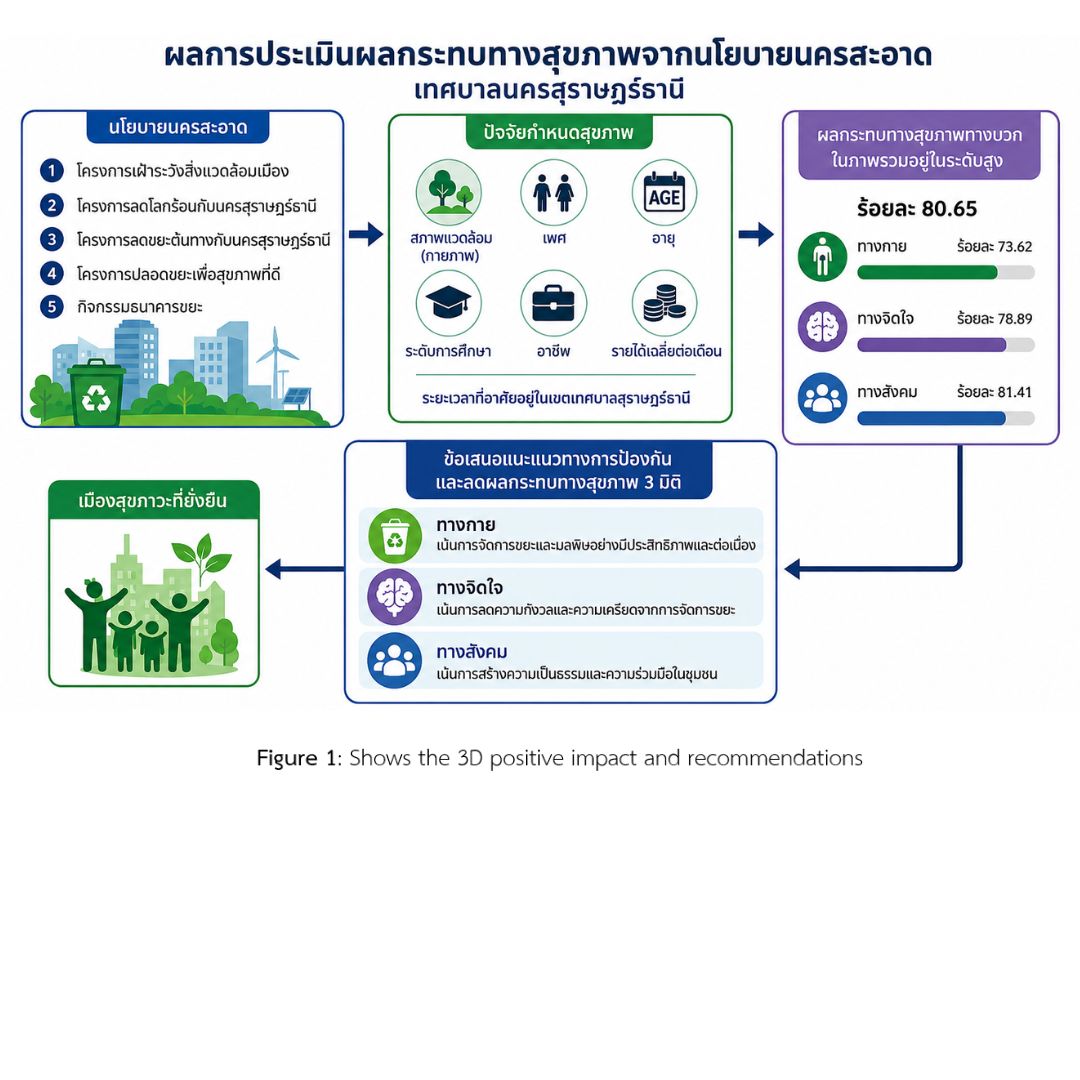
Increasing municipal solid waste has adversely affected environmental quality and the physical, mental, and social health of communities. Although Surat Thani Municipality has implemented the Clean City Policy to improve environmental quality and residents' well-being, evidence on its health impacts remains limited. This cross-sectional survey aimed to: 1) assess the physical, mental, and social health impacts of the Clean City Policy and 2) identify recommendations for promoting health and mitigating its potential impacts. A total of 398 residents, representing one individual from each household, were selected using multistage random sampling. Data were collected using a researcher-developed questionnaire with satisfactory content validity (IOC = 0.67–1.00) and excellent reliability (Cronbach's alpha = 0.95). Descriptive statistics and content analysis were employed. The findings indicated that most participants perceived positive health impacts at a high level in the physical (73.62%), mental (78.89%), and social (81.41%) dimensions, with an overall positive health impact of 80.65%. Key recommendations include strengthening sustainable waste and environmental management, promoting community participation, expanding health-promoting public spaces, and implementing appropriate environmental regulations to sustain positive health outcomes and support the development of a sustainable healthy city.
References
Best J. W. & Kahn J. V. (1977). Research in education (4th ed.). Englewood Cliffs, NJ: Prentice Hall.
Department of Health, Ministry of Public Health. (2013, September 10). Guidelines for applying health impact assessment at the local level. https://hia.anamai.moph.go.th/web-upload.../file_download/7df7a3597934e67f70d1d87dd82fbae2.pdf
Expenditure Budget Ordinance. (2025). Expenditure budget ordinance 2025. Surat Thani Municipality.
Khumthong C. & Juntu W. (2021). Effect of health education program applied disease prevention and social support motivation on the behavior of prevention of complications from chronic NCDs in the elderly with chronic non-communicable diseases in the area of Muang Surin District, Surin Province. Journal of Nursing and Health Care, 39(1), 39–48.
Local Government Organization of Surat Thani City. (2021, August 10). Policy statement to the Surat Thani City Council: Sustainable development with nine model cities. https://www.suratcity.go.th/web/index.php/th/content_page/item/8240-art-policy-of-mayor-64-th
Local Registration Office, Surat Thani Municipality. (2024). Household registration data as of September 2024. Surat Thani, Thailand.
National Health Commission Office of Thailand. (2021, August 10). Announcement on criteria and methods for assessing health impacts arising from public policy, B.E. 2564 (2021). https://www.nationalhealth.or.th/th/node/3581
OECD. (2019). Social cohesion and environmental governance. Paris, France: Organisation for Economic Co-operation and Development.
Pender, N. J. (2015). Health promotion model. New York, NY: Springer Publishing.
Pollution Control Department. (2023). Environmental statistics: Municipal solid waste report. Bangkok, Thailand: Ministry of Natural Resources and Environment.
Public Health Act B.E. 2535 (1992, March 29). Royal Gazette, 109(38), 1–62.
Supapak B. & Prawit K. (2024). Rapid health impact assessment: A tool for the development of public health–concerned policies. Journal of Health Science of Thailand, 6(3), 28.
UN-Habitat. (2020). Environmental confidence and well-being in urban settings. Nairobi, Kenya: United Nations Human Settlements Programmer.
World Health Organization (WHO). (2015). Healthy environments for healthier populations. Geneva, Switzerland: World Health Organization.
World Health Organization (WHO). (2021). Green space and mental well-being: Evidence and policy guidance. Geneva, Switzerland: World Health Organization.
Yamane, T. (1973). Statistics: An introductory analysis (2nd ed.). New York, NY: Harper & Row.
Downloads
Published
How to Cite
Issue
Section
License
Copyright (c) 2026 Primary Health Care Journal (Northeastern Edition)

This work is licensed under a Creative Commons Attribution-NonCommercial-NoDerivatives 4.0 International License.