ผลกระทบทางสุขภาพของประชาชนจากนโยบายนครสะอาด เทศบาลนครสุราษฎร์ธานี
คำสำคัญ:
การประเมินผลกระทบทางสุขภาพแบบเร่งด่วน, นโยบายนครสะอาด, ผลกระทบทางสุขภาพ, เมืองสุขภาพดี, เทศบาลนครสุราษฎร์ธานีบทคัดย่อ
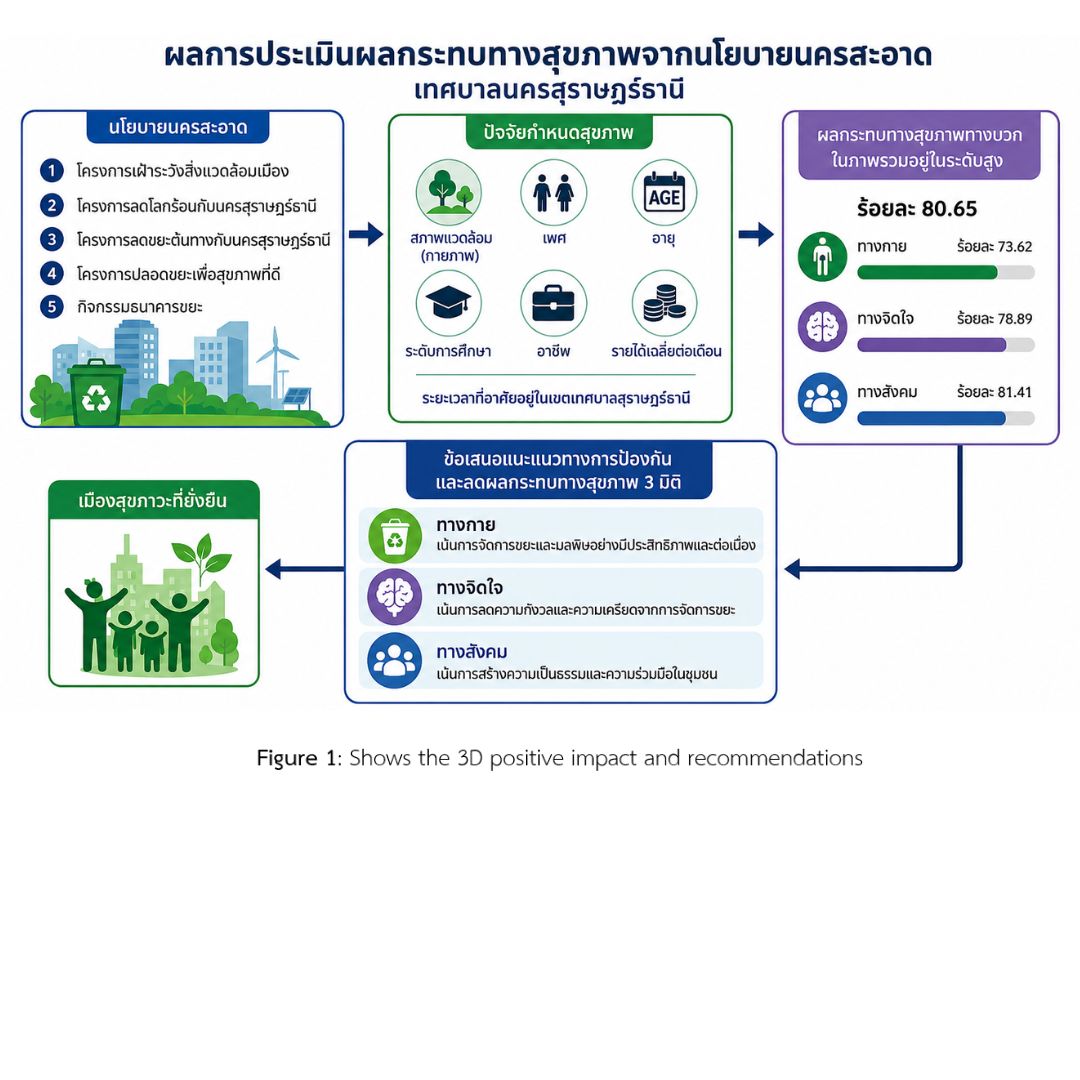
ปัญหาขยะมูลฝอยที่เพิ่มขึ้นส่งผลกระทบต่อสิ่งแวดล้อมและสุขภาพของประชาชนทั้งด้านร่างกาย จิตใจ และสังคม แม้เทศบาลนครสุราษฎร์ธานีได้ดำเนินนโยบายนครสะอาดเพื่อยกระดับคุณภาพสิ่งแวดล้อมและคุณภาพชีวิตของประชาชน แต่ยังขาดการประเมินผลกระทบทางสุขภาพอย่างเป็นระบบเพื่อใช้สนับสนุนการตัดสินใจเชิงนโยบาย รูปแบบการวิจัยเชิงสำรวจแบบภาคตัดขวางนี้ มีวัตถุประสงค์เพื่อ 1) ประเมินผลกระทบทางสุขภาพด้านร่างกาย จิตใจ และสังคมของประชาชนจากนโยบายนครสะอาด และ 2) ศึกษาข้อเสนอแนะและแนวทางการส่งเสริม ป้องกัน และลดผลกระทบทางสุขภาพจากนโยบายนครสะอาด กลุ่มตัวอย่างคือ ประชาชนที่อาศัยอยู่ในเทศบาลนครสุราษฎร์ธานี (ตัวแทนครัวเรือนละ 1 คน) จำนวน 398 คน คัดเลือกด้วยวิธีการสุ่มแบบหลายขั้นตอน เครื่องมือที่ใช้คือ แบบสอบถามที่ผ่านการตรวจสอบความตรงเชิงเนื้อหา (IOC = 0.67–1.00) และมีค่าความเชื่อมั่นทั้งฉบับเท่ากับ 0.95 เก็บรวบรวมข้อมูล ระหว่างเดือนตุลาคม พ.ศ. 2567 ถึงกันยายน พ.ศ. 2568 วิเคราะห์ข้อมูลด้วยสถิติเชิงพรรณนาและการวิเคราะห์เชิงเนื้อหา ผลการวิจัยพบว่า ประชาชนส่วนใหญ่ได้รับผลกระทบทางสุขภาพเชิงบวกในระดับสูง ทั้งด้านร่างกาย (ร้อยละ 73.62) ด้านจิตใจ (ร้อยละ 78.89) และด้านสังคม (ร้อยละ 81.41) ส่งผลให้ผลกระทบทางสุขภาพโดยรวมอยู่ในระดับสูง (ร้อยละ 80.65) ข้อเสนอแนะสำคัญ ได้แก่ การพัฒนาระบบจัดการขยะและสิ่งแวดล้อมอย่างต่อเนื่อง การส่งเสริมการมีส่วนร่วมของประชาชน การสร้างพื้นที่สุขภาวะ และการบังคับใช้มาตรการด้านสิ่งแวดล้อมอย่างเหมาะสม เพื่อธำรงรักษาผลกระทบเชิงบวกและสนับสนุนการพัฒนาเมืองสุขภาวะอย่างยั่งยืน
เอกสารอ้างอิง
Best J. W. & Kahn J. V. (1977). Research in education (4th ed.). Englewood Cliffs, NJ: Prentice Hall.
Department of Health, Ministry of Public Health. (2013, September 10). Guidelines for applying health impact assessment at the local level. https://hia.anamai.moph.go.th/web-upload.../file_download/7df7a3597934e67f70d1d87dd82fbae2.pdf
Expenditure Budget Ordinance. (2025). Expenditure budget ordinance 2025. Surat Thani Municipality.
Khumthong C. & Juntu W. (2021). Effect of health education program applied disease prevention and social support motivation on the behavior of prevention of complications from chronic NCDs in the elderly with chronic non-communicable diseases in the area of Muang Surin District, Surin Province. Journal of Nursing and Health Care, 39(1), 39–48.
Local Government Organization of Surat Thani City. (2021, August 10). Policy statement to the Surat Thani City Council: Sustainable development with nine model cities. https://www.suratcity.go.th/web/index.php/th/content_page/item/8240-art-policy-of-mayor-64-th
Local Registration Office, Surat Thani Municipality. (2024). Household registration data as of September 2024. Surat Thani, Thailand.
National Health Commission Office of Thailand. (2021, August 10). Announcement on criteria and methods for assessing health impacts arising from public policy, B.E. 2564 (2021). https://www.nationalhealth.or.th/th/node/3581
OECD. (2019). Social cohesion and environmental governance. Paris, France: Organisation for Economic Co-operation and Development.
Pender, N. J. (2015). Health promotion model. New York, NY: Springer Publishing.
Pollution Control Department. (2023). Environmental statistics: Municipal solid waste report. Bangkok, Thailand: Ministry of Natural Resources and Environment.
Public Health Act B.E. 2535 (1992, March 29). Royal Gazette, 109(38), 1–62.
Supapak B. & Prawit K. (2024). Rapid health impact assessment: A tool for the development of public health–concerned policies. Journal of Health Science of Thailand, 6(3), 28.
UN-Habitat. (2020). Environmental confidence and well-being in urban settings. Nairobi, Kenya: United Nations Human Settlements Programmer.
World Health Organization (WHO). (2015). Healthy environments for healthier populations. Geneva, Switzerland: World Health Organization.
World Health Organization (WHO). (2021). Green space and mental well-being: Evidence and policy guidance. Geneva, Switzerland: World Health Organization.
Yamane, T. (1973). Statistics: An introductory analysis (2nd ed.). New York, NY: Harper & Row.
ดาวน์โหลด
เผยแพร่แล้ว
วิธีการอ้างอิง
ฉบับ
บท
การอนุญาต
ลิขสิทธิ์ (c) 2026 วารสารสาธารณสุขมูลฐาน (ภาคตะวันออกเฉียงเหนือ)

This work is licensed under a Creative Commons Attribution-NonCommercial-NoDerivatives 4.0 International License.