DEVELOPMENT OF A PARTICIPATORY MODEL FOR TUBERCULOSIS SURVEILLANCE, PREVENTION AND CONTROL IN ANG THONG PROVINCE
Keywords:
Tuberculosis, Community-based Surveillance and Control, Participatory Action Research, Directly Observed Treatment (DOT), StigmaAbstract
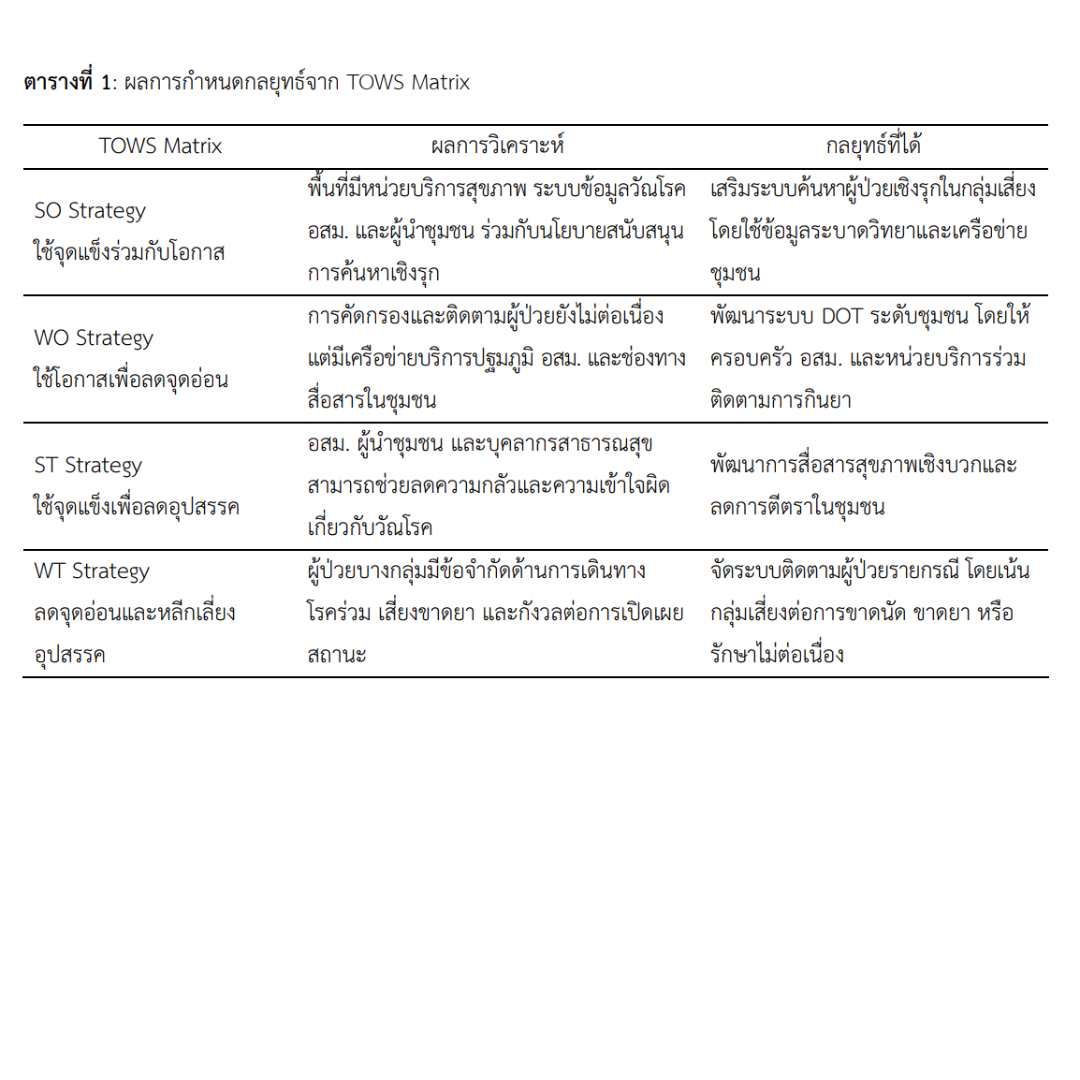
This participatory action research aimed to develop and evaluate a community-based tuberculosis (TB) surveillance, prevention, and control model in Ang Thong province. Guided by the PRECEDE-PROCEED framework (April-November 2025), the study involved five phases: assessment, strategy development, implementation, evaluation, and reflection. Participants across phases included 37 informants and 436 residents (assessment); 40 stakeholders (development); 55 patients, 55 family members, and 32 volunteers (implementation/evaluation); and 53 stakeholders (reflection). Data collected via secondary records, questionnaires, interviews, and logs were analyzed using descriptive statistics, paired t-tests, and content analysis. Assessment revealed incomplete screening, overreliance on personnel, discontinuous data linkage, and stigma hindering access. This led to three strategies: risk-stratified active case finding, community-based Directly Observed Treatment (DOT), and stigma reduction via positive communication. Short-term outcomes showed 85.00% of personnel and volunteers trained, 95.00% of at-risk groups screened, 88.60% of patients having DOT observers, and 91.20% medication adherence. Risk perception and treatment access scores increased significantly, while stigma scores decreased significantly. The model effectively integrated health services with community mechanisms. Long-term post-treatment monitoring is recommended to assess sustainability and success rates.
References
Aitambayeva N. et al. (2025). A systematic review of tuberculosis stigma reduction interventions. Healthcare, 13(15), 1846. https://doi.org/10.3390/healthcare13151846
Alinaitwe B. et al. (2025). Treatment adherence and its association with family support among pulmonary tuberculosis patients in Jinja, Eastern Uganda. Scientific Reports, 15(2025), 11150. https://doi.org/10.1038/s41598-025-96260-8
Ang Thong Provincial Public Health Office. (2024). Ang Thong Province Tuberculosis Situation Report, Fiscal Year 2023. Ang Thong: Ang Thong Provincial Public Health Office.
Craig G. M. et al. (2017). Tuberculosis stigma as a social determinant of health. International Journal of Infectious Diseases, 56, 90–100. https://doi.org/10.1016/j.ijid.2016.10.011
Davis R. A. et al. (2024). Examining interventions that aim to enhance TB treatment adherence in Southeast Asia: A systematic review and meta-analysis. Indian Journal of Tuberculosis, 71(1), 48–63. https://doi.org/10.1016/j.ijtb.2023.03.001
Department of Disease Control. (2023). National Tuberculosis Strategic Plan B.E. 2564–2569 (2021–2026). Ministry of Public Health.
Green L. W. & Kreuter M. W. (2005). Health program planning: An educational and ecological approach (4th ed.). McGraw-Hill.
Khan M. S. et al. (2022). Community-based interventions for tuberculosis control. International Journal of Tuberculosis and Lung Disease, 26(5), 420–429.
Kranzer K. et al. (2013). The benefits to communities and individuals of screening for active tuberculosis disease: A systematic review. The International Journal of Tuberculosis and Lung Disease, 17(4), 432–446.
MacNeil A. et al. (2020). Global epidemiology of tuberculosis. Lancet Infectious Diseases, 20(11), e325–e336.
Sommerland N. et al. (2017). Evidence-based interventions to reduce tuberculosis stigma: A systematic review. International Journal of Tuberculosis and Lung Disease, 21(11), 81–86. https://doi.org/10.5588/ijtld.16.0788
Sulistyorini D. et al. (2023). Tuberculosis stigma: Mapping research themes and future directions. Social Science & Medicine, 322, 115758.
Wallerstein N. & Duran B. (2010). Community-based participatory research contributions to intervention research: the intersection of science and practice to improve health equity. Am J Public Health, 1(1), S40-46. https://doi.org/10.2105/AJPH. 2009.184036.
World Health Organization. (2024a). Global tuberculosis report 2024. World Health Organization. https://www.who.int/teams/global-programme-on-tuberculosis-and-lung-health/tb-reports/global-tuberculosis-report-2024
World Health Organization. (2024b). WHO operational handbook on tuberculosis: Module 4: Treatment: Tuberculosis care and support. World Health Organization. https://iris.who.int/handle/10665/376743
Downloads
Published
How to Cite
Issue
Section
License
Copyright (c) 2026 Primary Health Care Journal (Northeastern Edition)

This work is licensed under a Creative Commons Attribution-NonCommercial-NoDerivatives 4.0 International License.