ปัจจัยที่มีความสัมพันธ์กับพฤติกรรมการบริโภคอาหารเช้าของนักเรียนมัธยมศึกษาตอนปลายของโรงเรียนศรีสงครามวิทยาในจังหวัดเลย
คำสำคัญ:
พฤติกรรมการบริโภคอาหารเช้า, ปัจจัยที่มีความสัมพันธ์, นักเรียนมัธยมศึกษาตอนปลาย, โภชนาการวัยรุ่นบทคัดย่อ
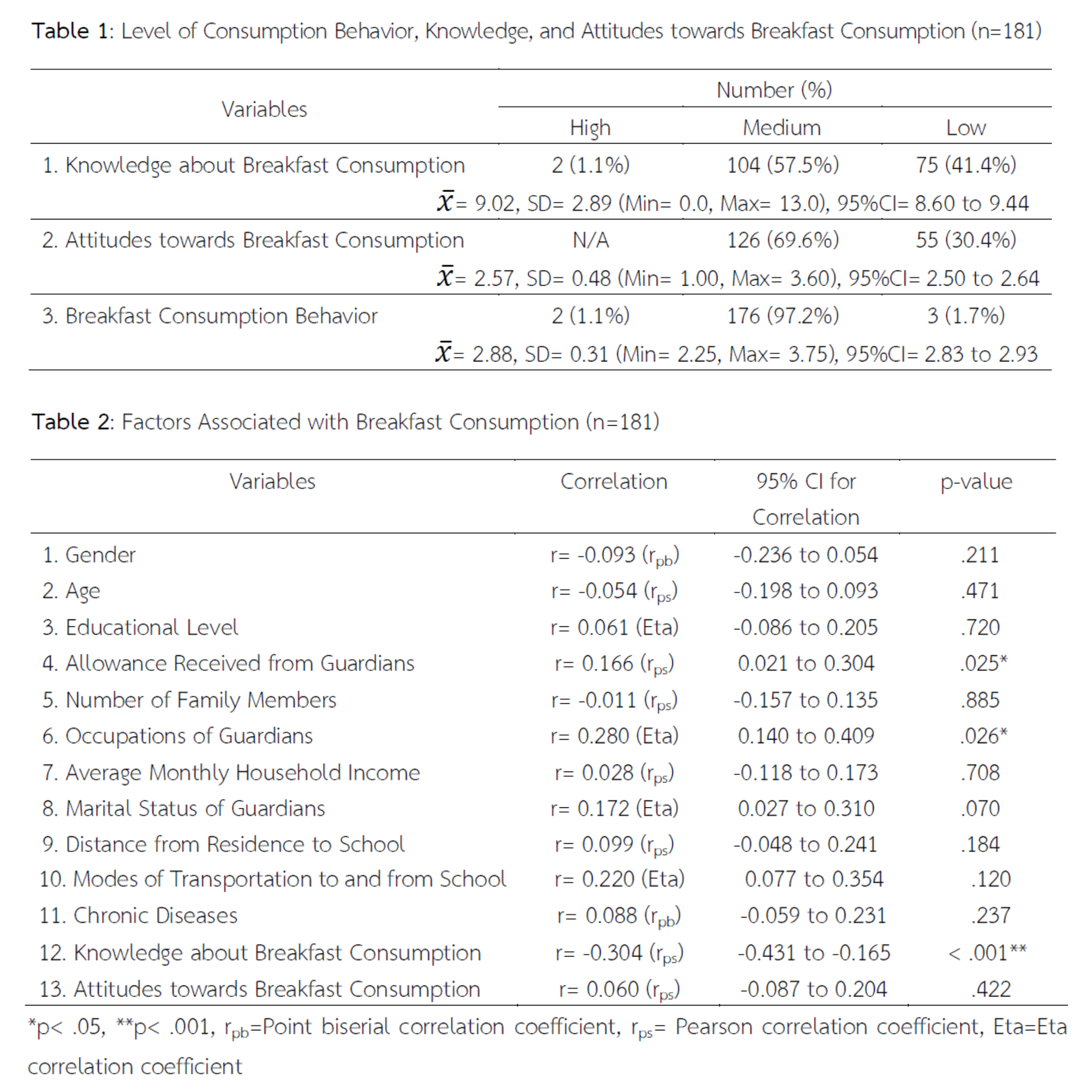
อาหารเช้าเป็นมื้อที่สำคัญ เนื่องจากร่างกายต้องการสารอาหารและพลังไปเลี้ยงส่วนต่าง ๆ ของร่างกายและสมอง หากนักเรียนไม่ได้รับประทานอาหารเช้า อาจทำให้ร่างกายได้รับสารอาหารและพลังงานไม่เพียงพอ ส่งผลให้ร่างกายอ่อนเพลีย เคลื่อนไหวร่างกายไม่กระฉับกระเฉง และไม่มีสมาธิในการเรียน การศึกษาเชิงวิเคราะห์แบบภาคตัดขวางนี้ มีวัตถุประสงค์เพื่อศึกษาปัจจัยที่มีความสัมพันธ์กับพฤติกรรมการบริโภคอาหารเช้าของนักเรียนมัธยมศึกษาตอนปลายของโรงเรียนศรีสงครามวิทยาในจังหวัดเลย กลุ่มตัวอย่าง จำนวน 181 คน โดยวิธีการสุ่มแบบง่าย เก็บข้อมูลโดยใช้แบบสอบถาม มีค่า IOC ระหว่าง 0.67-1.00 และค่าความเชื่อมั่น 0.85 วิเคราะห์ข้อมูลด้วยสถิติเชิงพรรณนา ได้แก่ ร้อยละ ค่าเฉลี่ย และส่วนเบี่ยงเบนมาตรฐาน สถิติเชิงอนุมาน ได้แก่ สถิติสัมประสิทธิ์สหสัมพันธ์แบบพอยท์ไบซีเรียล, อีต้า และเพียร์สัน ผลการศึกษาพบว่า กลุ่มตัวอย่างส่วนใหญ่มีความรู้เกี่ยวกับการบริโภคอาหารเช้าระดับปานกลาง ร้อยละ 57.5 (Mean=9.02, SD=2.89) ทัศนคติต่อการบริโภคอาหาเช้าระดับปานกลาง ร้อยละ 69.6 (Mean=2.57, SD=0.48) พฤติกรรมบริโภคเช้าระดับปานกลาง ร้อยละ 97.2 (Mean=2.88, SD=0.31) ปัจจัยที่มีความสัมพันธ์กับพฤติกรรมการบริโภคอาหารเช้า ได้แก่ รายได้ที่ได้รับจากผู้ปกครอง (r=0.166, p= .025) อาชีพของผู้ปกครอง (r=0.280, p=0.026) น้ำหนักตามเกณฑ์อายุ (r=0.424, p= .024) และความรู้เกี่ยวกับการบริโภคอาหาร (r=-0.304, p< .001) สรุป ปัจจัยด้านรายได้ที่รับจากผู้ปกครอง อาชีพของผู้ปกครอง น้ำหนักตามเกณฑ์อายุ มีความสัมพันธ์เชิงบวกกับพฤติกรรมการบริโภคอาหารเช้า ขณะที่ความรู้เกี่ยวกับการบริโภคอาหารเช้ามีความสัมพันธ์เชิงลบ ดังนั้น ควรส่งเสริมความรู้ด้านอาหารและโภชนาการ ควบคู่กับการสร้างเจตคติที่ดี และสนับสนุนโครงการอาหารเช้าเพื่อสุขภาพที่ดีของนักเรียน
เอกสารอ้างอิง
Best J.W. & Kahn J.V. (2006). Research in education (10th ed.). Pearson Education Inc.
Bloom B.S. et al. (1971). Handbook on formative and summative evaluation of student learning. New York: McGraw-Hill.
Chaimongkol L. et al. (2021). Breakfast skipping in school children: A case study of schools in municipality and non-municipality area of Muang, Pattani Province. Journal of Nutrition Association of Thailand, 56(2), 36–49.
Chaiwut Y. et al. (2021). Factors associated with junk food consumption among Department of Community Health students in University in the Northern. UBRU Journal for Public Health Research, 10(2), 15-25.
Daniel, W.W. (2013). Biostatistics: A Foundation for Analysis in the Health Sciences. John Wiley & Sons.
Deejuthamanee R. et al. (2022). Breakfast consumption behavior among secondary school students in Bangkok. Thai Journal of Public Health, 52(1), 30–43.
Department of Health, Ministry of Public Health, Thailand. (2019). Breakfast is an important meal and shouldn't be overlooked. https://multimedia.anamai.moph.go.th/help-knowledgs/breakfast/
Liu Y. et al. (2021). Relationship between nutritional status and breakfast behaviors of rural primary and middle school students in a minority area of a city in Guizhou Province in 2019. Wei Sheng Yan Jiu, 50(4), 552–557.
Maumeng N. & Yoncharoenlump P. (2017). Nutritional status and dietary behavior of school children in diamond level health promotion school, Regional Health Promotion Center 2 Phitsanulok. Lanna Journal of Health Promotion & Environmental Health, 7(1), 67–74.
Mungvongsa A. & Khangwa K. (2020). Factors Related to Food consumption behavior of senior high school students in Watjuntrawart (Sukprasarnrat) School, Phetchaburi Province. Hua Hin Medical Journal, 5(1), 1-17.
Nithitantiwat P. & Udomsapaya W. (2017). Food Consumption Behavior among Thai Adolescents, Impacts, and Solutions. Journal of Phrapokklao Nursing College, Chanthaburi, 28(1), 122-128.
Panchaiyapum N. & Uttamavatin P. (2021). Food preference behaviors of high school students at Waengnoi Suksa School, Khon Kaen Province. KKU Journal for Public Health Research, 14(1), 49–56.
Rattanayoung T. et al. (2019). Consumption behaviors, overweight, and obesity among senior high school students in Nakhon Pathom Province. Journal of Nursing, Public Health, and Education, 20(3), 132–143.
Ruangying J. et al. (2016). Food consumption behavior of adolescents in Songkhla Province: Synthesis of literacy and factors influencing food consumption behavior. Journal of Liberal Arts, Prince of Songkla University, 8(1), 245–264.
Srisongkram Wittaya School, Thailand. (2020). Self-assessment report of the educational institution for the academic year 2020. http://www.srisongkram.ac.th
Sukrod, S. (2015). A study of the relation between food consumption, exercise habits, and obesity of students from Srinakharinwirot University Prasarnmit Demonstration School (Secondary). Srinakharinwirot Research and Development (Journal of Humanities and Social Sciences), 7(13), 200–210.
Suwan K. et al. (2021). Factors associated with Food Consumption Behaviors in Overweight Secondary School Students in Mueang District, Yala Province. Lanna Public Health Journal, 17(1), 40-51
Tritipsombut J. et al. (2020). Relationships between knowledge, attitude, and dietary behavior among the overweight and obese students in Elementary School. Journal of the Office DPC 7 Khon Kaen, 27(2), 92–100.
Wanprayoon R. et al. (2023). Factors Related to Breakfast Consumption Behavior of High school Student in the Lower Northern Region. Journal of Science and Technology Northern, 4(2), 13-28.
Wongwiriya S. et al. (2019). Factors associated with food consumption behaviors among high school students in Namdibwittayakom School, Pasang District, Lamphun Province. Journal of Public Health and Health Sciences Research, 1(2), 45–54
ดาวน์โหลด
เผยแพร่แล้ว
วิธีการอ้างอิง
ฉบับ
บท
การอนุญาต
ลิขสิทธิ์ (c) 2025 วารสารสาธารณสุขมูลฐาน (ภาคตะวันออกเฉียงเหนือ)

This work is licensed under a Creative Commons Attribution-NonCommercial-NoDerivatives 4.0 International License.