ผลของการประยุกต์ใช้ทฤษฎีการรับรู้สมรรถนะแห่งตนร่วมกับการมีสติเพื่อลดระดับความเครียดในนักศึกษาระดับปริญญาตรีด้วยโปรแกรม "ตั้งสติ ตัด Stress"
คำสำคัญ:
ความเครียด, การมีสติ, สุขภาพจิต, การรับรู้สมรรถนะแห่งตน, โปรแกรมส่งเสริมสุขศึกษาบทคัดย่อ
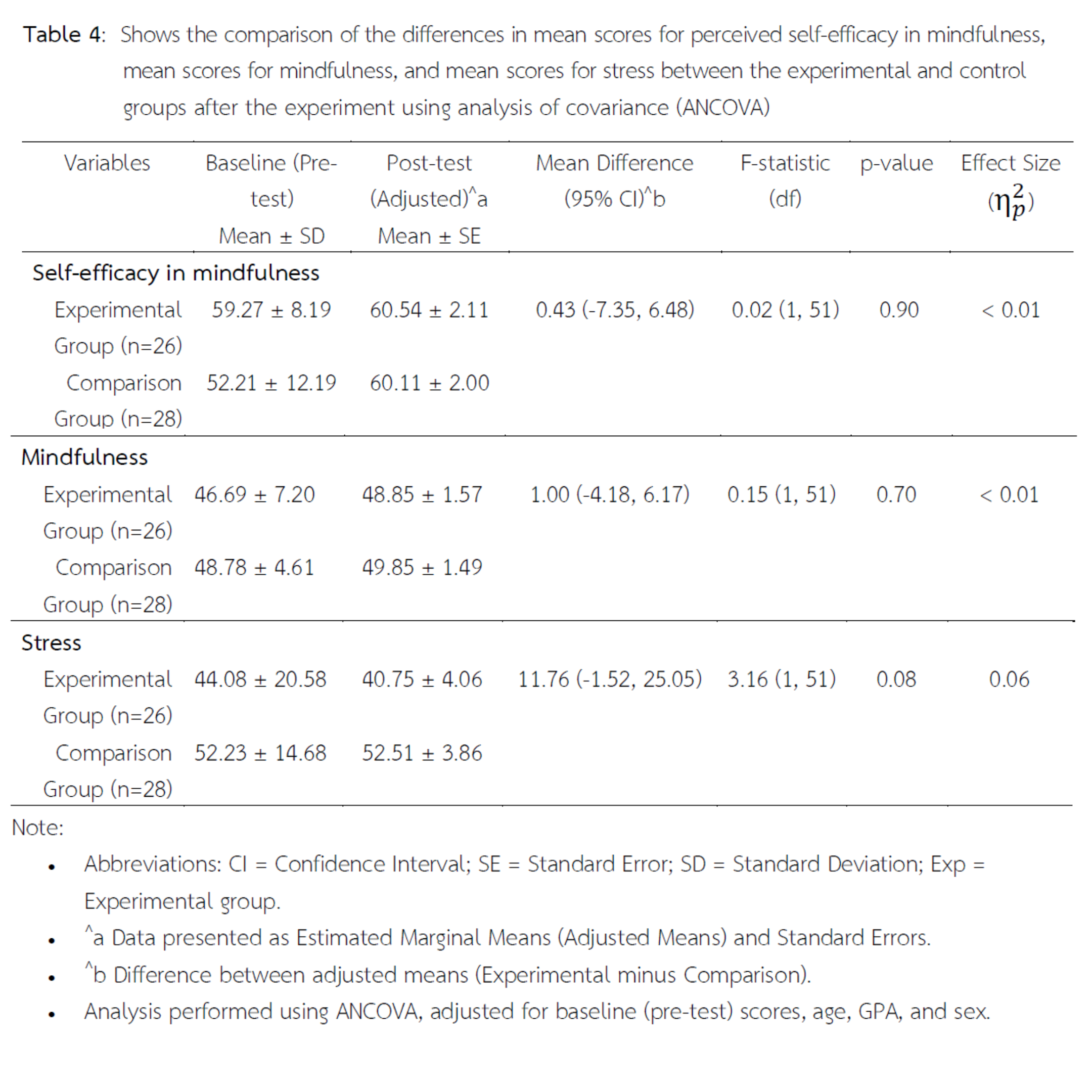
ปัญหาสุขภาพจิตเป็นปัญหาที่แพร่หลายทั่วโลก โดยเฉพาะในกลุ่มช่วงอายุ 18–25 ปี ซึ่งเป็นช่วงวัยของนักศึกษาระดับปริญญาตรี การวิจัยนี้มีวัตถุประสงค์เพื่อศึกษาผลของการประยุกต์ใช้ทฤษฎีการรับรู้สมรรถนะแห่งตนร่วมกับการฝึกสติ เพื่อลดระดับความเครียดในนักศึกษาระดับปริญญาตรีผ่านโปรแกรม "ตั้งสติ ตัด Stress" กลุ่มตัวอย่างเป็นนักศึกษาจำนวน 54 คน แบ่งเป็นกลุ่มทดลอง 26 คน และกลุ่มเปรียบเทียบ 28 คน โดยกลุ่มทดลองเข้าร่วมกิจกรรมตามองค์ประกอบของทฤษฎี การรับรู้สมรรถนะแห่งตนเป็นระยะเวลา 10 สัปดาห์ มีการเก็บข้อมูลระดับการรับรู้สมรรถนะแห่งตนในการรู้สติ ระดับการมีสติ และระดับความเครียด วิเคราะห์ข้อมูล ด้วยสถิติการวิเคราะห์ความแปรปรวนร่วม (ANCOVA) เพื่อเปรียบเทียบความแตกต่างระหว่างกลุ่ม โดยควบคุมค่าคะแนนก่อนการทดลองและเกรดเฉลี่ยสะสมเป็นตัวแปรร่วม กำหนดระดับนัยสำคัญทางสถิติที่ 0.05 ผลการวิจัยพบว่า เมื่อควบคุมคะแนนก่อนการทดลองและเกรดเฉลี่ยสะสมแล้ว คะแนนเฉลี่ยที่ปรับแก้ของการรับรู้สมรรถนะแห่งตนในการรู้สติ (F (1, 51) = 0.02, p = 0.90) การมีสติ (F (1, 51) = 0.15, p = 0.70) และความเครียด (F (1, 51) = 3.16, p = 0.08) ระหว่างกลุ่มทดลองและกลุ่มเปรียบเทียบไม่แตกต่างกันอย่างมีนัยสำคัญทางสถิติ ผลการศึกษาชี้ให้เห็นว่า โปรแกรม “ตั้งสติ ตัด Stress” ในรูปแบบระยะสั้นยังไม่แสดงผลเชิงประจักษ์ต่อการเปลี่ยนแปลงระดับการรับรู้สมรรถนะแห่งตนในการรู้สติ ระดับสติและระดับความเครียดของนักศึกษาปริญญาตรีอย่างมีนัยสำคัญ อย่างไรก็ตามแนวคิดการบูรณาการทฤษฎีการรับรู้สมรรถนะแห่งตนร่วมกับการฝึกสติยังคงมีศักยภาพในการพัฒนาโปรแกรมส่งเสริมสุขภาพจิตในบริบทสถาบันการศึกษา โดยอาจจำเป็นต้องเพิ่มระยะเวลา ความถี่ และความเข้มข้นของการฝึกเพื่อให้เกิดผลลัพธ์ที่ชัดเจนยิ่งขึ้นในอนาคต
เอกสารอ้างอิง
Alkhawaldeh A. et al. (2023). Stress Factors, Stress Levels, and Coping Mechanisms among University Students. The Scientific World Journal, 2023, 2026971. https://doi.org/10.1155/2023/2026971
American Psychological Association. (2018). Stress. Dictionary of Psychology. American Psychological Association. https://dictionary.apa.org/stress
American Psychological Association. (2023, November 15). Self-efficacy. Dictionary of Psychology. American Psychological Association. https://dictionary.apa.org/self-efficacy
Angkapanichkit J. & Rochanahastin A. (2021). Depression Situation for Thai University Students. Suranaree Journal of Social Science, 15(1), 61–86.
Antony A. & Prasad C. V. (2023). Effectiveness Of Mindfulness Meditation on Depression, Anxiety, and Stress among Undergraduate Nursing Students: A Quasi-experimental Study. Journal of Clinical and Diagnostic Research, 17(10), VC01-VC05. https://doi.org/10.7860/JCDR/2023/62873.18548
Baer R. A. et al. (2012). Weekly Change in Mindfulness and Perceived Stress in a Mindfulness-Based Stress Reduction Program. Journal of Clinical Psychology, 68(7), 755–765. https://doi.org/10.1002/jclp.21865
Bandura, A. (1977). Self-efficacy: Toward a unifying theory of behavioral change. Psychological Review, 84(2), 191–215. https://doi.org/10.1037/0033-295X.84.2.191
Bandura, A. (1997). Self-efficacy: The exercise of control. W H Freeman/Times Books/Henry Holt & Co.
Best, J.W. (1981). Research in Education. New Jersey: Prentice-Hall.
Bhochhibhoya A. et al. (2024). Coping in the Time of Crisis: A Study on College Students' Mental Health and Coping Mechanisms amidst the COVID-19 Pandemic. Health Behavior Research, 7(1), Art. 2. https://doi.org/10.4148/2572-1836.1211
Boonyuang P. et al. (2023). Developing Stress Model During COVID-19 Pandemic Situationby Applying Mental Health Literacy and Self -Efficacy Theory for Village Health Volunteers, Phetchabun Province. Journal of Health Science and Community Public Health, 6(1), 146-160.
Buric I. et al. (2022). Individual differences in meditation interventions: A meta-analytic study. British journal of health psychology, 27(3), 1043–1076. https://doi.org/10.1111/bjhp.12589
Carmody J. & Baer R. A. (2009). How long does a mindfulness-based stress reduction program need to be? A review of class contact hours and effect sizes for psychological distress. Journal of Clinical Psychology, 65(6), 627–638. https://doi.org/10.1002/jclp.20555
Cearns M. & Clark S. R. (2023). The Effects of Dose, Practice Habits, and Objects of Focus on Digital Meditation Effectiveness and Adherence: Longitudinal Study of 280,000 Digital Meditation Sessions Across 103 Countries. Journal of medical Internet research, 25, e43358. https://doi.org/10.2196/43358
Chantharawiwat T. & Tosangwan S. (2022). The effect of an online mindfulness-based program on stress levels and mindfulness among nursing students. Journal of Psychiatric Nursing and Mental Health, 35(3), 42–57.
Chirawatkul, A. (2009). Statistics for Health Science Research. Bangkok: Witthaypat.
Fincham G. W. et al. (2023). Effects of Mindfulness Meditation Duration and Type on Well-being: an Online Dose-Ranging Randomized Controlled Trial. Mindfulness, 14(5), 1171–1182. https://doi.org/10.1007/s12671-023-02119-2
Frank, B. (2022). Approximation to general economic costs of mental illness. European Journal of Economics, 2(1), 25–38. https://doi.org/10.33422/eje.v2i1.157
Galante J. et al. (2023). Individual participant data systematic review and meta-analysis of randomised controlled trials assessing adult mindfulness-based programmes for mental health promotion in non-clinical settings. Nature. Mental health, 1(7), 462–476. https://doi.org/10.1038/s44220-023-00081-5
González-Martín A. M. et al. (2023). Mindfulness to improve the mental health of university students: A systematic review and meta-analysis. Frontiers in Public Health, 11, 1284632. https://doi.org/10.3389/fpubh.2023.1284632
Hofman S. G. & Gómez A. F. (2017). Mindfulness-Based Interventions for Anxiety and Depression. Psychiatric Clinics of North America, 40(4), 739–749. https://doi.org/10.1016/j.psc.2017.08.008
Hunt C. A. et al. (2020). Assessing Perceived Barriers to Meditation: The Determinants of Meditation Practice Inventory-Revised (DMPI-R). Mindfulness, 11(5), 1139–1149. https://doi.org/10.1007/s12671-020-01308-7
Kabat-Zinn, J. (1990). Full catastrophe living: Using the wisdom of your body and mind to face stress, pain and illness. New York: Delacorte.
Komonwipast N. & Udomkankaset W. (2017). Effectiveness of Self-Efficacy Enhancing Program on Health Behaviors, Body Weight, and Waist Circumference of Nursing Students with Overweight. Journal of Research in Nursing-Midwifery and Health Sciences, 37(2), 118–131.
Liu Y. et al. (2024). A mindfulness-based intervention improves perceived stress and mindfulness in university nursing students: A quasi-experimental study. Scientific Reports, 14(2024), 13220. https://doi.org/10.1038/ s41598-024-64183-5
Mahattnirunkul S. et al. (2002). Suanprung Stress Test–20 (SPST–20). Nonthaburi, Thailand: Department of Mental Health, Ministry of Public Health.
Martinez M. E. et al. (2015). Challenges to Enrollment and Participation in Mindfulness-Based Stress Reduction Among Veterans: A Qualitative Study. The Journal of Alternative and Complementary Medicine, 21(7), 409-421. https://doi.org/10.1089/acm.2014.0324
McManus E. et al. (2022). The effects of stress across the lifespan on the brain, cognition and mental health: A UK biobank study. Neurobiology of Stress, 18(2022), 100447. https://doi.org/10.1016/j.ynstr.2022.100447
Moix J. et al. (2020). Effects of a Mindfulness Program for University Students. Clínica y Salud, 32(1), 23-28. https://doi.org/10.5093/clysa2020a24
National Institute of Mental Health. (2023, July 23). Mental illness. National Institute of Mental Health. https://www.nimh.nih.gov/health/statistics/mental-illness
Ochnik D. et al. (2021). Mental Health Prevalence and Predictors Among University Students in Nine Countries During the COVID-19 Pandemic: A Cross-National Study. Scientific Reports, 11(2021), 18644. https://doi.org/10.1038/s41598-021-97697-3
Office of the National Economic and Social Development Council. (2022). Annual report 2022. https://www.nesdc.go.th/wordpress/wp-content/uploads/2025/04/พลิกประเทศไทย-ก้าวไปด้วย2022.pdf
Schwarzer R. & Jerusalem M. (1995). Generalized Self-Efficacy scale. In J. Weinman S., Wright, & M. Johnston, Measures in health psychology: A user’s portfolio. Causal and control beliefs (pp. 35-37). Windsor, UK: NFER-NELSON.
Singh R. et al. (2012). Effect of examination stress on mood, performance and cortisol levels in medical students. Indian journal of physiology and pharmacology, 56(1), 48–55.
Siripongpan A. et al. (2022). Prevalence of depression and stress among the first-year students in Suranaree University of Technology, Thailand. Health Psychology Research, 10(3), 35464. https://doi.org/10.52965/001c.35464
Sperling E. L. et al. (2023). The effect of mindfulness interventions on stress in medical students: A systematic review and meta-analysis. PloS One, 18(10), e0286387.
Srisopa P. et al. (2023). Factors Predicting Depression, Anxiety, and Stress of Undergraduate Students in the Eastern Region of Thailand. Nursing Science Journal of Thailand, 41(3), 109–122.
Strohmaier S. et al. (2021). Effects of Length of Mindfulness Practice on Mindfulness, Depression, Anxiety, and Stress: a Randomized Controlled Experiment. Mindfulness, 12(2020), 198–214. https://doi.org/10.1007/s12671-020-01512-5
Thavongul S. & Prabpai S. (2021). Effects of Stress Management Program Applied Self-Efficacy Theory on Stress from First Nursing Practical among Student Nurses, Faculty of Nursing, Srinakharinwirot University. Journal of Health and Nursing Research, 37(1), 193-205.
Truong Q. C. et al. (2020). Applying generalizability theory to differentiate between trait and state in the Five Facet Mindfulness Questionnaire (FFMQ). Mindfulness, 11(4), 953–963. https://doi.org/10.1007/s12671-020-01324-7
Whelan-Berry K. & Niemiec R. (2021). Integrating Mindfulness and Character Strengths for Improved Well-Being, Stress, and Relationships: A Mixed-Methods Analysis of Mindfulness-Based Strengths Practice. International Journal of Wellbeing, 11(1), 38–50. https://doi.org/10.5502/ijw.v11i2.1545
World Health Organization. (2022). World mental health report: Transforming mental health for all. https://www.who.int/publications/i/item/9789240049338
ดาวน์โหลด
เผยแพร่แล้ว
วิธีการอ้างอิง
ฉบับ
บท
การอนุญาต
ลิขสิทธิ์ (c) 2026 วารสารสาธารณสุขมูลฐาน (ภาคตะวันออกเฉียงเหนือ)

This work is licensed under a Creative Commons Attribution-NonCommercial-NoDerivatives 4.0 International License.