EFFECTS OF THE HEALTH BELIEF MODEL APPLICATION PROGRAM TO ENCOURANGE CONSUMPTION BEHAVIOR OF ORGANIC VEGETABLES AND FRUITS AMONG FAMILY HEALTH LEADERS IN KHAO SUAN KWANG DISTRICT, KHON KAEN PROVINCE
Keywords:
Family health leaders, Health belief model, Social support, Health behavior, Consumption of pesticide-free vegetables and fruitsAbstract
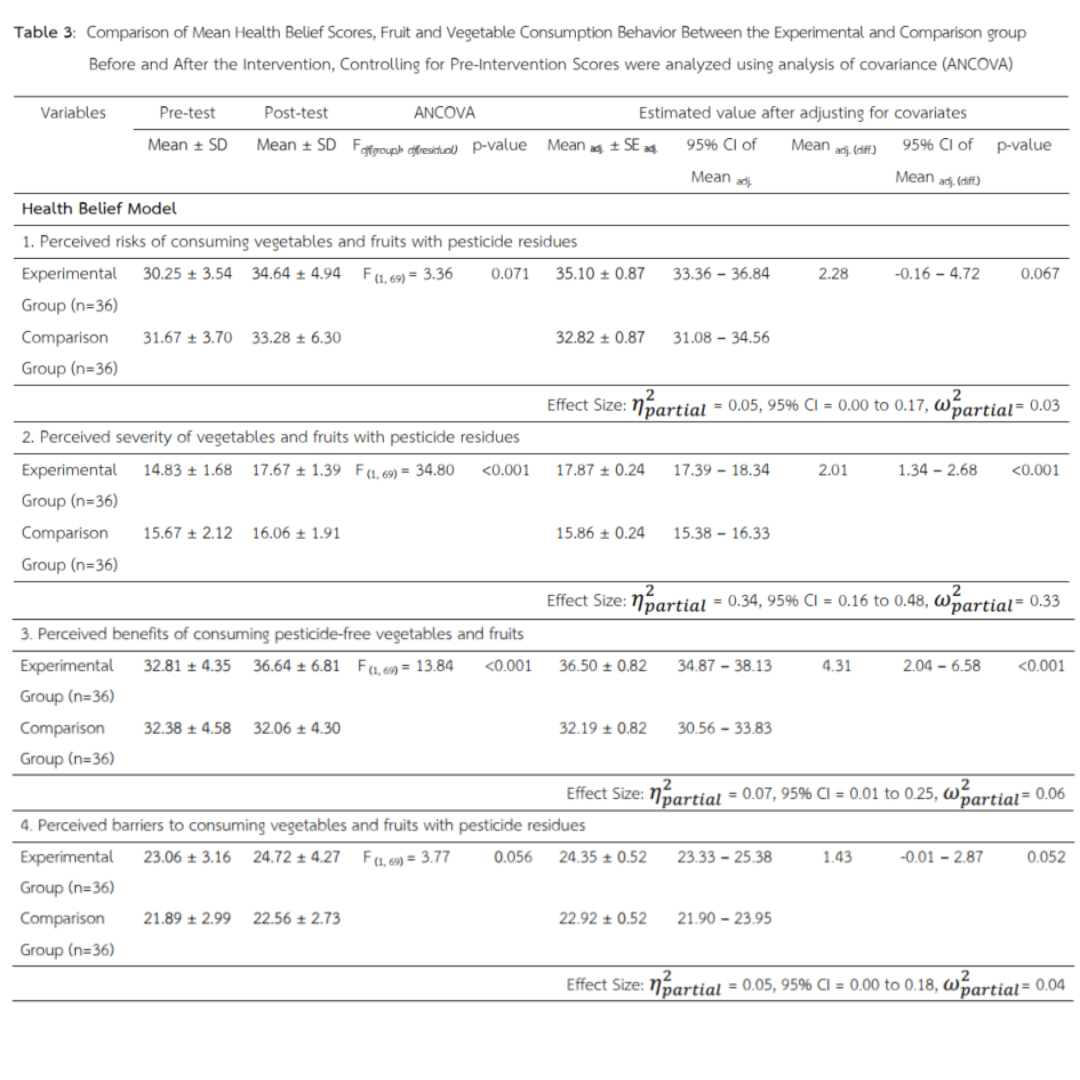
Exposure to pesticides from consuming vegetables and fruits with pesticide residues has long-term health impacts. This quasi-experimental research aimed to study the effects of a program applying the Health Belief Model to promote the consumption behavior of pesticide-free vegetables and fruits. The sample consisted of 72 family health leaders, divided into an experimental group of 36 participants who attended a 12-week program, and a Comparison group of 36 participants who continued their normal daily routines. Data were collected using questionnaires and blood cholinesterase enzyme level tests. Data were analyzed using descriptive statistics and inferential statistics, including the paired t-test, Analysis of Covariance (ANCOVA), and the McNemar’s test. The results revealed that after the experiment, the experimental group showed significantly higher mean scores across all HBM perceptions and safe consumption behaviors compared to baseline (p < 0.05). Controlling for pre-test scores, the experimental group exhibited significantly higher scores in perceived severity, benefits, and consumption behaviors than the Comparison group (p < 0.05). Furthermore, the proportion of experimental participants with safe cholinesterase levels increased from 16.67% to 88.89%. In conclusion, the HBM-based program effectively modifies safe consumption behaviors and reduces pesticide exposure risks. Public health agencies should expand this model to other communities.
References
Bureau of Epidemiology. (2020, September 01). Summary Report of Occupational and Environmental Disease Surveillance and Chronic Non-Communicable Diseases for the Year 2020. Department of Disease Control, Ministry of Public Health. https://apps-doe.moph.go.th/boeeng/annual.php
Bureau of Food Safety Extension and Support. (2023). Food safety situation report, fiscal year 2022. Office of the Permanent Secretary, Ministry of Public Health. https://foodsafety.moph.go.th/_WEBADMIN2/uploads/n_file/52yr82f1gxwkskw404.pdf
Bureau of Occupational and Environmental Diseases. (2015). Knowledge on risk screening for pesticide exposure using cholinesterase reactive paper for public health officers in primary care units. Department of Disease Control, Ministry of Public Health. https://www.ddc.moph.go.th/uploads/files/b6134dd3acfb435cab3bf0155b97ccc0.pdf
Chirawatkul, A. (2009). Statistics for Health Science Research. Bangkok: Witthaypat.
Hoothaisong N. & Heebkaew Padchasuwan N. (2021). The Effectiveness of Health Belief Model and Health Literacy Application Program for Pesticides use Dangerous Preventing Behavior Promotion among Rubber Farmers in Muang Buengkan District, Buengkan Province. Health Research and Development Journal, Nakhon Ratchasima Provincial Public Health Office, 7(2), 116-131.
Jantakot, S. (2023). Effects of Participation and Social Support to Change Diabetes Prevention Behaviors of Risk Groups in the Area of Responsibility of Huaydang Tambon Health Promoting Hospital, Donjik Subdistrict, Phiboonmangsahan District, Ubon Ratchathani Province. Journal of Health and Environmental Education, 8(1), 356-365.
Maejo Poll Center. (2020, December 06). 86.89% of consumers buy vegetables and fruits from fresh markets, but 79.31% are still not confident in consumption safety. https://maejopoll.mju.ac.th/poll.aspx?id=58
Matthapa K. et al. (2022). Pesticide Exposure Preventive Behaviors among Vegetable Farmers in the 10th Health Region in Thailand and its Related Factors. Journal of Public Health Nursing, 36(3), 1-15.
Naman M. et al. (2022). Changes in Concentration of Pesticide Residues in Fruits and Vegetables During Household Processing. Toxicology Reports, 9(2020), 1419-1425. https://doi.org/10.1016/j.toxrep.2022.06.013
Nusuk, N. (2018). Effect of Pesticide Prevention Program by Applying Health Belief Model among Elder Person in Soem Sai sub-district, Soemngam district, Lampang province. Journal of Disease Prevention and Control: DPC. 2 Phitsanulok, 5(2), 1-14.
Sam K. et al. (2008). Effectiveness of an Educational Program to Promote Pesticide Safety among Pesticide Handlers of South India. International Archives of Occupational and Environmental Health, 81(6), 787-795.
Singthong S. & Intamat S. (2023). The Application of Health Belief Model to Improve Preventive Health Behaviors on Pesticide Use among Allium Ascalonicum L Growers. Journal of Environmental and Community Health, 8(2), 677-686.
Terfe A. et al. (2023). Pesticide Residues and Effect of Household Processing in Commonly Consumed Vegetables in Jimma Zone, Southwest Ethiopia. Journal of Environmental and Public Health, 2023, 7503426. https://doi.org/10.1155/2023/7503426
Thai Pesticide Alert Network. (2020, December 04). Results of pesticide residue testing in vegetables and fruits for 2020. Thai-PAN. https://thaipan.org/highlights/2283
Wijaksanakul, K. (2024). Effects of Creating Participation and Social Support on Changing Diabetes Prevention Behaviors Among At-Risk Populations in the Service Area of Phia Phao Tambon Health Promoting Hospital, Kham Nam Saep Subdistrict, Warin Chamrap District, Ubon Ratchathani Province. Journal of Environmental Health and Community Health, 9(3), 518-527.
Downloads
Published
How to Cite
Issue
Section
License
Copyright (c) 2026 Primary Health Care Journal (Northeastern Edition)

This work is licensed under a Creative Commons Attribution-NonCommercial-NoDerivatives 4.0 International License.