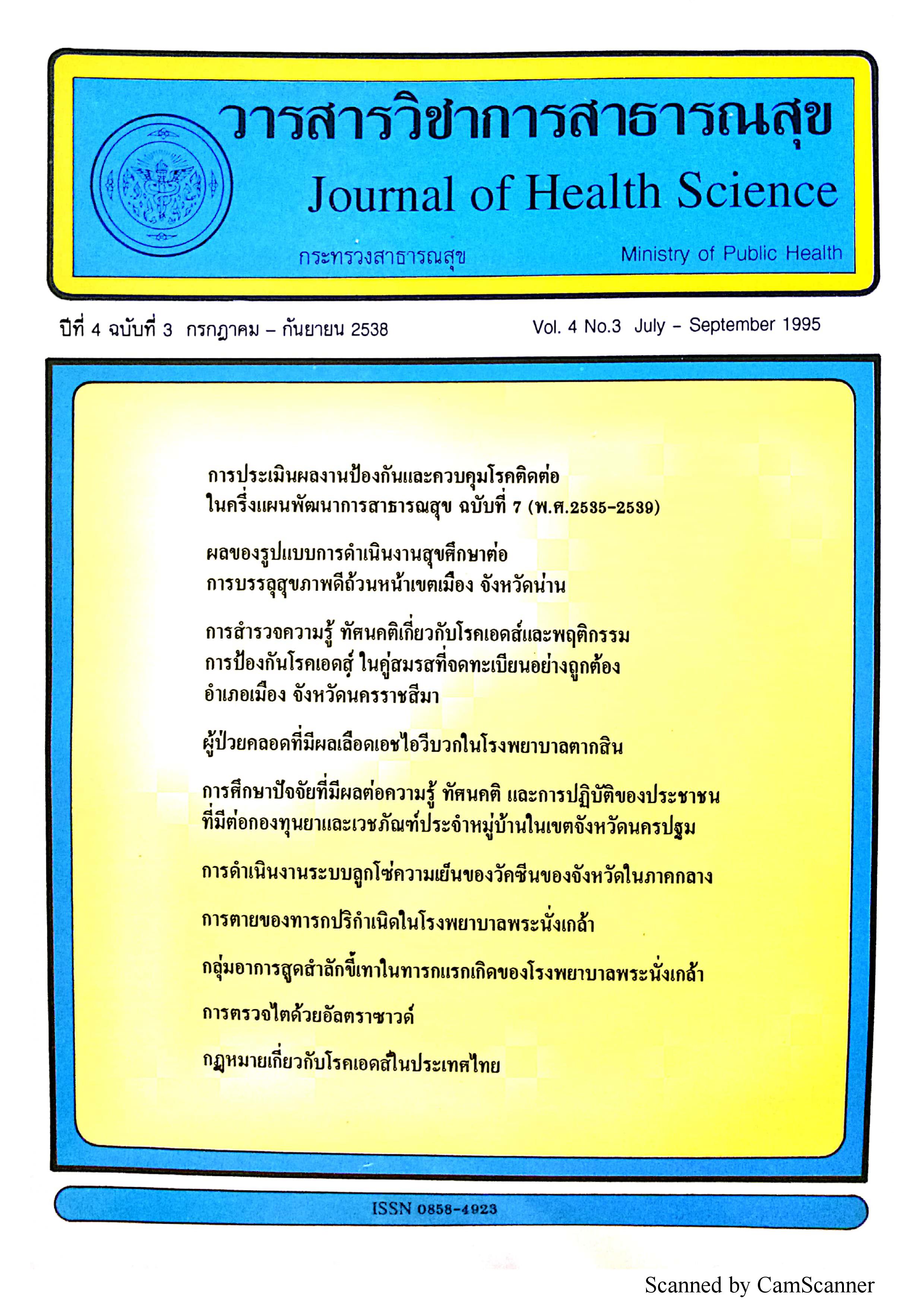
Effects of Health Education Patterns to Reach Health For All in Nan Urban Area
Abstract
The purpose of this study was to find the best way to promote communities to reach Health For All criteria by using health education methods. The study was conducted in 26 communities of Muang District of Nan Province. It was found that most households in the communities rece messages from television, radio and newspapers. Communities which had reached Health For All criteria had received the messages more than the other communities. All communities had significantly better knowledge in Health For All criteria after the health education framwork was introduced (p < .001). Although no significant differences between the two groups of communities found dued to different frequency of communications, this study found the differences in (1). personnel visits, (2) display of Basic Minimum Needs' form, (3) community committee's activities. (4) health volunteer team meeting and (5) health volunteers' meetings with people.
This study demonstrated that health education strategies to reach Health For All criteria should comprise the use of BMN forms, personnel visits, which usually addressed the problems and how to solve them at all level of community meetings. These made health education process tangibly sustainable and a way for Communities to reach Health For All.
Downloads
Downloads
Published
How to Cite
Issue
Section
License
Copyright (c) 1995 Ministry of Public Health

This work is licensed under a Creative Commons Attribution-NonCommercial-NoDerivatives 4.0 International License.