
A Point Prevalence Survey of Intravenous Antimicrobial Use, Antimicrobial Resistant Infections, Clinical Outcomes and Medical Costs Among Inpatients at Mae Sot Hospital
Keywords:
intravenous antimicrobial, antimicrobial resistant infections, point prevalence survey, clinical outcomes, medical costsAbstract
Background: Irrational antimicrobial use is a major driver of antimicrobial resistance. Evidence-based surveillance using standardized tools is essential for advancing hospital antimicrobial stewardship programs.
Objectives: To investigate the prevalence of intravenous antimicrobial use, the incidence of antimicrobial-resistant infections, clinical outcomes, and medical costs among inpatients at Mae Sot Hospital.
Methods: A cross-sectional descriptive study utilizing the WHO point prevalence survey (PPS) methodology was conducted between October 20 and 22, 2025, across 28 inpatient wards. Data were analyzed using descriptive statistics.
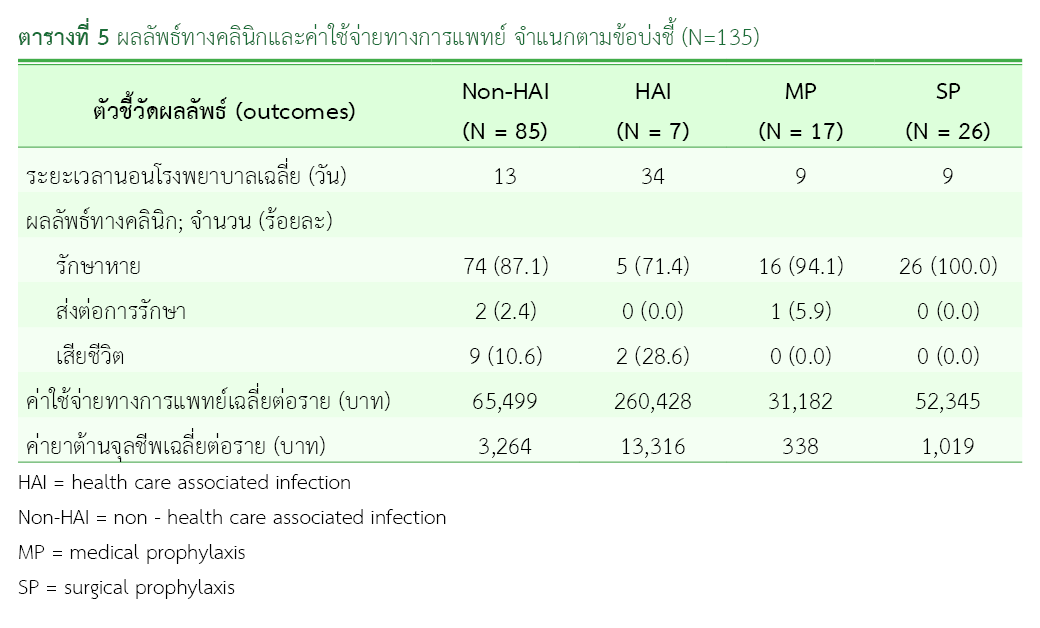
Results: Of 315 inpatients, 135 received intravenous antimicrobials, yielding a prevalence of 42.9%. The surgical intensive care unit exhibited the highest prevalence (75.0%). Ceftriaxone was the most frequently prescribed antimicrobial (23.4%). Based on the WHO AWaRe classification, the "Watch" group accounted for 62.5% of prescriptions. Notably, ceftriaxone comprised 35.0% of all surgical prophylaxis prescriptions. Thirteen cases of multidrug-resistant infections were found among 48 patients with detected pathogenic microorganisms (27.1%). Patients with hospital-acquired infections had an average length of stay of 34 days, a 28.6% mortality rate, and an average medical cost of THB 260,428 per case.
Conclusion: The hospital demonstrated a high prevalence of "Watch" group antimicrobial use, while hospital-acquired infections were associated with poorer clinical outcomes and increased healthcare costs. These findings support strengthening the hospital's antimicrobial stewardship program through systematic antimicrobial restriction policies and regular audits of surgical antimicrobial prophylaxis.
References
ศูนย์เฝ้าระวังเชื้อดื้อยาต้านจุลชีพแห่งชาติ. รายงานประจำปี NARST 2567 [อินเทอร์เน็ต]. กรุงเทพมหานคร: ศูนย์เฝ้าระวังเชื้อดื้อยาต้านจุลชีพแห่งชาติ สถาบันวิจัยวิทยาศาสตร์สาธารณสุข กรมวิทยาศาสตร์การแพทย์; 2567 [สืบค้นเมื่อ 20 ส.ค. 2568]. สืบค้นจาก: https://narst.dmsc.moph.go.th/static/NARST%20Annual%20Report%202567.pdf
กองระบาดวิทยา. แนวทางการเฝ้าระวังและสอบสวนเชื้อดื้อยาต้านจุลชีพ. พิมพ์ครั้งที่ 1 [อินเทอร์เน็ต]. กรุงเทพมหานคร: กองระบาดวิทยา กรมควบคุมโรค กระทรวงสาธารณสุข; 2565 [สืบค้นเมื่อ 20 ส.ค. 2568]. สืบค้นจาก: https://narst.dmsc.moph.go.th/manuals/แนวทางเฝ้าระวังและสอบสวนเชื้อดื้อยา_คร.pdf
กองยา. ข้อมูลปริมาณการบริโภคยาต้านจุลชีพในมนุษย์และในสัตว์เพื่อการบริโภคของประเทศไทย พ.ศ. 2567 และแนวโน้มระหว่างปี พ.ศ. 2560 - 2567 [อินเทอร์เน็ต]. นนทบุรี: สำนักงานคณะกรรมการอาหารและยา กระทรวงสาธารณสุข; 2569 [สืบค้นเมื่อ 8 ก.ค. 2569]. สืบค้นจาก: https://drug.fda.moph.go.th/information-service/thailand-surveillance
World Health Organization. WHO methodology for point prevalence survey of antimicrobial consumption in hospitals.Version 1.1 [Internet]. Geneva: World Health Organization; 2018 [cited 2025 Aug 24]. Available from: https://iris.who.int/server/api/core/bitstreams/53d71d65-278b-4ad1-aa6f-f34a10e5dedd/content
กองยา. แผนปฏิบัติการด้านการดื้อยาต้านจุลชีพแห่งชาติ ฉบับที่ 2 พ.ศ. 2566 - 2570 [อินเทอร์เน็ต]. นนทบุรี: กองยา สำนักงานคณะกรรมการอาหารและยา กระทรวงสาธารณสุข; 2566 [สืบค้นเมื่อ 27 มี.ค. 2569]. สืบค้นจาก: https://amrthailand.net/แผนปฏิบัติการด้านการดื-2/
Polit DF, Beck CT. The content validity index: are you sure you know what's being reported? critique and recommendations. Res Nurs Health. 2006;29(5):489-97. doi: 10.1002/nur.20147.
World Health Organization. The 2021 WHO AWaRe classification of antibiotics for evaluation and monitoring of antimicrobial consumption. Geneva: World Health Organization; 2021 [cited 2026 Feb 20]. Available from: https://www.who.int/publications/i/item/2021-aware-classification
ธราณี สิริชยานุกุล, ปภาณิน กาศวิลาศ, ชลลดา คะชา, นพพล ขอดเตชะ. การสำรวจความชุกการใช้ยาต้านจุลชีพทางหลอดเลือดดำของผู้ป่วยในโรงพยาบาลแพร่. วารสารโรงพยาบาลแพร่ [อินเทอร์เน็ต]. 2565 [สืบค้นเมื่อ 25 มี.ค. 2569];30(2):1-12. สืบค้นจาก: https://www.thaidj.org/index.php/jpph/article/view/12634
Anugulruengkitt S, Charoenpong L, Kulthanmanusorn A, Thienthong V, Usayaporn S, Kaewkhankhaeng W, et al. Point prevalence survey of antibiotic use among hospitalized patients across 41 hospitals in Thailand. JAC Antimicrob Resist. 2023;5(1):dlac140. doi: 10.1093/jacamr/dlac140.
Ahmed NJ, Haseeb A, Alamer A, Almalki ZS, Alahmari AK, Khan AH. Meta-analysis of clinical trials comparing cefazolin to cefuroxime, ceftriaxone, and cefamandole for surgical site infection prevention. Antibiotics (Basel). 2022;11(11):1543. doi: 10.3390/antibiotics11111543.
กองยุทธศาสตร์และแผนงาน. รายละเอียดตัวชี้วัดกระทรวงสาธารณสุข ประจำปีงบประมาณ พ.ศ. 2569 [อินเทอร์เน็ต]. นนทบุรี: กองยุทธศาสตร์และแผนงาน สำนักงานปลัดกระทรวงสาธารณสุข; 2568 [สืบค้นเมื่อ 27 มี.ค. 2569]. สืบค้นจาก: https://spd.moph.go.th/wp-content/uploads/2026/03/KPI_template_2569_edit1.pdf
Downloads
Published
How to Cite
Issue
Section
License
Copyright (c) 2026 Health Administration Division, Office of the Permanent Secretary, Ministry of Public Health and The Society of Hospital Pharmacist, Ministry of Public Health

This work is licensed under a Creative Commons Attribution-NonCommercial-NoDerivatives 4.0 International License.
วารสารเภสัชกรรมคลินิกเป็นวารสารในรูปแบบเปิด ผู้ใช้ทั่วไปสามารถเข้าถึง ดาวน์โหลด เอกสารไฟล์บทความบนเว็บไซต์วารสาร โดยไม่มีค่าใช้จ่ายแต่อย่างใด
ข้อความภายในบทความที่ตีพิมพ์ในวารสารเภสัชกรรมคลินิกทั้งหมด รวมถึงรูปภาพประกอบ ตาราง เป็นลิขสิทธิ์ของกองบริหารการสาธารณสุข สำนักงานปลัดกระทรวงสาธารณสุข และ ชมรมเภสัชกรโรงพยาบาลกระทรวงสาธารณสุข อนุญาตให้นำไปใช้ประโยชน์และเผยแพร่ต่อได้โดยอยู่ภายใต้เงื่อนไขสัญญาอนุญาตครีเอทีฟคอมมอนส์ โดยต้องแสดงที่มาจากวารสาร – ไม่ใช้เพื่อการค้า – ห้ามแก้ไขดัดแปลง (Creative Commons Attribution-NonCommercial-NoDerivatives 4.0; CC BY-NC-ND 4.0) การนำเนื้อหา ข้อความหรือข้อคิดเห็น รูปภาพ ตาราง ของบทความไปจัดพิมพ์เผยแพร่ในรูปแบบต่าง ๆ เพื่อใช้ประโยชน์ในเชิงพาณิชย์ ต้องได้รับอนุญาตจากกองบรรณาธิการวารสารเภสัชกรรมคลินิกอย่างเป็นลายลักษณ์อักษร
ข้อความที่ปรากฏในบทความในวารสารเป็นความคิดเห็นส่วนตัวของผู้เขียนแต่ละท่านไม่เกี่ยวข้องกับกองบริหารการสาธารณสุข สำนักงานปลัดกระทรวงสาธารณสุข และบุคลากรในกองบริหารการสาธารณสุข สำนักงานปลัดกระทรวงสาธารณสุข แต่อย่างใด ความรับผิดชอบองค์ประกอบทั้งหมดของบทความแต่ละเรื่องเป็นของผู้เขียนแต่ละท่าน หากมีความผิดพลาดใด ๆ ผู้เขียนแต่ละท่านจะรับผิดชอบบทความของตนเอง ตลอดจนความรับผิดชอบด้านเนื้อหาและการตรวจร่างบทความเป็นของผู้เขียน ไม่เกี่ยวข้องกับกองบรรณาธิการ