DEVELOPMENT OF A FALL PREVENTION MODEL FOR THE ELDERLY IN THALE CHUPSORN SUBDISTRICT, MUEANG LOPBURI DISTRICT, LOPBURI PROVINCE
Keywords:
Fall prevention, Elderly, Fall prevention modelAbstract
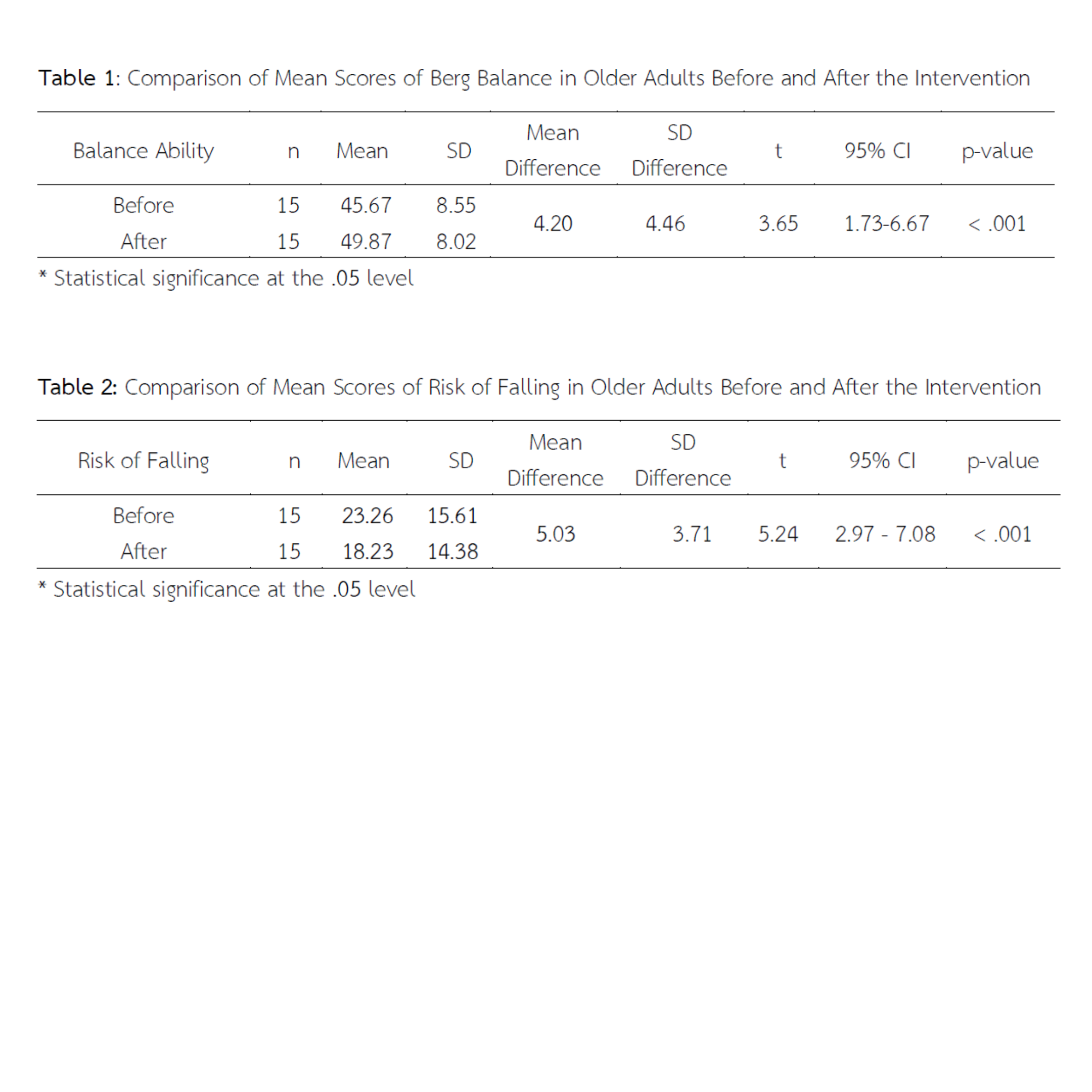
Thailand has become a fully aging society, with a continuously increasing elderly population. Aging causes physical decline, increasing the risk of falls, which can lead to physical injuries, psychological effects, and loss of confidence in daily living. This research aimed to develop a fall prevention model for older adults. The study was conducted in three phases. The sample consisted of 15 elderly individuals at risk of falling who participated in a 12-week intervention. Tools included a fall prevention model, a balance ability assessment, and a fall risk assessment. Data were analyzed using descriptive statistics and the dependent t-test. The results showed that participants had an average age of 73.46 years and BMI indicating overweight (mean = 27.33). Most had underlying diseases (86.67%) and took more than four medications (53.33%). Major risk factors were balance problems (86.67%) and visual impairments (53.33%). Most had not fallen in the past six months and lived in homes with floor heights under 1.5 meters. The fall prevention model included initial assessment, mastery experiences, observational learning, verbal encouragement, physical and emotional regulation, and environmental and assistive technology adjustments. Implementation was supported by local health officers and village health volunteers (VHVs). After the intervention, participants had significantly improved balance scores, increasing by 4.20 points (95% CI = 1.73–6.67, p < .001), and significantly decreased fall risk scores by 5.03 points (95% CI = 2.97–7.08, p < .001). The findings suggest that a structured fall prevention program, coupled with community support, can enhance physical ability and reduce fall risk among older adults.
References
Berg K. O. et al. (1989). Measuring balance in elderly: Preliminary development of an instrument. Physiotherapy Canada, 41(6), 304-311.
Bandura, A. (1997). Self-Efficacy: The Exercise of Control. New York: W.H. Freeman and Company.
Bureau of Epidemiology, Department of Disease Control. (2019, April 1). Falls in the Elderly. http://www.correct.go.th.
Foundation of Thai Gerontology Research and Development Institute (TGRI). (2021). Situation of the Thai Older Persons 2020. Nakhon Pathom: Institute for Population and Social Research, Mahidol University.
Foundation of Thai Gerontology Research and Development Institute (TGRI). (2022). Situation of the Thai Older Persons 2021. Nakhon Pathom: Institute for Population and Social Research, Mahidol University.
Foundation of Thai Gerontology Research and Development Institute (TGRI). (2023). Situation of the Thai Older Persons 2022. Bangkok: Amarin Corporations Public Company Limited.
Institute of Neurology, Department of Medical Services, Ministry of Public Health. (2020). Clinical Practice Guidelines for Dementia. Bangkok: Thana Press Co., Ltd.
Jitapankul, S. (2015). Principles of Geriatric Medicine (3rd ed.). Bangkok: Chulalongkorn University Press.
Kaekai, P. (2023). The Effectiveness of the Fall Prevention Program in Elderly, Lampang Province. Nursing, Health, and Public Health Journal, 2(3), 35-49.
Kangthamniem, K. (2016). Adoption Health Partnership Concept for Caring: Nurse Role. Journal of Public Health Nursing, 30(2), 124-132.
King Narai Hospital. (2024, October 1). Patient Fall Statistics Report. Lopburi: HosXp Information System.
Kumkhwan Y. et al. (2018). Guidelines for preventing falls at home in the elderly: The context of Thailand. Journal of the Ministry of Public Health Nursing, 28(3), 10-22.
Lopburi Provincial Public Health Office. (2024, October 1). Elderly. https://lri.hdc.moph. go.th.
Rachamee W. et al. (2022, January). Factors Affecting Falling and Falling in Elderly Health region 6. Health region 6. https://hpc6.anamai.moph.go.th/th/cms-of-15/download/?did=213400&id=91524.
Sawangbumrung M. et al. (2024). Literature Synthesis on Falls of the Elderly in the Year 2013-2022. Regional Health Promotion Center 9 Journal, 18(3), 918-934.
Sherrington C. et al. (2020). Evidence on physical activity and falls prevention for people aged 65+: systematic review to inform the WHO guidelines on physical activity and sedentary behaviour. International Journal of Behavioral Nutrition and Physical Activity, 17(144), 1-9.
Sirivibulyankit, C. (2020). The Effects of Thasala Model on Physical Competency Promoting to Minimize Risk from Falls in the Elderly. Region 4-5 Medical Journal, 39(1), 127-137.
Songpatanasilp T. et al. (2016) Thai Osteoporosis Foundation (TOPF) position statements on management of osteoporosis. Osteoporos Sarcopenia, 2(4), 191-207.
Tasuwanin T. & Tappakit K. (2017). Effects of a Falling Prevention Program for Elderly. Journal of Nursing and Health Care, 35(3), 186-195.
Thammacharoen, R. (2023). Effect of Nursing Program on Fall Prevention Behaviors among Elderly in the Community, Muang Sam Sip District. Science and Technology Journal of Sisaket Rajabhat University, 3(2), 22-38.
Wongsaya E. et al. (2016). Validity of a Three Times Stand and Walk Test (TTSW) for the Measurement of Physical Function in Elderly. Srinagarind Medical Journal, 31(4), 197-201.
Downloads
Published
How to Cite
Issue
Section
License
Copyright (c) 2025 Primary Health Care Journal (Northeastern Edition)

This work is licensed under a Creative Commons Attribution-NonCommercial-NoDerivatives 4.0 International License.