EFFECT OF A HEALTH LITERACY PROGRAM USING THE “HINSAMWAN MODEL” ON HEALTH PROMOTING BEHAVIORS AMONG BUDDHIST MONKS
Keywords:
Health literacy, Health behaviors, Behavior modification, Self-efficacy, Buddhist monksAbstract
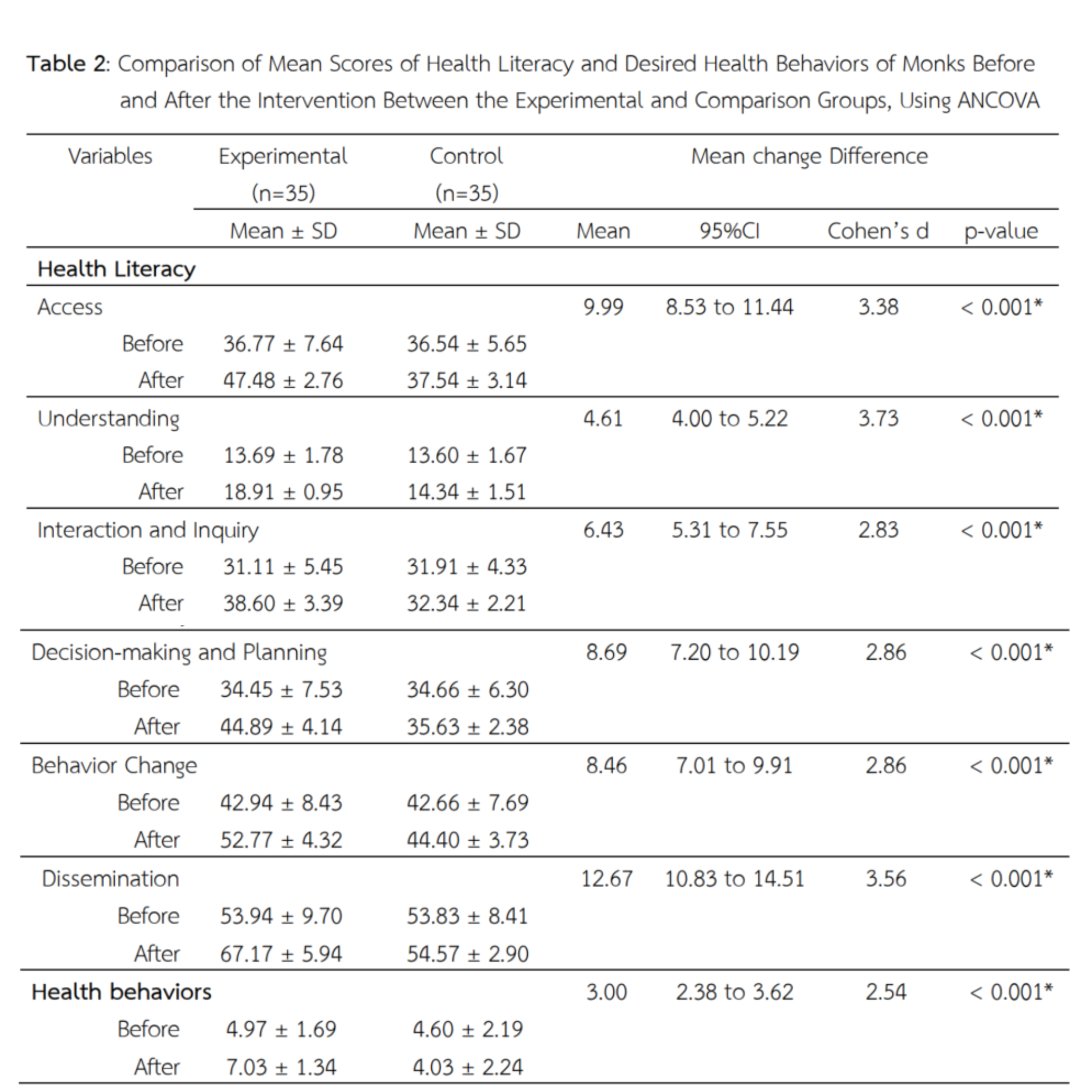
Buddhist monks, as spiritual leaders, play significant roles in religion, society, and public health. Currently, monks are facing health challenges, particularly non-communicable diseases stemming from undesirable health behaviors. This quasi-experimental study aimed to evaluate the effects of a health literacy program designed to promote desirable health behaviors among Buddhist monks. The sample comprised 70 monks, divided into an experimental group (n=35) and a comparison group (n=35). The experimental group participated in the 12-week “HINSAMWAN Model” health literacy program. Data were collected using questionnaires and health assessments before and after the intervention, and analyzed using Paired t-test and Analysis of Covariance (ANCOVA) with a significance level of 0.05. The results showed that after the intervention, the experimental group had significantly higher mean health literacy scores than the comparison group across all six dimensions: accessing information (X̅diff = 9.99), understanding (X̅diff = 4.61), interaction (X̅diff = 6.43), decision-making (X̅diff = 8.69), behavioral change (X̅diff = 8.46), and advocacy (X̅diff = 12.67). Furthermore, the monks' desirable health behaviors improved significantly (X̅diff = 3.00, 95% CI: 2.38 to 3.62). Health outcomes also showed significant improvements, with reductions in Body Mass Index (X̅diff = 1.11), waist circumference (X̅diff = 2.11), blood glucose levels (X̅diff = 9.03), and cardiovascular disease risk (X̅diff = 1.24). Therefore, compared to the comparison group, the program was effective in promoting health literacy and desirable health behaviors among Buddhist monks.
References
Bandura, A. (1977). Self-efficacy: Toward a unifying theory of behavioral change. Psychological Review, 84(2), 191–215.
Bueng Kan Provincial Office of Buddhism. (2567). Report on Temples, Monks, and Novices in Bueng Kan Province for the Year 2024 (1st ed.). Bueng Kan: Bueng Kan Provincial Office of Buddhism.
Chandi C. & Posuya K. (2021). The Effective of Health Literacy Model in Novices, Phrapariyattidhamma Watphuket School, Nan Province. Academic Journal of Community Public Health, 7(4), 56-71.
Chirawatkul, A. (2009). Statistics for health science research. Wittayapat.
Department of Health, Ministry of Public Health. (2018). Core concepts and principles of a health-literate organization (1st ed.). Office of the 4.0 Strategic Project for Health Literacy Promotion.
Department of Health. (2025, October 10). Desirable health behaviors of Buddhist monks. Department of Health Ministry of Public Health. https://kku.world/n3pfy
House, J. S. (1981). Work stress and social support. California: Addison-Wesley
Juthasong, N. (2021). Behavior Changing for Health to Reduce Sweet, Oily, Salty Add Vegetables, Exercise far from Chronic Disease. Journal of Health and Environmental Education, 6(3), 8-15.
Nitirat P. et al. (2018). Effects of Mixed-Theory based Model for Behavioral Modification on the Perception toward Self-efficacy in Self-management and the Reduction of Chronic Disease Risks among Professional and Non-professional Staffs in Phrapokklao College of Nursing, Chanthaburi, Thailand. J Prapokklao Hosp Clin Med Educat Center, 35(1), 18-29.
Noo-in S. et al. (2022). The Effects of Health Behavior Changing Program for Systolic Blood Pressure Reduction Among Thai Buddhist Monks, Thailand. Advances in Informatics, Management and Technology in Healthcare, 295, 193-196. http://doi.org/10.3233/SHTI220695
Sookpool A. et al. (2020). Effectiveness of Health Literacy and Health Behavior Development Program for Working People. Journal of Health Science, 29(3), 419-429.
Sutatorn, P. (2018, November 30). Monks and the health security system. Hfocus. https://kku.world/znvq1
Wattanayingcharoenchai, S. (2023, October 13). More than half of Thai monks suffer from diabetes. ThaiHealth Promotion Foundation. https://kku.world/zlz6y
Downloads
Published
How to Cite
Issue
Section
License
Copyright (c) 2025 Primary Health Care Journal (Northeastern Edition)

This work is licensed under a Creative Commons Attribution-NonCommercial-NoDerivatives 4.0 International License.