PREVALENCE, MENTAL HEALTH LITERACY AND ASSOCIATED FACTOR MENTAL HEALTH AMONG PUBLIC HEALTH PERSONNEL IN CHUMPHAE HOSPITAL, CHUMPHAE DISTRICT, KHON KAEN PROVINCE: A CROSS-SECTIONAL ANALYTICAL STUDY
Keywords:
Stress, Mental health literacy, Public health personnelAbstract
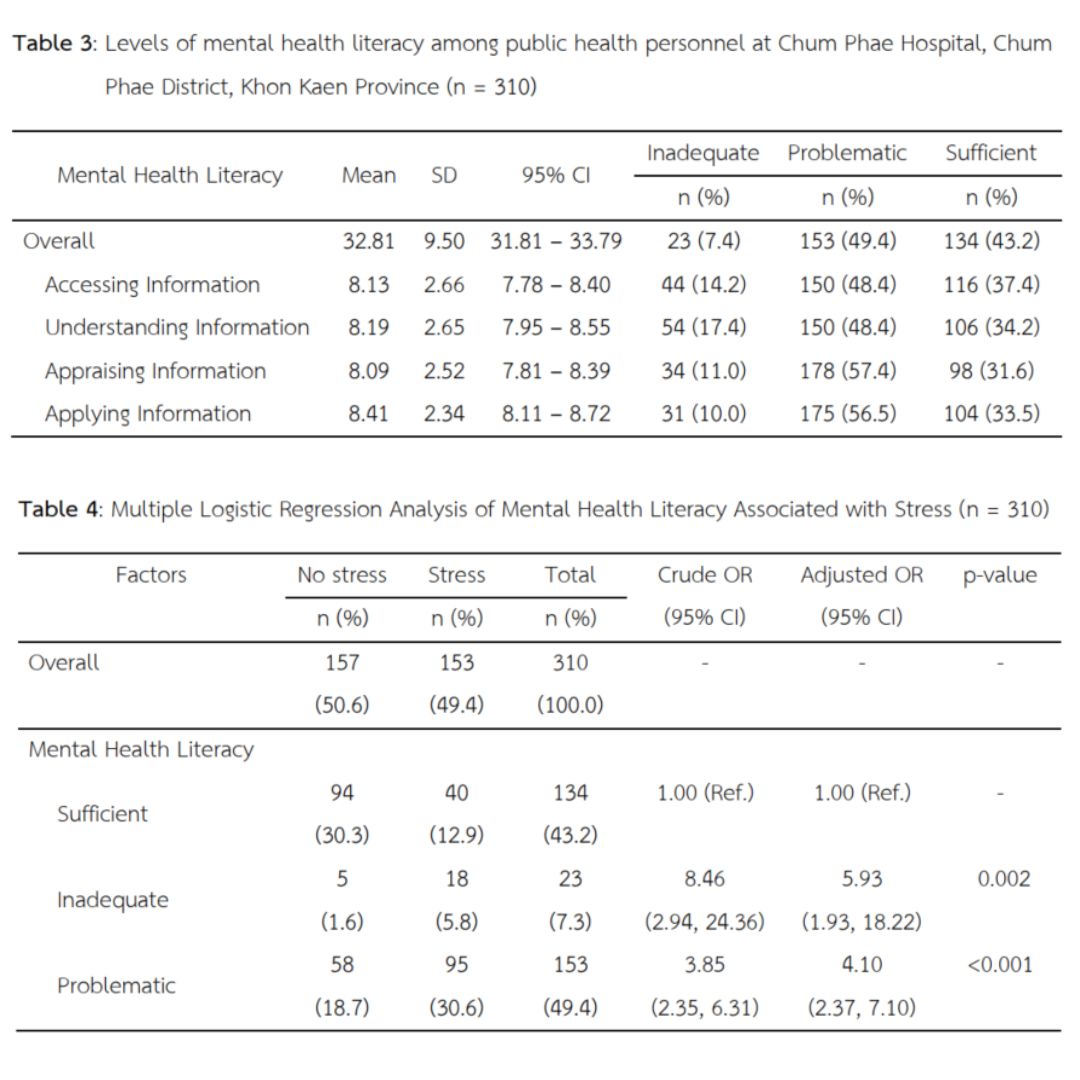
Stress among public health personnel significantly affects quality of life and service efficiency, with mental health literacy serving as a key protective factor. This cross-sectional analytical study aimed to investigate the prevalence of stress, levels of mental health literacy, and associated factors among 310 public health personnel at Chum Phae Hospital, Khon Kaen Province, selected via stratified random sampling. Data were collected using a mental health literacy questionnaire and the Suan Prung Stress Test-20 (SPST-20), then analyzed using descriptive statistics, Chi-square, Pearson's correlation coefficient, One-Way ANOVA, Independent Samples t-test, and multiple logistic regression. Results showed that 49.4% of personnel experienced high to severe stress levels, and 49.4% had problematic mental health literacy. Personnel with inadequate mental health literacy were significantly more likely to experience stress (AOR = 5.93, 95%CI = 1.93-18.22), as were those with problematic literacy (AOR = 4.10, 95%CI = 2.37-7.10), compared to those with adequate levels (p-value < 0.05). Furthermore, significant differences in stress levels were observed based on age, work experience, income sufficiency, work environment, and organizational benefits/compensation (p-value < 0.05). Conclusion, nearly half of healthcare personnel suffer from high levels of stress, with low mental health literacy significantly increasing stress risks. Organizations should promote mental health literacy alongside improving the work environment and employee benefits.
References
Chum Phae Hospital. (2023). Organizational engagement and organizational wellness report [Supporting document]. Khon Kaen: Human Resources Department, Chum Phae Hospital.
Department of Mental Health. (2020). Guidelines for enhancing public mental health knowledge. Nonthaburi: Beyond Publishing Company Limited.
Department of Mental Health. (2020). Screening assessment manual for psychiatric and mental health problems. N.p.: Nursing Mission Group, Suansaranrom Hospital.
Department of Mental Health. (2023, October 14). Stress test (ST-5). https://dmh.go.th/test/Download/view.asp?id=18
Department of Mental Health. (2024, October 21). Division of Mental Health Promotion and Development. https://share.google/Z0BwT203aXX3Iihtm
Hsieh F. Y. et al. (1998). A simple method of sample size calculation for linear and logistic regression. Statistics in medicine, 17(14), 1623–1634.
Jintanapramote K. & Sittisaranakul P. (2019). Physiology of work-related stress and coping strategies among physicians. Journal of Medicine and Health Sciences, 26(2), 112–123.
Khon Kaen Provincial Public Health Office. (2023). Mental health data of Khon Kaen Province [Report document]. Khon Kaen: Human Resources Unit, Provincial Public Health Office.
Noywong P. & Singkiboot S. (2026). Mental Health Literacy, Knowledge, and Management of Mental Health Problems among Older Adults in Dong Hong Hae Sub-district Health Promoting Hospital, Ubon Ratchthani Province. Journal of Nursing and Therapeutic Care, 41(3), e264500.
Pitspingkum W. et al. (2025). Factors Associated with Mental Health and Stress among Healthcare Personnel Responsible for COVID-19 in Lampang Province. Journal of Phrapokklao Nursing College, Chanthaburi, 36(1), 281–298.
Rueangsaeng, S. (2023). Stress among Health Personnel at Sub-district Health Promoting Hospital Pathum Thani Province during COVID-19 Outbreak, [Thesis of Master of Public Health School of Health Science]. Graduate School: Sukhothai Thammathirat Open University.
Sørensen K. et al. (2012). Health literacy and public health: A systematic review and integration of definitions and models. BMC Public Health, 12(1), 80.
Sørensen K. et al. (2013). Measuring health literacy in populations: Illuminating the design and development process of the European Health Literacy Survey Questionnaire (HLS-EU-Q). BMC Public Health, 13, 948.
Srisiri, N. (2025). Mental health literacy, perceived stress and psychological distress in caregivers of persons with schizophrenia after COVID-19 pandemic, [Thesis of Master of Master of Nursing Science of Psychiatric Nursing and Mental Health]. Graduate School: Chiang Mai University.
Thangkratok P. et al. (2020). Mental health literacy: concept and application for mental health problem prevention in older adults. Biomedical Sciences and Clinical Medicine, 59(3), 163-172.
Wichitrapan, T. (2016). Prevalence and Risk Factors of Occupational Stress in Health Care Providers. Academic Psychiatry and Psychology Journal, 32(3), 55–69.
World Health Organization. (2023, October 15). Stress. https://www.who.int/news-room/questions-and-answers/item/stress
Yothaburee S. et al. (2022). Prevalence and factors associated of mental health among personnel in Mahasarakham hospital. Mahasarakham Hospital Journal, 19(3), 149–164.
Downloads
Published
How to Cite
Issue
Section
License
Copyright (c) 2026 Primary Health Care Journal (Northeastern Edition)

This work is licensed under a Creative Commons Attribution-NonCommercial-NoDerivatives 4.0 International License.