ปัจจัยที่มีความสัมพันธ์กับประสิทธิภาพการปฏิบัติงานของบุคลากรกรมสนับสนุนบริการสุขภาพ กระทรวงสาธารณสุข ประเทศไทย
คำสำคัญ:
ภาวะผู้นำทางการพยาบาล, บรรยากาศองค์การ, การตั้งเป้าหมายรายบุคคล, ประสิทธิภาพการปฏิบัติงานบทคัดย่อ
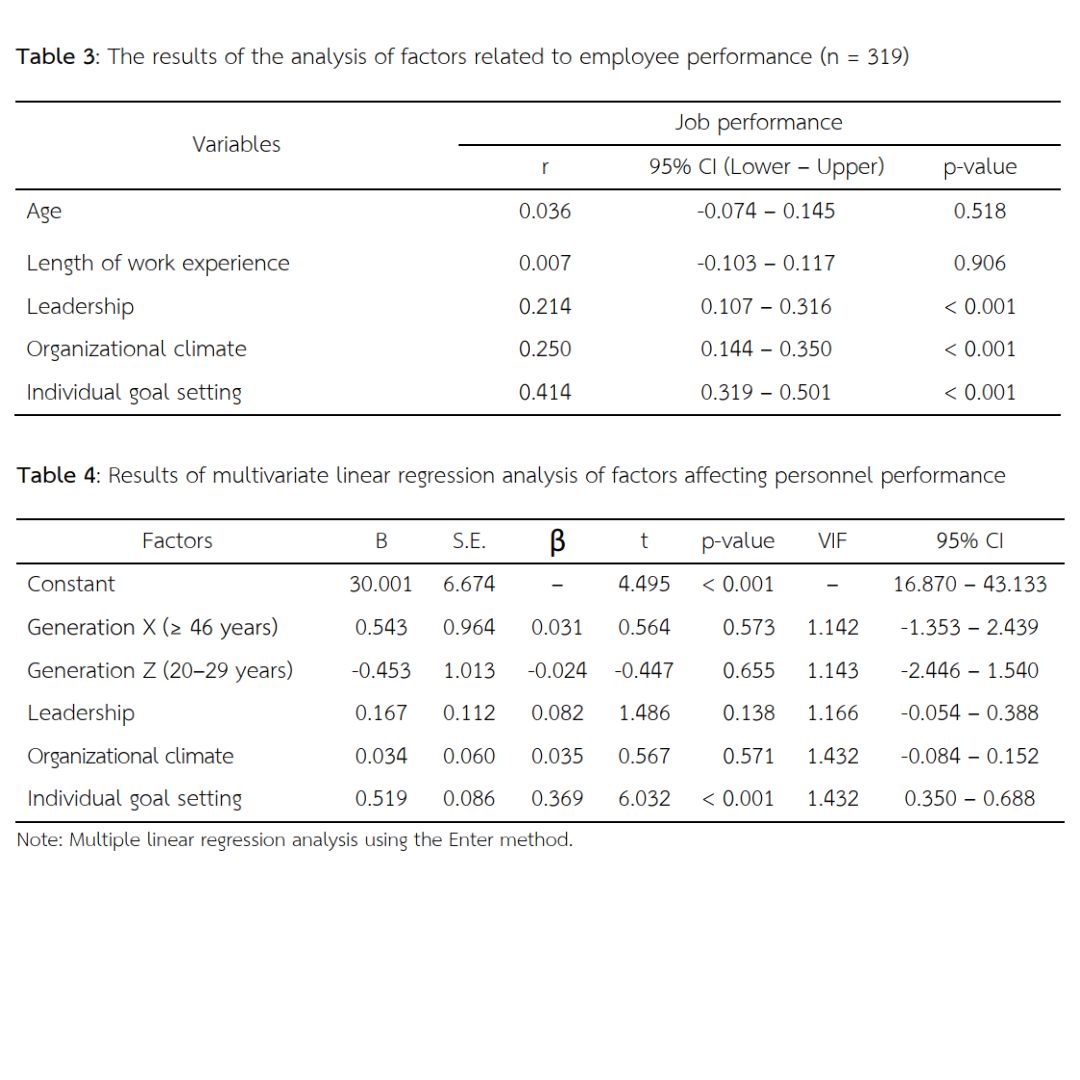
กรมสนับสนุนบริการสุขภาพ กระทรวงสาธารณสุข เผชิญความท้าทายจากภาระงานที่เพิ่มขึ้นและข้อจำกัดด้านกำลังคน ซึ่งส่งผลกระทบโดยตรงต่อคุณภาพและความรวดเร็วในการดำเนินงานตามภารกิจหลัก การศึกษาวิจัยเชิงพรรณนาแบบภาคตัดขวางนี้มีวัตถุประสงค์เพื่อ 1) ศึกษาระดับภาวะผู้นำ บรรยากาศองค์กร การตั้งเป้าหมายรายบุคคล และประสิทธิภาพการปฏิบัติงานของบุคลากรกรมสนับสนุนบริการสุขภาพ กระทรวงสาธารณสุข และ 2) ทำนายปัจจัยที่มีผลต่อประสิทธิภาพการปฏิบัติงานของบุคลากร กลุ่มตัวอย่างคือ บุคลากรกรมสนับสนุนบริการสุขภาพ จำนวน 319 คน เก็บรวบรวมข้อมูลด้วยแบบสอบถามออนไลน์ วิเคราะห์ข้อมูลด้วยสถิติเชิงพรรณนา สถิติไคสแควร์ สัมประสิทธิ์สหสัมพันธ์ของเพียร์สัน และการถดถอยพหุคูณแบบ Enter Method ผลการวิจัยพบว่า บุคลากรมีระดับภาวะผู้นำ บรรยากาศองค์กร และการตั้งเป้าหมายรายบุคคล อยู่ในระดับสูง ขณะที่ประสิทธิภาพการปฏิบัติงาน อยู่ในระดับปานกลาง ปัจจัยที่มีความสัมพันธ์กับประสิทธิภาพการปฏิบัติงาน อย่างมีนัยสำคัญทางสถิติ (p-value < 0.001) ได้แก่ ภาวะผู้นำ บรรยากาศองค์การ และการตั้งเป้าหมายรายบุคคล ปัจจัยทำนายที่ส่งผลต่อประสิทธิภาพการปฏิบัติงานของบุคลากร อย่างมีนัยสำคัญทางสถิติ ได้แก่ การตั้งเป้าหมายรายบุคคล (B = 0.519, beta = 0.369, p-value < 0.001) สรุป การยกระดับประสิทธิภาพการปฏิบัติงานในระบบราชการสาธารณสุข ควรให้ความสำคัญกับการแปลงยุทธศาสตร์องค์กรไปสู่การกำหนดเป้าหมายระดับบุคคลที่มีความชัดเจน ท้าทาย ประเมินผลได้จริง ควบคู่กับการติดตามและให้ข้อมูลป้อนกลับอย่างสม่ำเสมอ
เอกสารอ้างอิง
Bandura, A. (1997). Self-efficacy: The exercise of control. W. H. Freeman.
Bass B. M. & Avolio B. J. (Eds.). (1994). Improving organizational effectiveness through transformational leadership. Sage Publications.
Berberoglu, A. (2018). Impact of organizational climate on organizational commitment and perceived organizational performance: Empirical evidence from public hospitals. BMC Health Services Research, 18, 399. https://doi.org/10.1186/s12913-018-3149-z
Best, J. W. (1977). Research in Education. Englewood Cliffs. New Jersy: Pretice Hall.
Borman W. C. & Motowidlo S. J. (1997). Task performance and contextual performance: The meaning for personnel selection research. Human Performance, 10(2), 99–109. https://doi.org/10.1207/s15327043hup1002_3
Campbell J. P. & Wiernik B. M. (2015). The modeling and assessment of work performance. Annual Review of Organizational Psychology and Organizational Behavior, 2, 47–74. https://doi.org/10.1146/annurev-orgpsych-032414-111427
Cohen J. & Cohen P. Applied multiple regression/ correlation analysis for the behavioral sciences (2nd ed.). Hillsdale NJ: Erlbaum, 1983.
Department of Health Service Support. (2024). Five-year strategic plan of the Department of Health Service Support (2023–2027). Department of Health Service Support.
Department of Health Service Support. (n.d.). Mor 3 system. https://3doctor.hss.moph.go.th/
House, R. J. (1971). A path-goal theory of leader effectiveness. Administrative Science Quarterly, 16(3), 321–338.
Kaewtee, S. (2022). Relationship between work behavior and work efficiency of personnel and personnel administration in the Udon Thani Provincial Public Health Office. Udon Thani Hospital Medical Journal, 30(1), 110–121.
Khan, R. (2014). The impacts of goal setting and curiosity on the employee job performance: A perspective from NGO sector of Pakistan. Management Studies and Economic Systems, 1(1), 13–22.
Koopmans L. et al. (2011). Conceptual frameworks of individual work performance: A systematic review. Journal of Occupational and Environmental Medicine, 53(8), 856–866. https://doi.org/10.1097/JOM.0b013e318226a763
Krejcie R.V. & Morgan D.W. (1970) Determining Sample Size for Research Activities. Educational and Psychological Measurement, 30, 607-610.
Litwin G. H. & Stringer R. A., Jr. (1968). Motivation and organizational climate. Division of Research, Graduate School of Business Administration, Harvard University.
Locke E. A. & Latham G. P. (1990). A theory of goal setting and task performance. Prentice Hall.
Ministry of Public Health. (2023). Policies and operational directions of the Ministry of Public Health, fiscal years 2023–2025. Ministry of Public Health.
National Strategy. (2018). National strategy, B.E. 2561–2580 (2018–2037). Royal Thai Government Gazette, 135(82a), 1–74.
Northouse, P. G. (2010). Leadership: Theory and practice (5th ed.). Sage Publications.
Rakha A. et al. (2021). The effect of perceived organizational climate on the performance of nurses in private hospitals. Journal of Client-Centered Nursing Care, 7(1), 17–26. https://doi.org/10.32598/JCCNC.7.1.368.1
Restivo V. et al. (2022). Leadership effectiveness in healthcare settings: A systematic review and meta-analysis of cross-sectional and before-after studies. International Journal of Environmental Research and Public Health, 19(17), 10995. https://doi.org/10.3390/ijerph191710995
Rovinelli R.J. & Hambleton R.K. (1977) On the Use of Content Specialists in the Assessment of Criterion-Referenced Test Item Validity. Tijdschrift Voor Onderwijs Research, 2, 49-60.
United Nations. (2015). Transforming our world: The 2030 agenda for sustainable development. https://sdgs.un.org/2030agenda
Utinet K. et al. (2024). Factors affecting job performance of public health personnel transferred to the Samut Sakhon Provincial Administrative Organization. Singburi Hospital Journal, 33(2), B97–B111.
Wongbut N. et al. (2021). Self-leadership and job performance of nurses. Chiang Mai Medical Journal, 60(1), 99–112. https://doi.org/10.12982/CMUMEDJ.2021.09
Yukl, G. (2013). Leadership in organizations (8th ed.). Pearson.
ดาวน์โหลด
เผยแพร่แล้ว
วิธีการอ้างอิง
ฉบับ
บท
การอนุญาต
ลิขสิทธิ์ (c) 2026 วารสารสาธารณสุขมูลฐาน (ภาคตะวันออกเฉียงเหนือ)

This work is licensed under a Creative Commons Attribution-NonCommercial-NoDerivatives 4.0 International License.