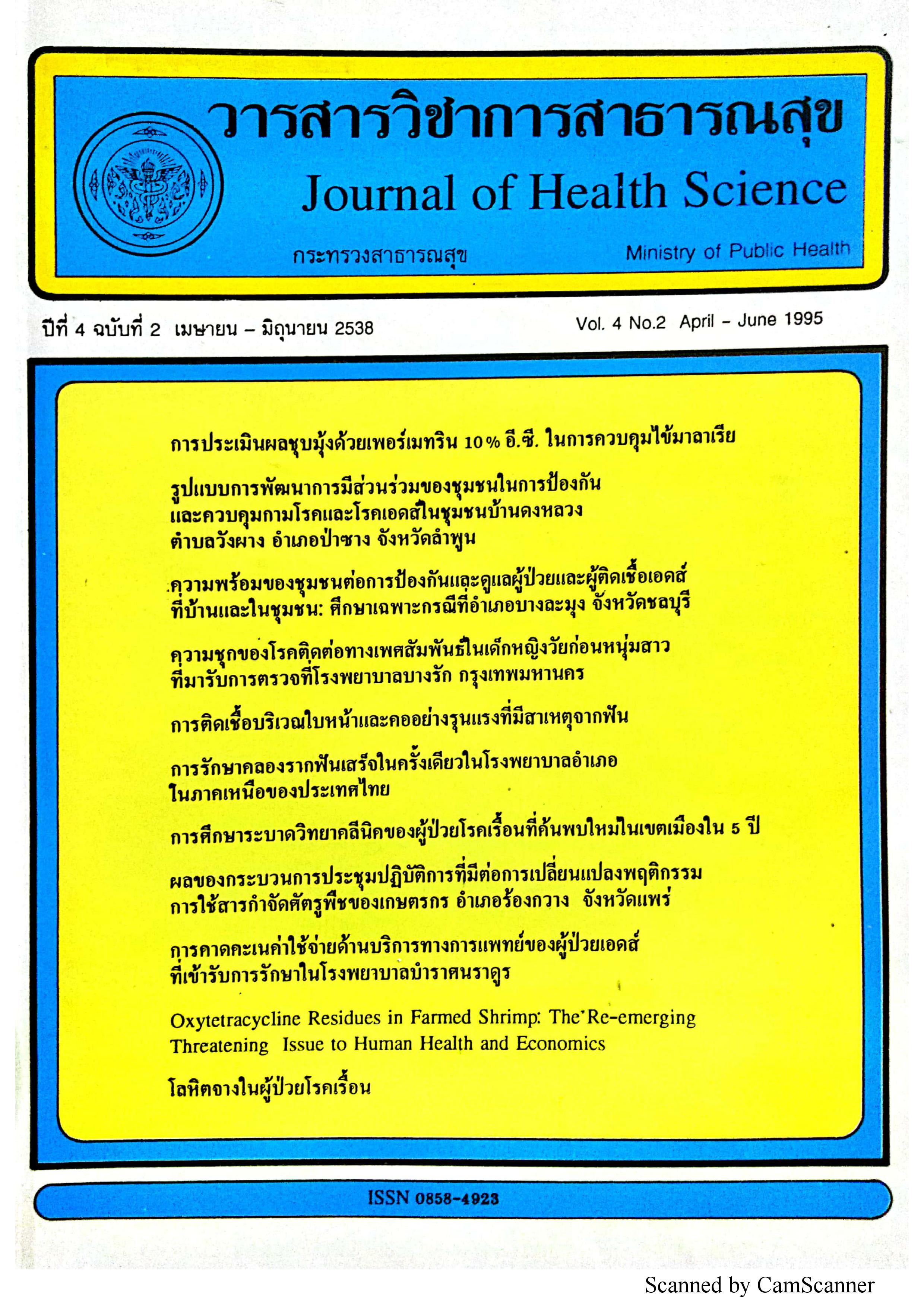
Evaluations of Bed-nets Treated with Permethrin 10% E.C. for Malaria Control
Abstract
A field trial of malaria control using 0.3 gm Permethrin per square meter impregnated bed.no was carried out in a village of Tak Province, to evaluate the impact on densities of malaria ve in reducing transmission and acceptance by the people involving impregnation of bed. non During February - December 1993, pre and post treated bed-nets observation was carried out entomological study was conducted 4 nights a month (18.00 - 24.00 hrs.) and captured in mosquitoes at the window trap of the experimental hut in the morning. The epidemiological and operational data of the village was collected from responsible malaria officers of Malaria Sem 6 Mae Ku. Surveyon KAP of people in study area was undertaken using interview form. The resulta were shown, the longevity and vectorial capacity of An. dirus and An. minimus declined after the introduction of impregnated bed nets and were significantly reduced 65.7% and 83.7% to 39 50 and 58.4% respectively. After treatment for 3 months, effect on biting densities of the 2 vectors were reduced to 33.3% and 44% respectively. For excito-repellency effect, we found that the vectors densities increased in outdoor and indoor-untreated bed-nets. The mosquitoes entered the experimental hut and escaped into the window trap were increasing in mortality of mosquitoes with the rate of 30-40%. After treatment for 6 months, no significant biting densities before and after impregnation of bed-nets were observed, due to 60% of the permethrin degradation. Therefore, base on the above mentioned studies, reimpregnation of bed-nets shoud be done at 3 monthly interval. Though malaria incidence was reduced, transmission was not completely interrupted during the study period, due to outdoor transmission. The acceptance of the permethrin impregnation of bed-nets in the village was 89.3%.
Downloads
Downloads
Published
How to Cite
Issue
Section
License
Copyright (c) 1995 Ministry of Public Health

This work is licensed under a Creative Commons Attribution-NonCommercial-NoDerivatives 4.0 International License.